
The textile industry has reached a crossroads where tradition meets innovation. For decades, screen printing was the undisputed king of garment decoration, offering unmatched speed for massive orders. 하지만, as consumer behavior shifts toward personalization and fast fashion, the limitations of traditional methods have become apparent. 오늘, the debate between digital textile printing fabric techniques and screen printing is no longer about which is “better,” but which is more adaptable to a modern business model. For manufacturers, the transition to a professional digital textile printer represents a strategic move toward efficiency, sustainability, and limitless design potential. 업계 선두주자로서, Xinflying Group (XF-Group) provides the industrial-grade hardware necessary to bridge this gap, allowing businesses to maintain the durability of traditional prints with the precision of digital technology.
The Mechanical Shift: Setup and Production Time
The most striking difference between these two methods lies in the preparation phase. Traditional screen printing is an analog process that requires the creation of physical screens for every color in a design. This involves darkrooms, emulsions, 그리고 화학적 노출, a process that can take hours or even days. If a design has six colors, six screens must be burned and perfectly aligned. For a B2B factory, this means that small orders are financially impossible due to the sheer labor cost of the setup.
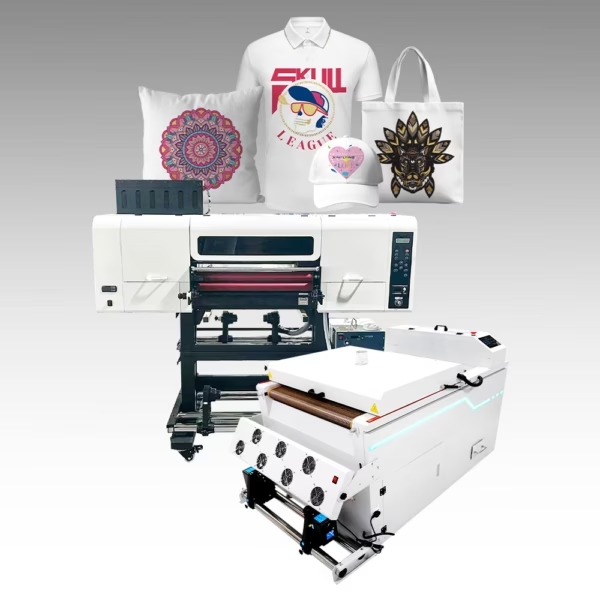
대조적으로, a digital textile printer operates on a “file-to-fabric” logic. There are zero physical setups required. The design is sent from the RIP software directly to the printer, which executes the design with microscopic precision. This allows for “Just-in-Time” 조작, where a business can produce a single sample or a run of 50 units with the same ease as 500. Xinflying’s high-speed DTF systems, such as the XF-602, are engineered to handle these transitions seamlessly, providing the agility that modern brands need to stay relevant in a fast-paced market.
Achieving Quality: Digital Textile Printing Fabric Versatility
When it comes to the finished product, the characteristics of digital textile printing fabric have evolved to rival the best screen prints. Traditionally, screen printing was favored for its “thick” ink deposits and durability. 하지만, modern DTF (직접 영화) 기술, a primary subset of digital printing, utilizes a hot-melt adhesive that provides a similar level of bond strength.
A major advantage of the digital textile printer is its ability to handle complex, photographic imagery. Screen printing is limited by “halftones” 그리고 “LPI” (lines per inch), making it difficult to achieve smooth gradients or high-detail portraits. Digital systems from XF-Group utilize Epson i3200-A1 print heads, which fire variable droplets to create stunning, high-resolution graphics with millions of colors. 뿐만 아니라, while screen printing is often restricted to certain fabric types due to ink chemistry, digital textile transfers are fabric-agnostic. Whether the substrate is 100% 면, a polyester blend, or waterproof nylon, the digital process delivers consistent, vibrant results that pass level 4 wash-fastness tests.
Economic Efficiency and ROI for Manufacturers
From a B2B perspective, the return on investment (ROI) is the ultimate metric. Screen printing is only cost-effective when the volume is high enough to amortize the setup costs. This leaves a massive “mid-market” gap where orders are too small for screens but too large for basic hobbyist tools. This is where the digital textile printer excels.
By eliminating screens, emulsions, and heavy water usage, the digital process significantly reduces overhead. There is less ink waste, as the printer only deposits what is needed for the design. Xinflying Group’s integrated production lines—combining printing, powdering, and curing into one automated flow—allow a single operator to manage multiple machines. This reduction in labor costs, combined with the ability to offer “no minimum order” 서비스, allows businesses to capture high-margin custom orders that screen printers must turn away. For a growing company, the ability to scale from small boutique batches to industrial-level throughput with the same hardware is a powerful economic advantage.
Sustainability: The Environmental Impact
As global regulations on industrial waste tighten, 그만큼 “green” factor has become a significant differentiator. Traditional screen printing is water-intensive; screens must be washed with chemicals and large volumes of water after every run. This creates chemical runoff that is difficult to manage. 추가적으로, plastisol inks used in screen printing often contain PVC and phthalates.
The digital textile printer offers a much cleaner alternative. It uses water-based pigment inks that are often Oeko-Tex certified, ensuring they are safe for both the environment and human skin. Because the process is digital, there is no need for water-intensive cleaning of screens. For brands that prioritize sustainability, digital textile printing fabric solutions are the only way to meet modern ESG (Environmental, Social, and Governance) criteria. XF-Group supports this mission by providing eco-friendly consumables that help their clients build a “greener” brand image, which is increasingly important to today’s conscious consumers.
Space and Operational Flexibility
마지막으로, the physical footprint of the production floor is a major consideration. A full-scale screen printing setup with carousels, flash dryers, and darkrooms requires a massive amount of square footage. For startups or businesses in urban areas, this is often a deal-breaker.
A high-performance digital textile printer and its accompanying shaker-dryer unit are remarkably compact. XF-Group’s A3 and 60cm models are designed to provide industrial-grade output within a fraction of the space. This allows businesses to set up production in smaller facilities, reducing rent costs and allowing for localized manufacturing closer to the end customer. This operational flexibility, combined with the ability to print “환승” that can be stored and pressed later, allows for a more streamlined and responsive supply chain.
결론
The comparison between digital textile printing fabric techniques and traditional screen printing reveals a clear winner in terms of modern business needs. While screen printing still holds a place for massive, single-design bulk orders, the digital textile printer offers the versatility, 속도, and cost-efficiency required for today’s market of mass customization. 신플라잉 Group continues to lead this industrial shift, providing the precision hardware and integrated solutions that empower manufacturers to deliver retail-quality garments with zero setup barriers. By embracing the digital revolution, textile businesses can reduce waste, increase their margins, and provide their customers with the high-definition, durable products they demand. In the battle for the future of textiles, digital is no longer just an alternative—it is the standard for success.
