
In today’s competitive digital printing industry, businesses are constantly evaluating which technology delivers better efficiency, 내구성, and application flexibility. As Xinflying, a global digital printing supplier specializing in DTF printers, UV DTF 프린터, DTG 프린터, 승화 프린터, 및 관련 소모품, we understand how critical this decision is for production growth.
Among the most frequently compared solutions are UV DTF printer systems and sublimation printing. Both technologies serve different market needs, yet they are often misunderstood or incorrectly interchanged. 이 기사에서는, we provide a clear, practical comparison of UV DTF 프린터 and sublimation technologies to help business buyers choose the right solution for their production requirements and long-term business strategy.
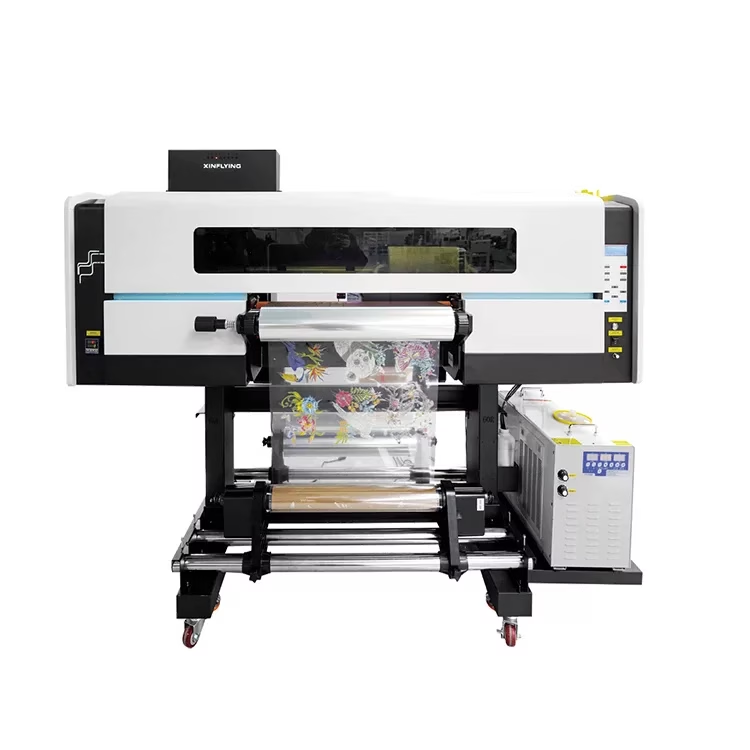
Understanding UV DTF Printer Technology in Modern Production
The UV DTF printer is a relatively new digital printing solution designed for direct transfer film applications using UV-curable ink technology. 기존의 인쇄방식과는 다르게, it allows designs to be printed on special film and transferred to a wide range of rigid and irregular surfaces.
This technology uses UV light curing to instantly solidify ink, ensuring strong adhesion and high durability. It is widely used in product customization industries such as promotional goods, 포장 장식, and industrial labeling.
For manufacturers, UV DTF printer systems offer a major advantage in substrate flexibility. They can handle materials such as glass, 금속, 플라스틱, and coated surfaces without requiring heat pressing like sublimation.
Sublimation Printing Technology Overview for Textile Applications
Sublimation printing is a heat transfer process where dye-based inks are converted into gas under high temperature and then bonded into polyester-coated materials. This technology is widely used in apparel, 소프트 간판, 머그잔, and promotional textiles.
Unlike UV-based systems, sublimation relies heavily on polyester content or polymer coating to achieve color bonding. This makes it highly effective for fabric-based production but limited in rigid material applications.
From a production standpoint, sublimation is known for producing smooth, photo-quality images with excellent color vibrancy. 하지만, it lacks compatibility with non-polyester surfaces, which restricts its application scope compared to UV DTF printer solutions.
UV DTF printer vs Sublimation: Core Differences in Application and Performance
When comparingDTF UV 인쇄기 and sublimation technologies, the most significant difference lies in material adaptability. UV DTF systems are designed for rigid and flexible substrates, while sublimation is primarily restricted to polyester-based textiles and coated blanks.
In terms of durability, UV-cured prints offer strong resistance to water, UV exposure, and scratches. Sublimation prints, while long-lasting on fabric, are not suitable for hard surfaces or outdoor exposure in demanding environments.
Another key difference is workflow. UV DTF printer systems typically use film-based transfer with adhesive layers, while sublimation requires heat pressing equipment and precise temperature control.
For business manufacturers, this means UV DTF solutions offer broader market opportunities, especially in personalized gifts, industrial labeling, and multi-material customization businesses where sublimation cannot be applied.
XF-600S 3D UV DTF 프린터: Integrated Industrial Solution from Xinflying
Xinflying에서, we develop advanced printing systems designed to meet industrial production demands. Our XF-600S is a next-generation integrated UV DTF printer that combines 3D simulated embroidery effects with high-performance UV printing technology.
The system is equipped with three Epson i3200-U1 printheads, delivering high-speed and high-precision output for 24-inch wide-format production. It is designed to support efficient UV DTF workflows with stable performance and enhanced visual effects.
One of the key advantages of the XF-600S is its advanced UV curing system. The water-cooled curing technology ensures stronger ink solidification, 더 높은 바니시 광택, 향상된 내구성, and better weather resistance for finished products.
To improve operational stability, the system integrates a Hoson control board, 자동 필름 박리 시스템, laminating roller, 진공 흡입 플랫폼, and intelligent base plate heating. These features reduce manual intervention and improve production efficiency.
Technical specifications of the XF-600S include a printing width of 24 신장, printing speed of 6Pass: 3㎡/시간, and a compact industrial structure measuring L2000 × W820 × H1600 mm. This configuration makes it suitable for scalable production environments requiring consistent output quality.
Production Efficiency and Business Value of UV DTF Printer Systems
For modern printing businesses, efficiency and flexibility directly influence profitability. UV DTF printer systems offer a strong advantage by reducing material limitations and expanding application categories.
Compared to sublimation workflows, UV-based printing eliminates the need for heat pressing and polyester dependency, allowing faster turnaround times and simplified production processes.
Xinflying에서, we design our UV DTF printer solutions to support automation, 안정, 및 확장성. This enables business clients to reduce operational costs while expanding into higher-margin product markets such as custom branding, industrial decoration, and premium promotional goods.
As market demand for personalized and multi-surface printing continues to grow, UV DTF technology is becoming a strategic investment for forward-looking manufacturers.
결론
Both UV DTF printer and sublimation technologies play important roles in the digital printing industry, but they serve different production goals. Sublimation remains strong in textile-based applications, while UV DTF printer systems offer significantly broader material compatibility and application flexibility.
Xinflying에서, we continue to develop advanced UV printing and digital textile solutions that help businesses scale efficiently in competitive markets. With systems like the XF-600S, we aim to provide reliable, high-performance equipment that supports industrial-grade UV DTF production and long-term business growth.