
In textile customization and promotional product manufacturing, consistent color output and stable printing performance are essential for maintaining profitability and brand reputation.
As a global digital printing supplier, Xinflying provides integrated solutions across sublimation, DTG, DTF, and UV printing technologies, helping business users achieve scalable production efficiency.
이러한 기술 중에는, sublimation printing remains one of the most widely used methods for polyester fabrics, 머그잔, 깃발, 그리고 맞춤형 상품. 하지만, even high-performance systems depend heavily on proper ink management. Incorrect handling of 승화 잉크 or inconsistent refilling practices can lead to clogging, color deviation, and reduced printhead lifespan.
이 기사에서는, we explain how to properly refill dye sublimation inks and maintain optimal printing performance in professional production environments.
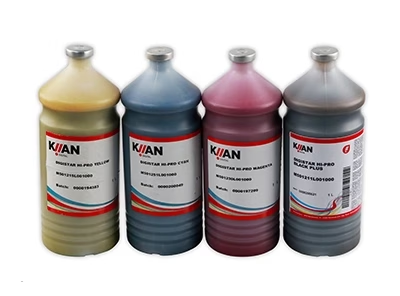
Understanding the Role of Sublimation Ink in Printing Stability
A sublimation ink system relies on heat transfer technology, where ink transitions from solid to gas and bonds with polyester-based materials. This process requires extremely stable ink chemistry to ensure consistent vaporization and color accuracy.
We supply dye sublimation inks formulated with microfiltration technology, featuring particles smaller than 0.2 µm. This fine formulation prevents printhead blockage and ensures smooth ink flow even during high-speed production.
Ink stability is not only about color output. It directly impacts nozzle health, spray accuracy, and long-term machine reliability. That is why correct refilling procedures are critical for maintaining production efficiency.
Preparing the System Before Refilling Dye Sublimation Inks
Before adding new dye sublimation inks, preparation is essential to avoid contamination or ink mixing issues. We always recommend checking ink levels through the printer’s monitoring system and ensuring that cartridges or tanks are nearly empty before refilling.
The ink tank should be cleaned periodically to prevent sediment buildup. Residual ink from previous batches can cause color inconsistency if not properly flushed. Operators should also inspect ink lines and dampers for air bubbles, as trapped air can interrupt stable ink delivery.
By preparing the system correctly, businesses can ensure that each refill of sublimation ink maintains consistent output quality without affecting production continuity.
Step-by-Step Refilling Process for Sublimation Ink Systems
The refilling process for dye sublimation inks should always be handled in a controlled environment to prevent dust contamination. 첫 번째, ensure that the printer is powered off or in maintenance mode to avoid pressure imbalance in the ink system.
다음, gently shake the ink bottle to ensure pigment uniformity before pouring. When filling the tank, avoid overfilling, as this can cause backflow issues or leakage during operation. It is also important to use dedicated funnels or sealed refilling tools to minimize air exposure.
After refilling sublimation ink, perform a nozzle check and small cleaning cycle to stabilize ink flow. This step ensures that any air introduced during refilling is removed and print consistency is restored.
Ink Compatibility and ICC Color Management Optimization
One of the most overlooked factors in sublimation ink performance is compatibility with ICC color profiles. Even high-quality inks can produce inconsistent results if color management settings are not properly calibrated.
Our dye sublimation inks are designed with ICC-based color management support, allowing users to achieve natural gradients, strong 3D effects, and balanced saturation. 하지만, each refilling cycle may slightly affect color density due to batch variations or environmental conditions.
그러므로, after refilling, it is recommended to recalibrate ICC profiles to ensure that output colors remain consistent with design expectations. This is especially important for commercial printing businesses that require strict brand color accuracy.
Preventing Printhead Clogging and Ink Flow Issues
Printhead clogging is one of the most common problems associated with improper handling of sublimation ink. It often occurs when ink is exposed to air for too long or when low-quality ink is mixed with existing supply.
Our dye sublimation inks use microfiltration technology with ultra-fine particles below 0.2 µm, significantly reducing the risk of nozzle blockage. 하지만, proper maintenance is still necessary to ensure long-term stability.
Operators should avoid letting ink tanks run completely dry, as this introduces air into the system. Regular printing cycles and automatic cleaning functions help maintain continuous ink flow and prevent sediment accumulation inside the printhead.
Storage Conditions and Shelf Life Management of Dye Sublimation Inks
Proper storage of sublimation ink plays a critical role in maintaining performance quality. Ink should always be stored in a cool, dry environment away from direct sunlight to prevent chemical degradation.
We recommend sealing ink bottles tightly after each use to avoid oxidation. Exposure to air can gradually reduce pigment stability and affect color vibrancy during printing.
Our dye sublimation inks are engineered for long shelf life stability, but consistent storage practices ensure maximum performance throughout the ink lifecycle. Businesses managing large-scale production should also implement FIFO (first-in-first-out) inventory control for ink usage.
XF Dye Sublimation Ink Solution for Industrial Applications
As part of our integrated printing ecosystem at Xinflying, we provide high-performance dye sublimation inks designed for industrial textile and merchandise production.
Our ink formulation combines bright color output, strong washing resistance, and stable jetting performance. With ICC color management support and advanced microfiltration technology, the ink ensures smooth printing across a wide range of sublimation printers.
These properties make our sublimation ink suitable for applications such as sportswear, 홈 섬유, promotional gifts, and customized apparel production where durability and color accuracy are essential.
결론: Building Reliable Production with Proper Ink Refilling Practices
Efficient refilling of dye sublimation inks is not just a maintenance task—it is a critical factor in ensuring long-term production stability and print quality. From system preparation and controlled refilling to ICC calibration and storage management, each step directly influences final output performance.
Xinflying에서, we are committed to helping business customers achieve consistent results through advanced sublimation ink solutions and reliable printing technology. By combining high-quality consumables with proper operational practices, businesses can significantly improve efficiency, reduce downtime, and maintain professional-grade printing performance in competitive markets.