
In the evolving landscape of digital textile decoration, two technologies currently dominate the market: Прямо на фильм (ДТФ) and Dye Sublimation. For businesses looking to invest in new hardware, the choice between a DTF-принтер and a sublimation unit is more than just a matter of price—it is a strategic decision that dictates which fabrics you can print on, в “hand-feel” of your products, and your overall production efficiency.
While sublimation has long been the go-to for custom sportswear, the rise of the industrial dual head DTF printer has introduced a level of versatility that is rapidly making it the preferred choice for comprehensive apparel manufacturing. Ниже, we break down the key differences to help you choose the right profit engine for your business.
1. Substrate Versatility: The “Cotton Barrier”
The most significant difference between these two technologies is the type of fabric they can handle.
сублимация: This process relies on a chemical bond between the ink and polyester fibers. Because the ink turns into a gas and permeates the fabric, it only works on materials with at least 65% polyester content. Более того, sublimation is limited to white or very light-colored fabrics, as it lacks a white ink layer.
DTF-принтер: A Xinflying DTF printer has no such limitations. Because the design is printed onto a PET film and then bonded to the fabric via a TPU adhesive, it can be applied to 100% хлопок, полиэстер, нейлон, холст, кожа, и смеси. Most importantly, because DTF utilizes a white ink underbase, you can achieve vibrant, opaque results on pitch-black garments—a feat that is impossible with standard sublimation.
2. Print Quality and Tactile “Hand-Feel”
The “science” of how the design sits on the fabric differs greatly between the two methods, affecting the final texture.
сублимация: Since the dye becomes part of the fiber, there is “zero feel” to the print. The fabric remains as breathable as it was before printing. This is ideal for performance athletic wear.
DTF-принтер: The result of a принтер DTF с двойной головкой is a thin, flexible layer that sits on top of the fabric. While modern DTF inks and fine powders provide a very soft “hand-feel,” it is still a physical layer. Однако, for streetwear and corporate branding, в “plastisol-like” finish of DTF is often preferred for its crispness and color pop.
3. Hardware Configuration: The Power of the Dual Head
When comparing the efficiency of the two systems, the hardware configuration plays a massive role.
сублимация: Usually requires a single-head setup as there is no white ink to manage.
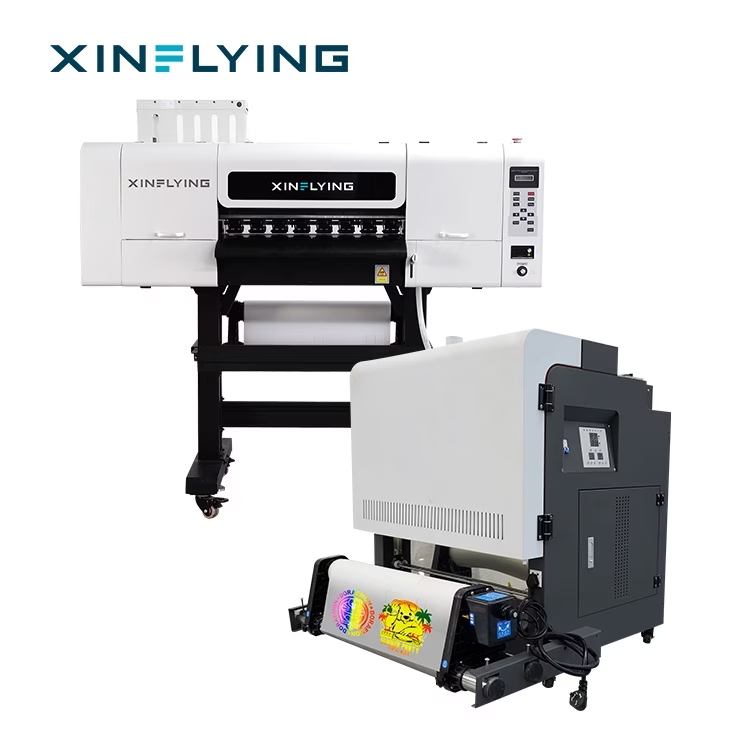
Dual Head DTF Printer: High-performance units like the Xinflying C602 utilize a dual head DTF printer configuration. In this setup, one Epson i3200-A1 head is dedicated to the CMYK colors, while the second head is dedicated entirely to White ink. This allows for “single-pass” printing where the color and the white underbase are deposited simultaneously. This significantly increases production speed, allowing businesses to output up to 13m²/h, far exceeding the throughput of many entry-level sublimation setups.
Technical Comparison Table:
| Особенность | сублимация | Xinflying DTF Printer |
| Совместимость с тканью | Polyester Only | Хлопок, Poly, Нейлон, Кожа, и т. д.. |
| Цвет ткани | Light Colors Only | Any Color (Including Black) |
| Белые чернила | Нет | Да (High Opacity) |
| Pre-treatment | Нет | Нет (Powder replaces pre-treat) |
| печатающая головка | Varies | Dual Epson i3200-A1 |
4. The Production Workflow
The steps required to reach a finished garment differ in complexity and equipment.
Sublimation Workflow: Print on sublimation paper → Heat press directly to the garment. It is a simple two-step process.
DTF Workflow: Print on PET film → Apply adhesive powder → Cure in oven → Heat press to garment. While DTF has an extra “powdering” step, Xinflying’s integrated systems automate this with an all-in-one shaker and dryer. This automation means that once the DTF printer starts, the film is automatically powdered, вылеченный, and rolled, requiring very little manual labor.
5. Cost Analysis and ROI
When evaluating the dual head DTF printer against sublimation, you must consider both CAPEX (Capital Expenditure) and OPEX (Operational Expenditure).
Расходные материалы: DTF inks and powders are generally very cost-effective, especially when bought in bulk. Sublimation inks can be cheaper, but the requirement for specialized polyester garments (which are more expensive than basic cotton tees) often eats into the profit margins.
Versatility ROI: A DTF printer allows you to say “да” to every customer, whether they want a silk banner, a cotton hoodie, or a polyester jersey. This versatility typically leads to a much faster return on investment because your machine is never sitting idle due to fabric restrictions.
6. Maintenance and Durability
Both machines require care, but their needs are different.
сублимация: Requires regular head cleaning, but because the ink is thin, clogs are less frequent.
DTF-принтер: Because white DTF ink contains titanium dioxide, it requires a circulation system to prevent settling. Xinflying’s dual head DTF printer models include automated white ink stirring and circulation, which mitigates the maintenance burden significantly. In terms of durability, both methods are excellent, with DTF prints typically lasting 40+ washes without significant cracking or fading.
Заключение: Which is Right for You?
The choice between a DTF printer and a sublimation printer depends on your target market. If your business is exclusively focused on white polyester athletic apparel (like cycling jerseys or marathon shirts), sublimation remains a strong choice.
Однако, if you want to capture the massive market for custom cotton t-shirts, black hoodies, and diverse promotional items, the dual head DTF printer is the undisputed winner. Синьфлайинг Group’s industrial DTF solutions provide the speed of the Epson i3200-A1 heads and the stability of Hoson mainboards, ensuring that your business can handle any fabric the customer brings to the table. In the modern “on-demand” world, the versatility of a DTF printer is the ultimate competitive advantage.
