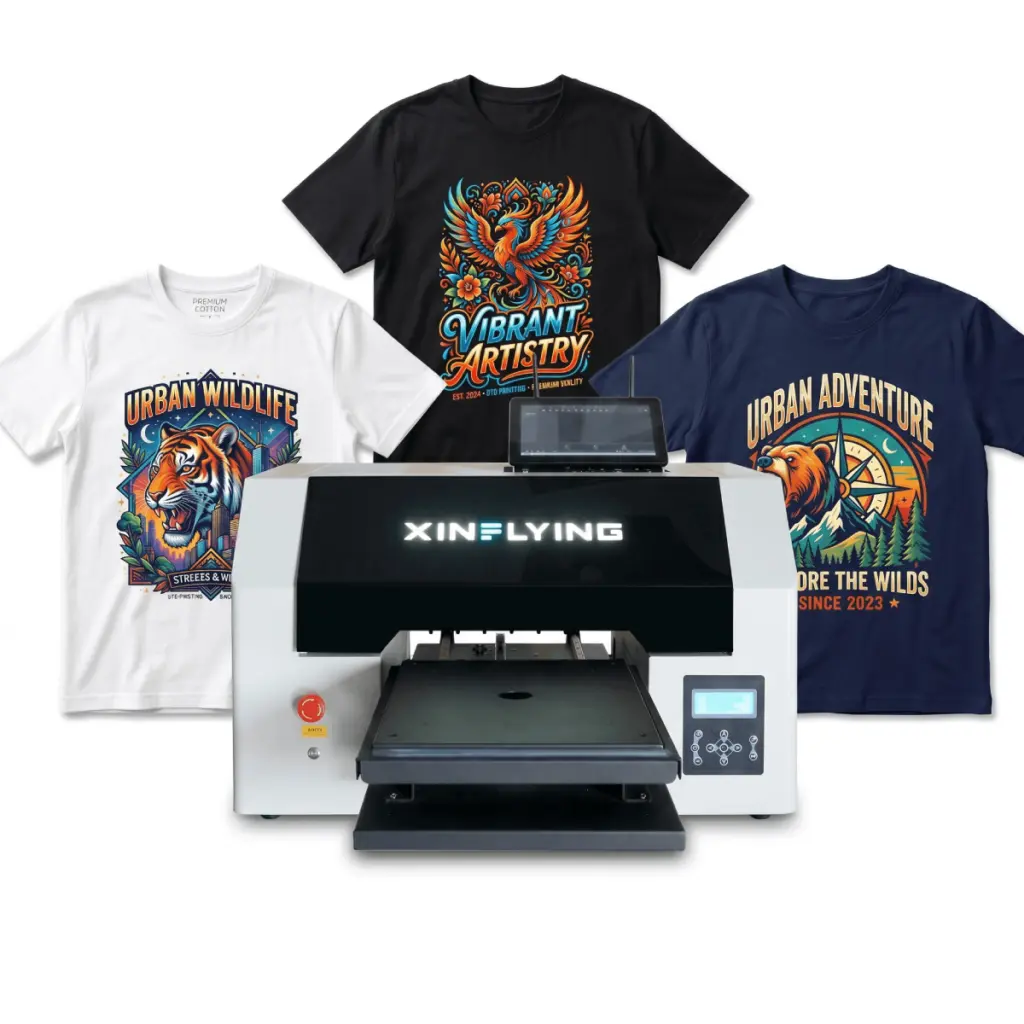
If you’re exploring custom garment printing, two technologies come up more than any other: DTF (Doğrudan Filme) Ve DTG (Doğrudan Giysiye). Both produce high-quality, tam renkli baskılar. Both are digital. Both work without screens or setup fees.
But they work very differently — and the wrong choice for your product line or business model can cost you time, money, and customers.
This guide gives you a complete, honest comparison of DTF vs DTG across every dimension that matters: kumaş uyumluluğu, baskı kalitesi, maliyet, hız, dayanıklılık, and which type of business each technology is best suited for.
DTF Baskı Nedir??
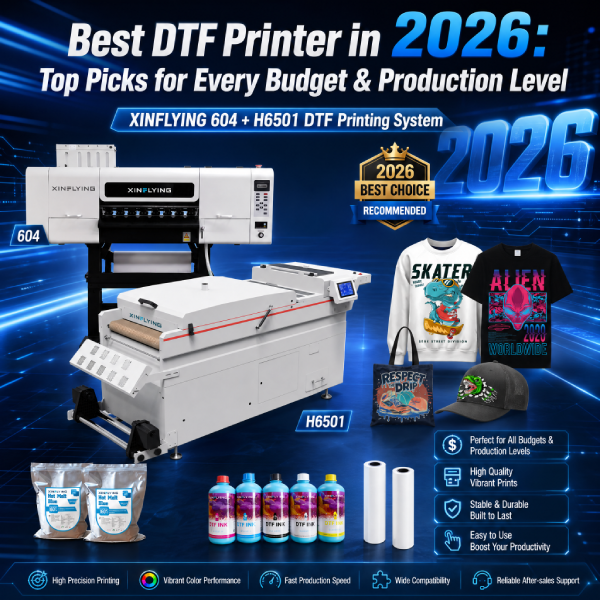
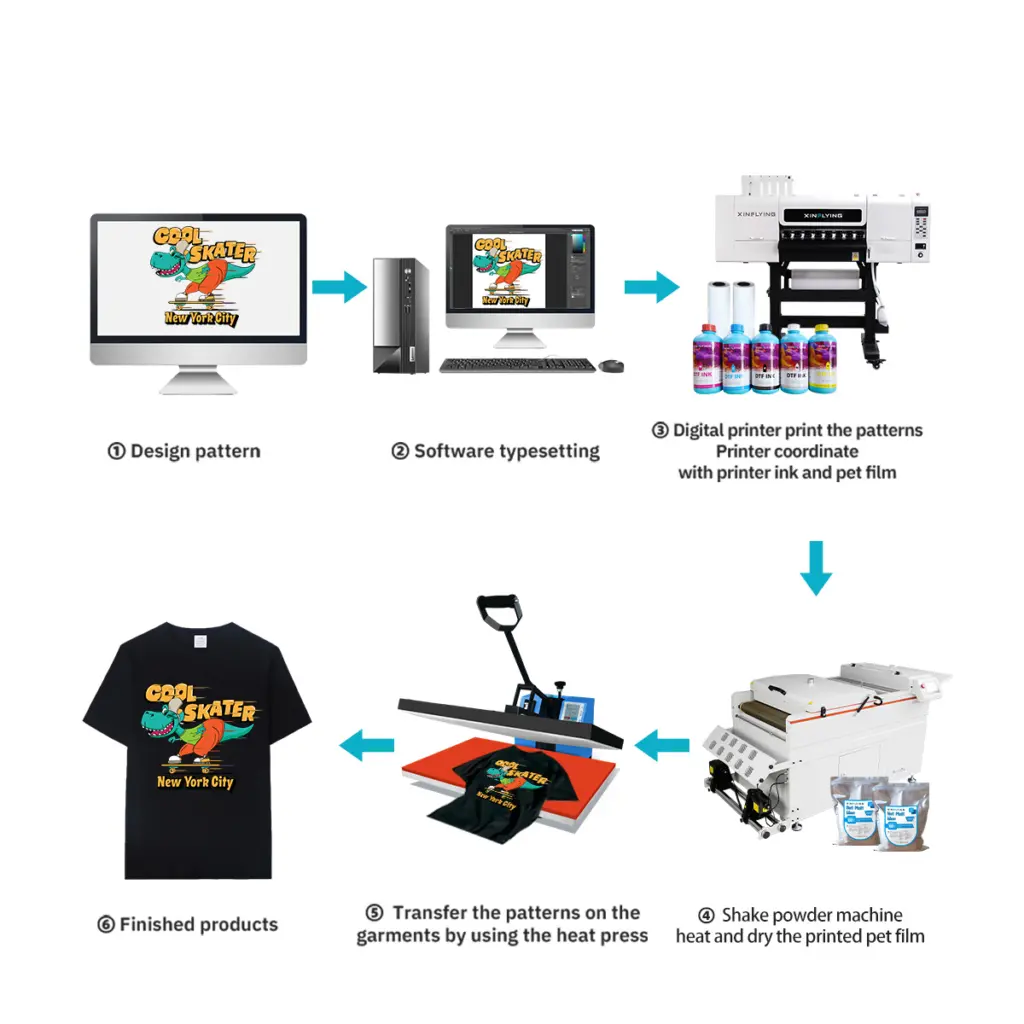
DTF yazdırma prints your design onto a PET transfer film using water-based ink, coats it with hot-melt adhesive powder, cures it in an oven, and transfers it onto fabric using a heat press.
The key advantage of DTF is versatility. Because the transfer is applied on top of the fabric rather than directly into it, DTF works on virtually any fabric type — cotton, polyester, naylon, karışımlar, kot, and more — in any color, including black and other dark shades.
DTF requires no pretreatment of the garment, works on finished products (no need to load a flat platen), and produces flexible, wash-resistant transfers with vibrant color.
DTG Baskı Nedir??
DTG yazdırma sprays water-based textile ink directly onto the surface of the garment using inkjet print heads — essentially printing on fabric the way a desktop printer prints on paper.
DTG excels on cotton and high-cotton blends, where the ink absorbs deeply into the fibers and creates a soft, breathable print with no texture or hand feel. For dark garments, a white ink underbase is applied first, which requires pretreatment of the fabric with a liquid chemical solution before printing.
DTG is fast for single-unit production and produces photographic-quality prints on cotton with exceptional softness and detail.
DTF vs DTG: Full Comparison Table
| Özellik | DTF Yazdırma | DTG Yazdırma |
|---|---|---|
| How it works | Print on film → powder → heat press onto fabric | Print ink directly onto garment |
| Kumaş uyumluluğu | Hemen hemen her kumaşta çalışır | En iyisi 100% cotton and high-cotton blends |
| Dark garment printing | Excellent — white ink built into process | Requires pretreatment liquid before printing |
| Pretreatment required | HAYIR | Evet, for dark or colored garments |
| Print feel | Hafif doku / hand feel | Yumuşak, nefes alabilen, no texture |
| Print durability | Excellent — 50+ washes | Excellent with proper curing |
| Minimum order | No minimum — single unit production | No minimum — single unit production |
| Üretim hızı | Fast — transfer can be pre-made in batches | Fast for single units |
| Startup equipment cost | Ilıman (yazıcı + fırın + ısı basın) | Orta ila yüksek (yazıcı + ısı basın) |
| Per-unit consumable cost | Düşük | Low to moderate (pretreatment + mürekkep) |
| Maintenance complexity | Ilıman | Moderate — white ink requires daily attention |
| Best fabric colors | Light and dark — all colors | Best on white and light colors; dark requires more care |
| All-over printing | Yes — transfers can cover full garment panels | Limited by platen size |
| Şunun için en iyisi: | Mixed-fabric orders, koyu giysiler, esneklik | Pamuklu Tişörtler, soft-touch prints, photo-quality detail |
Kumaş Uyumluluğu: The Most Important Difference
This is where DTF and DTG diverge most significantly — and it’s the single most important factor when choosing between them.
DTG Fabric Requirements
DTG ink is designed to bond with natural fibers, particularly cotton. The more cotton content in the fabric, the better the print quality, renk canlılık, and wash durability.
- 100% pamuk — Best results, maximum vibrancy and durability
- 50/50 cotton-polyester blend — Good results, slight reduction in vibrancy
- Tri-blend (cotton/polyester/rayon) — Acceptable results, softer vintage look
- 100% polyester — Poor results — ink sits on surface, prone to fading and washing out
- Naylon, tayt, performance fabrics — Not compatible
If your business primarily sells cotton T-shirts and hoodies, DTG is a natural fit. If you regularly handle polyester sportswear, nylon bags, mixed-fabric orders, or accessories, DTG will let you down on many of those materials.
DTF Fabric Compatibility
DTF transfers use a hot-melt adhesive that bonds to fiber surfaces regardless of fiber type. This makes DTF compatible with nearly every fabric on the market:
- 100% cotton ✓
- 100% polyester ✓
- Nylon ✓
- Spandex and stretch fabrics ✓
- Cotton/poly blends ✓
- Denim ✓
- Canvas ✓
- Leather and faux leather ✓
- Light and dark colors ✓
For businesses that handle diverse orders across multiple fabric types, DTF offers a level of flexibility that DTG simply cannot match.
Dark Garment Printing: A Critical Comparison
Printing on dark fabrics is one of the most common challenges in custom apparel — and DTF and DTG handle it very differently.
DTG on Dark Garments
To print on a black or dark-colored garment with DTG, you must:
- Pretreat the fabric with a chemical pretreatment liquid, applied by spray machine or roller
- Cure the pretreatment using a heat press to activate it
- Tasarımı yazdır — the printer lays down a white ink underbase first, then the CMYK colors on top
- Cure the ink using a heat press or tunnel dryer
This four-step process adds time, maliyet, and complexity to every dark garment order. Pretreatment application must be even and consistent — uneven pretreatment leads to blotchy prints, color inconsistency, and premature fading. It also adds a consumable cost (pretreatment liquid) to every dark garment.
DTF on Dark Garments
DTF printing handles dark garments with no additional steps. The white ink layer is part of the standard print process — it is printed automatically onto the transfer film regardless of the garment color. When the transfer is pressed onto a black shirt, the white underbase is already there.
There is no pretreatment. No extra curing step. The workflow for a black shirt is identical to the workflow for a white shirt.
For businesses that regularly handle dark garment orders, this difference in workflow efficiency is significant — both in time and in operational simplicity.
Print Quality and Feel
DTG Print Quality
DTG produces some of the finest print quality available in garment decoration. Because the ink is sprayed directly into the fibers of the fabric, the result is:
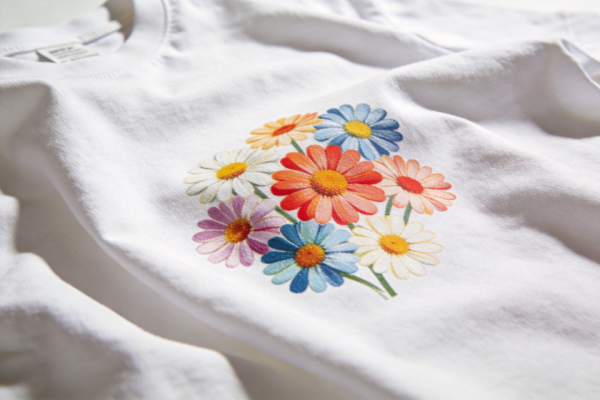
- Photographic-quality detail and gradient reproduction
- Completely soft hand feel — the print is not detectable by touch on cotton
- Breathable finish that moves naturally with the fabric
- Rich, saturated colors on white and light cotton
For fashion brands, premium streetwear, and any product where the tactile quality of the print is a priority, DTG delivers a result that is difficult to match.
DTF Print Quality
DTF print quality is excellent and has improved significantly with modern print heads and ink formulations. The key difference from DTG is the hand feel: because a DTF transfer is applied on top of the fabric surface, there is a slight texture at the edges of the design and a subtle raised feel to the printed area.
For most applications — casual apparel, spor giyim, accessories — this texture is barely noticeable and customers rarely notice it. For premium fashion or products where a completely natural fabric feel is essential, DTG has a slight edge.
In terms of color vibrancy and detail, DTF and DTG are closely matched on comparable substrates. DTF often produces more vibrant results on dark garments, since the white underbase in the transfer film is more consistent than spray-applied pretreatment.
Production Workflow and Speed
DTG Workflow
- Pretreat garment (dark colors only) → cure with heat press
- Load garment onto platen
- Basılı
- Cure printed garment with heat press or tunnel dryer
- Finished product
For light-colored garments, DTG is a streamlined two-step process (baskı + tedavi). For dark garments, the pretreatment step adds 2–3 minutes per unit plus the time for the pretreatment to cure.
DTG is best suited for on-demand single-unit production where the garment is printed immediately after the order is received.

DTF Workflow
- Print design onto transfer film + toz uygula + cure in oven (can be done in advance, in batches)
- Press transfer onto garment with heat press
- Peel film
- Finished product
The key workflow advantage of DTF is that transfers can be pre-produced in batches and stored until needed. A print shop can print 100 transfers in the morning and press them throughout the day — or even days later. This batch production model improves efficiency and allows one operator to run the printer and press simultaneously.
İçin fulfillment businesses and wholesalers that produce large volumes of the same design, DTF’s batch workflow is significantly more efficient than DTG.
Maintenance and Reliability
DTG Maintenance
DTG printers require consistent, regular maintenance — particularly the white ink system. White ink is dense and settles quickly, which means:
- Daily print head cleaning routines are essential
- White ink must circulate regularly to prevent clogging
- Print heads are sensitive and expensive to replace if damaged by dried ink
- Irregular use (days without printing) accelerates clogging risk
DTG printers with automatic white ink circulation systems significantly reduce this burden, but maintenance remains a daily consideration.
DTF Maintenance
DTF maintenance is generally less demanding than DTG. The ink system is simpler (no white ink circulating through a complex printhead array), and the printer is more tolerant of irregular use schedules.
The main maintenance considerations for DTF are:
- Regular print head nozzle checks and cleaning
- Keeping the powder shaker and oven clean of residue
- Ensuring film feeds smoothly to prevent jams
For businesses with variable production schedules or operators who are new to digital printing, DTF’s lower maintenance burden is a practical advantage.
Which Technology Is Right for Your Business?
Choose DTF if:
- You handle a mix of fabric types and don’t want to turn down orders
- A significant portion of your orders are dark or black garments
- You want to produce transfers in advance and press on demand
- You’re building a wholesale transfer business supplying other decorators
- You’re new to digital printing and want a lower-maintenance setup
- You print on accessories, çanta, şapkalar, and items beyond just T-shirts
Choose DTG if:
- Your product line is primarily 100% cotton T-shirts and hoodies
- Soft hand feel and a no-texture print finish are priorities for your brand
- You run a print-on-demand business producing single units immediately after orders come in
- Your customer base values premium print quality on natural fabrics
- You already have a pretreatment workflow in place
Run Both if:
- You want to serve the full range of custom apparel customers
- You need DTG’s soft-touch quality for your premium cotton line and DTF’s flexibility for everything else
- You’re scaling a garment decoration business and want no limitations on what you can accept
Many professional print shops run both DTF and DTG side by side. The two technologies complement each other: DTG handles the premium cotton apparel orders where soft feel matters most, while DTF handles everything else — dark garments, mixed fabrics, aksesuarlar, and high-volume batch runs.
Sık sorulan sorular
Is DTF better than DTG? Neither technology is universally better — they are better suited to different applications. DTF offers greater fabric versatility, easier dark garment printing, and a batch-friendly workflow. DTG produces a softer print feel on cotton and is ideal for single-unit on-demand production. The best choice depends on your product mix, fabric types, and business model.
Can DTF replace DTG printing? For many businesses, DTF has replaced DTG as the primary production method because of its fabric versatility and simpler dark garment workflow. Fakat, DTG remains the preferred choice for businesses focused on premium cotton apparel where the softness and breathability of the print are important to their customers.
Which lasts longer — DTF or DTG prints? Both DTF and DTG prints are highly durable when produced correctly. DTF transfers are rated for 50+ wash cycles without significant deterioration. DTG prints on properly pretreated cotton are similarly durable. DTG prints on fabrics with lower cotton content may fade faster. In practice, the durability of both methods is comparable for most real-world use cases.
Is DTF or DTG cheaper to run? Running costs are similar for light garment printing. For dark garments, DTF is cheaper per unit because it requires no pretreatment liquid and no extra curing step. DTG printer hardware is generally more expensive than comparable DTF hardware. Etraflı, DTF tends to have a lower total cost of ownership for shops with a high proportion of dark garment orders.
Can you use the same heat press for both DTF and DTG? Evet. A standard flat heat press works for both DTF transfer application and DTG ink curing. The temperature and time settings differ between the two processes, but the same machine handles both.
Which is better for printing photos on T-shirts? Both produce excellent photo-quality prints. DTG has a slight edge on white and light cotton garments due to the completely smooth, texture-free finish that best reproduces photographic gradients. DTF produces excellent photo prints on all fabric types and colors, with a marginally detectable texture at close inspection.