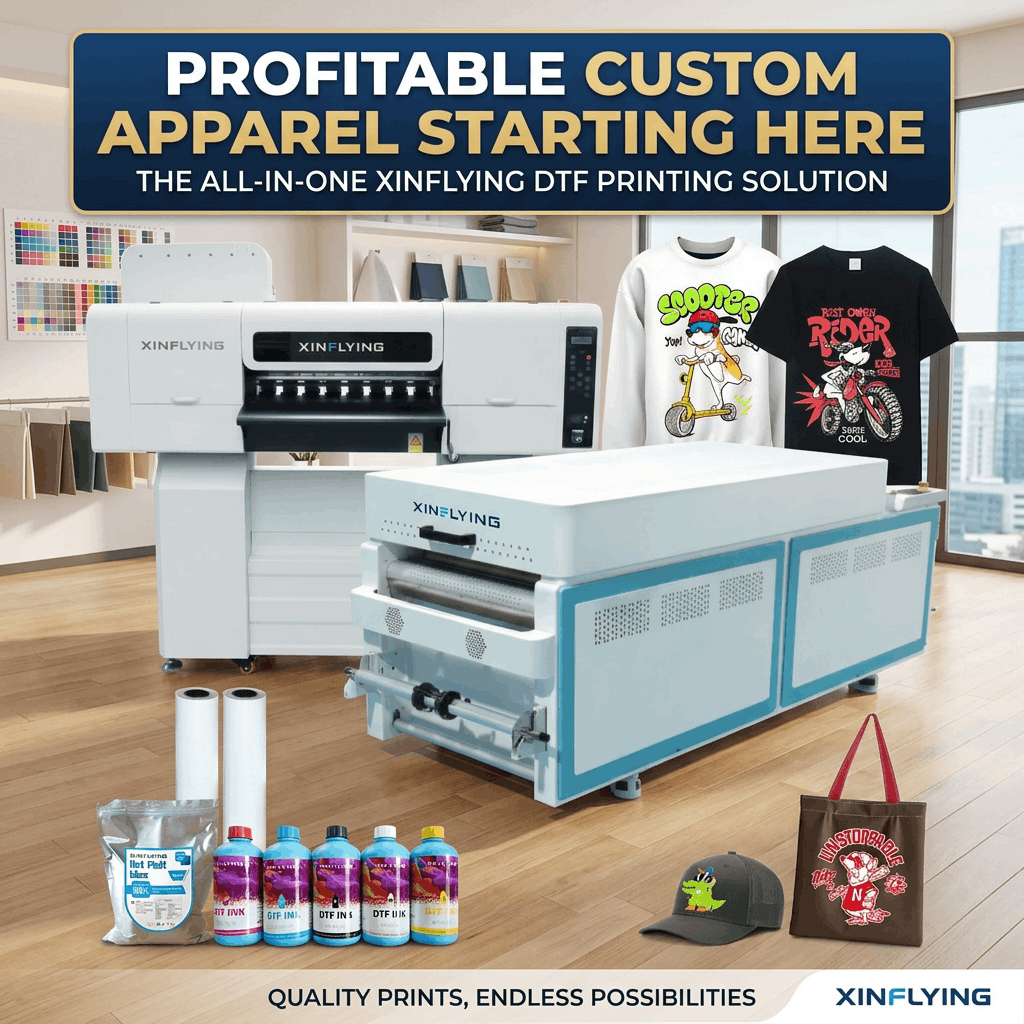
Custom apparel is a $10 billion industry — and Pencetakan DTF has quietly become the most accessible entry point into it.
No screen setup. No minimum orders. No fabric restrictions. A DTF printer lets you take a customer’s design from file to finished garment in under 10 menit. And unlike Pencetakan DTG, there’s no pretreatment, no fabric limitations, and significantly less maintenance overhead.
This guide breaks down exactly how to build a profitable DTF printing business in 2026 — including which machine to start with, how to price your work, how gang sheets transform your margins, and what a realistic ROI timeline looks like.
Why DTF Printing Is One of the Best Business Opportunities in 2026
Three trends are converging right now:
1. Print-on-demand is exploding. Shopify sellers, Etsy creators, and independent clothing brands all need custom apparel production without minimum order requirements. DTF delivers this better than any other technology.
2. DTF quality has surpassed screen printing for small runs. Modern DTF transfers with Epson i3200-A1 printheads produce photographic detail, warna-warna cerah, and wash-resistant prints that screen printing simply can’t match at quantities under 50 pieces.
3. The barrier to entry has dropped. Complete professional DTF setups are now accessible to solo operators, studio kecil, and side businesses — making this one of the most viable low-overhead businesses to start in 2026.
Itu 3 DTF Business Models (Choose Before You Buy Equipment)
Your business model should determine which machine you buy — not the other way around.
Model 1: Print-on-Demand for Your Own Brand
You design and sell custom apparel under your own brand. You print to order, with no inventory.
- Terbaik untuk: Penjual Etsy, streetwear brands, sports teams, event merchandise
- Volume: 500 prints/day to start
- Machine needed: A3 or A2 DTF printer (entry to mid range)
- Key advantage: High margins — you control the full value chain
Model 2: DTF Transfer Reseller
You print DTF transfers — not finished garments — and sell them to other decorators, screen printers, and embroidery shops who apply them with their own heat presses.
- Terbaik untuk: Wholesale-focused operators, people without garment inventory
- Volume: 500–1000+ prints/day
- Machine needed: 24-inch DTF printer with 4 kepala (gang sheet efficiency is critical)
- Key advantage: Predictable recurring revenue; no garment buying required
Model 3: Full-Service Custom Apparel Production
You take orders for finished garments — t-shirts, hoodie, jerseys — and handle the full production workflow.
- Terbaik untuk: Local print shops, sports apparel businesses, corporate merchandise suppliers
- Volume: 1000–2000+ prints/day
- Machine needed: 31-inch or 48-inch industrial DTF system
- Key advantage: Highest revenue per job; strongest customer relationships
Gang Sheets: The Profit Multiplier Most Beginners Miss
If you’re not using gang sheets, you’re wasting 30–50% of your film and your time.
A DTF gang sheet is a layout where multiple designs are arranged together on a single sheet of PET film. Instead of printing one design at a time, you fill the entire printable width — whether 24, 31 inches — with as many designs as will fit.
Why this matters for your margins:
- You pay for film by the linear meter, not by the number of designs
- A wider-format gang sheet might fit 200–300 small designs that cost significantly less each when ganged versus printed individually
- For B2B transfer resellers, gang sheet efficiency is the difference between a good business and a great one
How to create gang sheets: Most DTF RIP software (Maintop, Cetak foto, Kothari) has a built-in gang sheet tool. For clients, offer a discounted per-transfer rate for gang sheet orders — you save film, they save money. Everyone wins.
The Complete DTF Setup: What You Actually Need
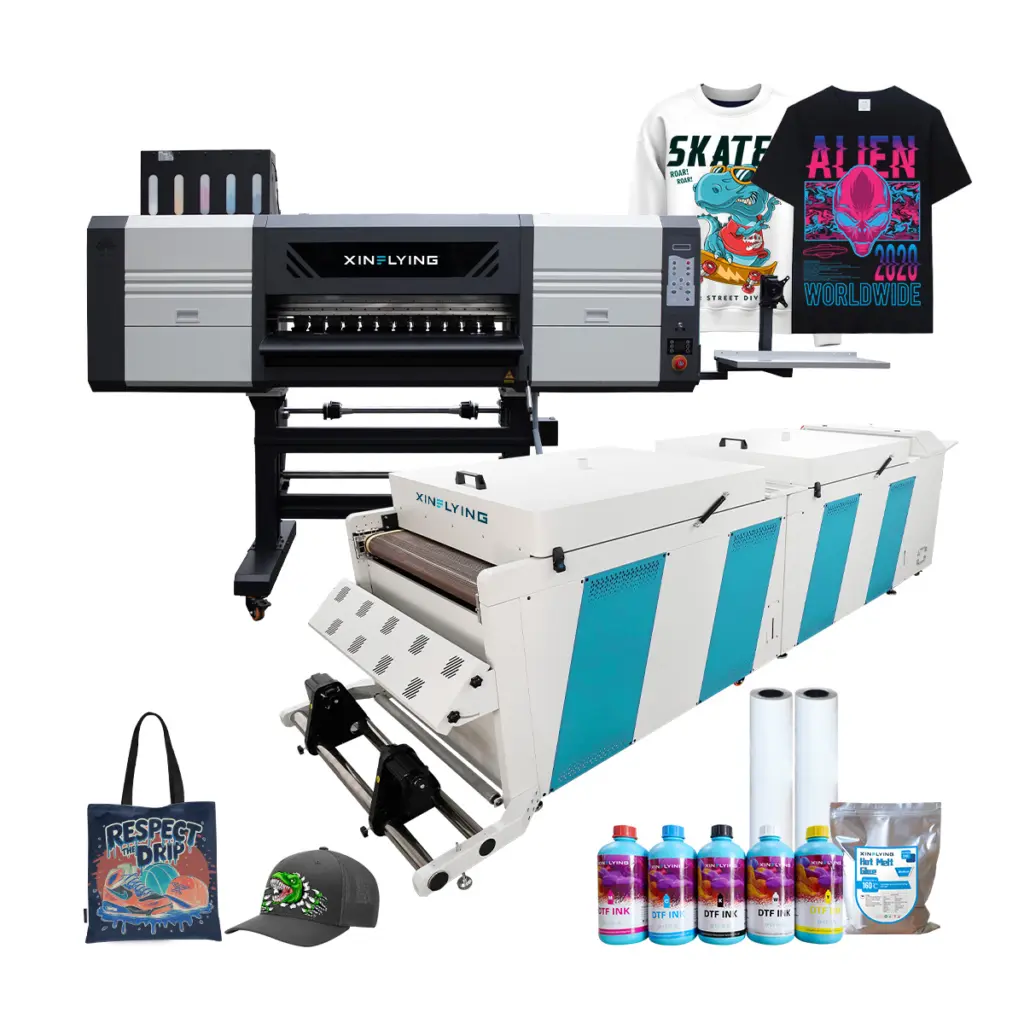
A common mistake is budgeting only for the printer. A complete DTF production setup requires four components:
1. Pencetak DTF
The core machine. Key specs to prioritize:
- Kepala cetak: Epson XP600 (entry), i1600-A1 (mid), or i3200-A1 (commercial and above)
- Sirkulasi tinta putih: Automated stirring/circulation system is non-negotiable
- Lebar cetak: Matches your volume model (A3, A2, 24-inci, 31-inci)
2. Pengocok Bubuk + Oven Penyembuhan
Setelah dicetak, the transfer film needs hot melt adhesive powder applied and heat-cured. At low volumes, manual application is manageable. Beyond 200 prints/day, an automatic powder shaker + oven is essential.
- Manual powder application: adds 2–3 minutes per sheet
- Automatic shaker: 8 seconds per sheet, consistent results
3. Tekan Panas
Required for applying transfers to garments. For production use:
- Minimum 15×15 inch platen
- Consistent temperature (within ±5°C)
- Commercial-rated (not a craft press)
Standard DTF heat press settings: 160°C, 6–10 seconds, medium pressure.
4. Perangkat Lunak RIP
Required for managing color profiles, white ink under-base, dan mencetak antrian. Xinflying machines ship pre-configured with compatible RIP software, removing this setup headache.
Choosing the Right Xinflying DTF Printer for Your Business Stage
Starting Out (Low volume, under 500 prints/day)
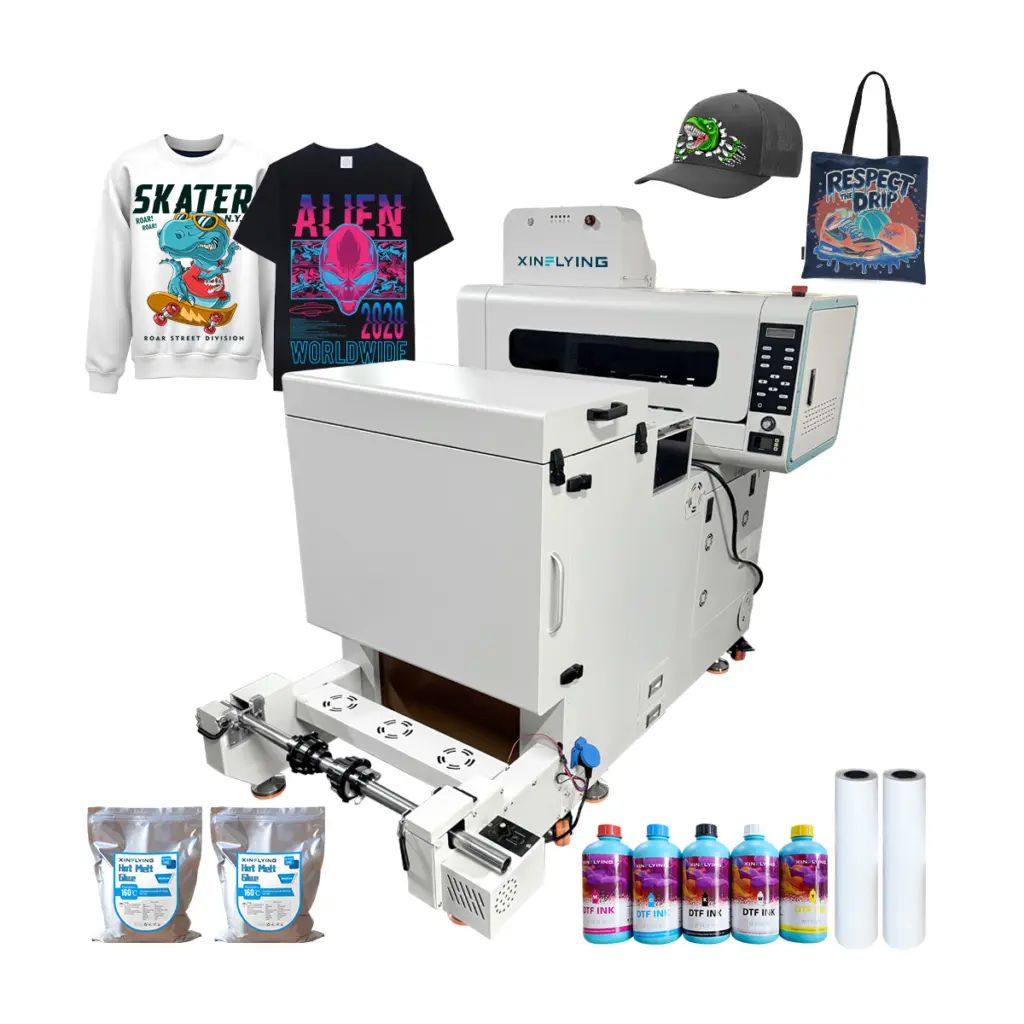
XF-450Pro — A2 All-in-One DTF Printer (Dual i1600-A1)
A step up in both speed and print quality. The XF-450Pro uses dual Epson i1600-A1 printheads — more durable and efficient than XP600 heads at higher volumes. The all-in-one integrated design combines printing and DTF workflow in one unit, reducing setup complexity. Supports continuous production with advanced white ink circulation.
Terbaik untuk: Growing small businesses that need higher daily output without stepping up to large-format machines.
Growing Business (1000-2000 prints/day)
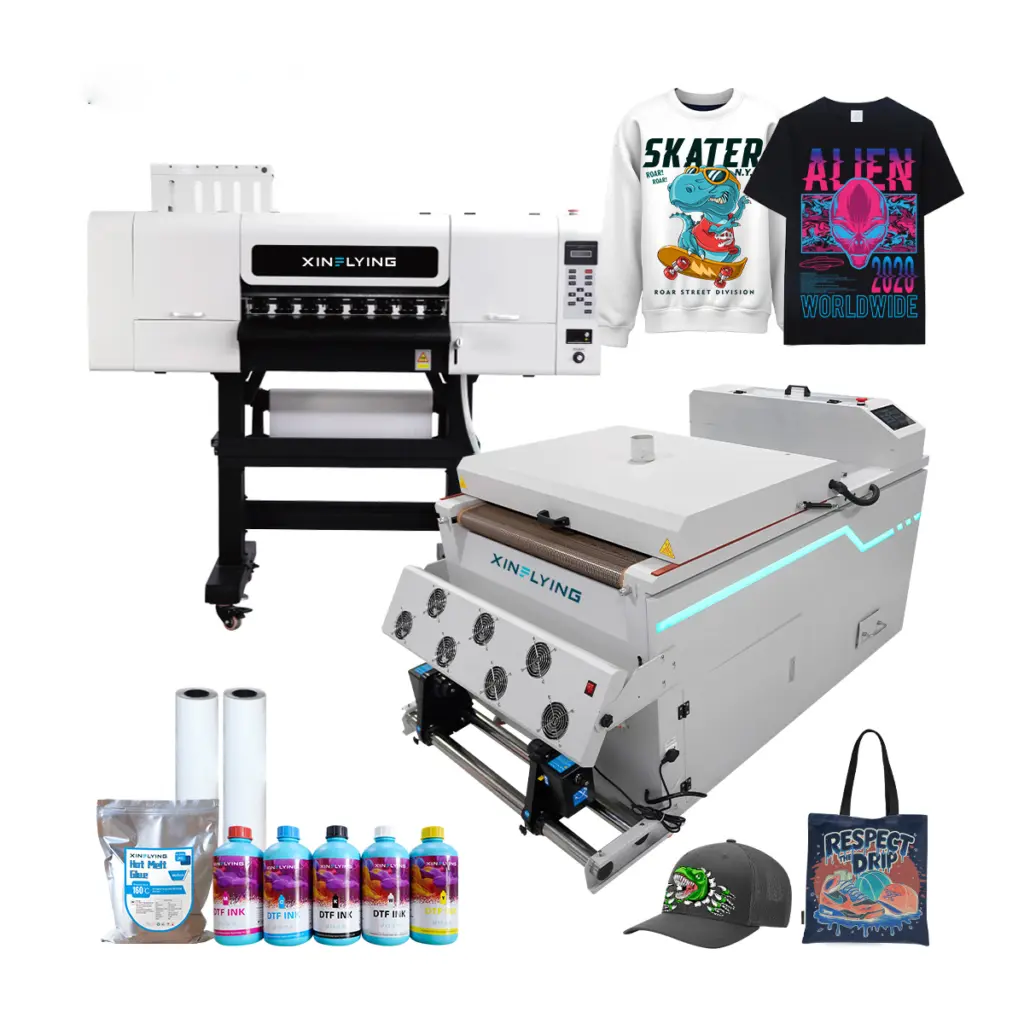
C602+C650H — 24-inch Dual i3200-A1 DTF Printer
The 24-inch width unlocks gang sheet efficiency that transforms your cost-per-transfer. Featuring dual Epson i3200-A1 printheads, this machine delivers sharp, bersemangat, and durable prints with excellent white ink density — covering both light and dark fabrics consistently. Equipped with an imported mute rail system for smooth, precise, low-noise operation.
Terbaik untuk: Mid-sized print shops, DTF businesses moving from A2 to production scale, operators wanting i3200-A1 quality at a 2-head configuration.
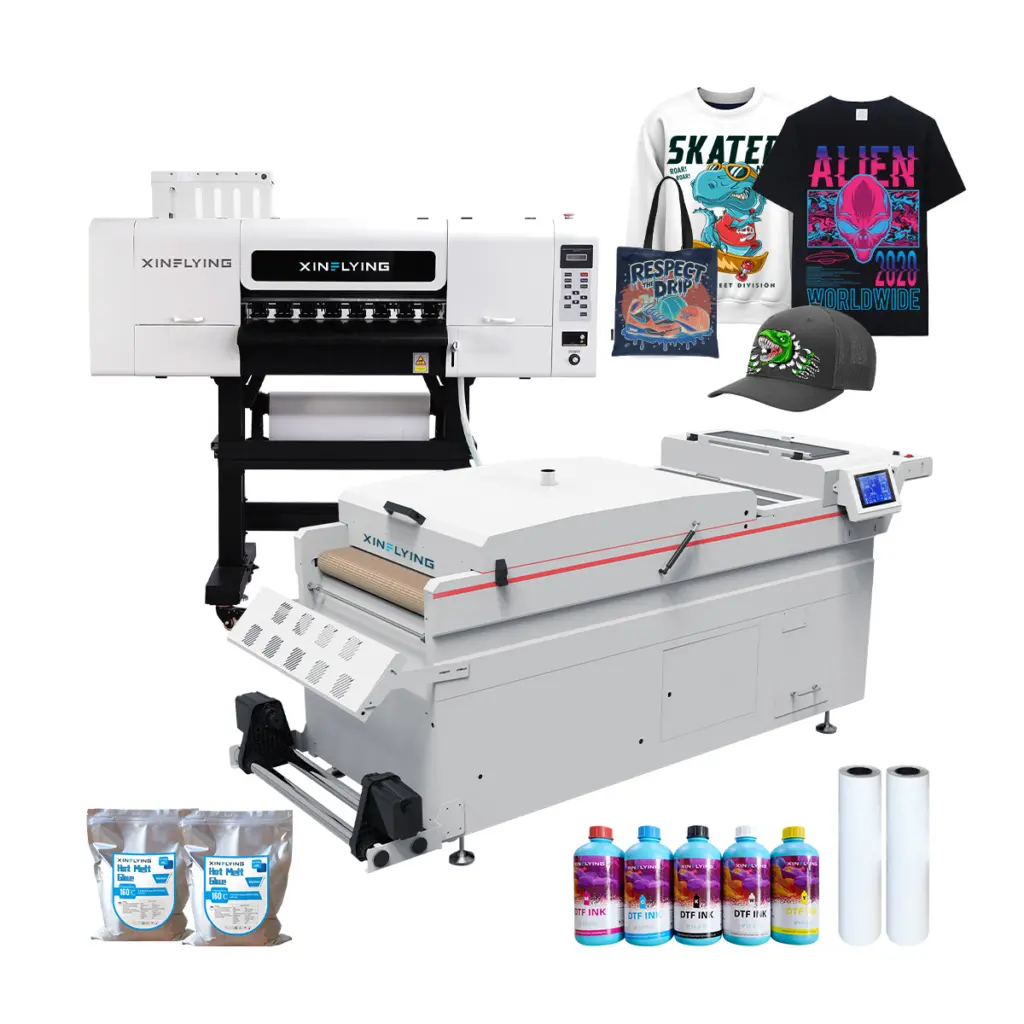
C604+H6501 — 24-inch 4-Head i3200-A1 DTF Printer
Four Epson i3200-A1 printheads deliver significantly higher throughput than the dual-head configuration — ideal for businesses whose daily volume is consistently exceeding what a 2-head machine can handle. Designed for mass production needs with stable, continuous output.
Terbaik untuk: Established print shops, DTF transfer resellers, businesses doing 2000+ orders per day.
Produksi Volume Tinggi (2500+ prints/day)
L808+D808 — 31-inch 8-Head i3200-A1 DTF Printer
Eight Epson i3200-A1 printheads in a 31-inch format — built for serious commercial output. Features a CMYK+White ink system optimized for high-volume gang sheet production, perlindungan anti-tabrakan, a precision mute rail system, and an advanced control interface for efficient workflow management.
Terbaik untuk: Commercial garment decorators, wholesale DTF transfer suppliers, high-volume print fulfillment operations.
Pricing Your DTF Services: A Framework That Works
Pricing is where most new DTF businesses undercharge and erode their margins. Here’s a simple framework:
Base transfer price = (Consumable cost × 3) + tenaga kerja
Calculate your consumable cost per transfer (tinta + film + bubuk), multiply by at least 3 for a viable margin, then factor in labor time. As volume increases and gang sheet efficiency improves, your consumable cost per transfer drops — widening your margins without raising prices.
Additional services that justify premium pricing:
- Rush turnaround (same-day or next-day): +30–50%
- Design preparation/file cleanup: flat fee per job
- Application service (you press the transfer onto garments): per-piece add-on
- White-label fulfillment for POD brands: monthly retainer model
Contact Xinflying for consumable cost estimates and a free consultation on pricing for your specific setup.
How to Get Your First 10 Customers
Once your setup is running, the first customers are closer than you think:
1. Local sports leagues and school teams They need custom jerseys every season, in small quantities. No screen printer wants a 12-piece order. You do.
2. Small clothing brands on Instagram and TikTok Reach out to micro-brands with under 10,000 followers. They can’t afford minimum orders at traditional print shops. Offer a sample run of 20 pieces.
3. Etsy sellers upgrading from iron-on vinyl Vinyl sellers frequently hit quality ceilings. DTF transfers look and wash better than HTV. Target them directly in Etsy seller communities.
4. Local screen printers and embroidery shops Become their overflow vendor for jobs under 24 pieces. Most screen printers won’t touch orders below 24 unit. Those jobs are yours.
5. Corporate merchandise buyers HR departments order branded apparel for onboarding kits, Acara, and team gear. Reach out to local businesses directly.
Pertanyaan yang Sering Diajukan
Q: Berapa biaya untuk memulai bisnis percetakan DTF? A: The investment varies depending on the machine size, printhead configuration, and whether you need a complete bundle (pencetak + pengocok + oven + tekan panas). Contact Xinflying for a detailed quote tailored to your production goals — we offer solutions for every business stage, from individual startups to factory-scale operations.
Q: Is DTF printing better than DTG for a small business? A: Untuk sebagian besar usaha kecil, DTF offers more flexibility. DTF prints on virtually any fabric (kapas, poliester, campuran, nilon) without pretreatment, while DTG requires pretreatment and works best on 100% kapas. DTF also has lower maintenance overhead. DTG produces a softer hand feel on cotton — but for general custom apparel, DTF is the more versatile business choice.
Q: Can you make money selling DTF transfers (not finished garments)? A: Yes — and many operators find this the most scalable DTF business model. You print transfers and sell them wholesale to other decorators, screen printers, and embroidery shops. No garment inventory required, predictable B2B revenue, and gang sheet production maximizes your margins.
Q: How long do DTF transfers last on garments? A: High-quality DTF transfers produced with genuine Epson inks and premium PET film are wash-durable for 50+ wash cycles with proper care. Wash inside-out in cold water, tumble dry low, and avoid ironing directly on the transfer.
Q: Do I need design skills to run a DTF printing business? A: Not necessarily. Many DTF businesses accept customer-supplied artwork files and don’t create original designs. If you want to offer design services, basic Canva or Adobe Express skills are sufficient for most custom apparel orders.
Q: What’s the difference between the XP600, i1600, and i3200 printhead? A: All three are Epson printheads used in DTF printing. The XP600 is entry-level — affordable and easy to replace, ideal for low-volume shops. The i1600-A1 offers better speed and durability for growing businesses. The i3200-A1 is the commercial standard — more nozzles, higher throughput, and optimized for continuous production environments.
Ready to Start Your DTF Printing Business?
The equipment, the market, and the business model are all available right now. The only variable is your first step.
Xinflying has helped businesses across North America, Eropa, and Asia set up profitable DTF operations — from solo Etsy sellers to commercial print factories. Every machine ships with pre-configured RIP software, a 1-year warranty, and dedicated technical support. Xinflying also maintains an overseas warehouse in California, Amerika Serikat, with in-stock products deliverable within 7 hari.
👉 Browse DTF printer packages for every business size →
Atau contact the Xinflying team directly to discuss which setup is right for your production goals — and request a free video demonstration or sample pack.