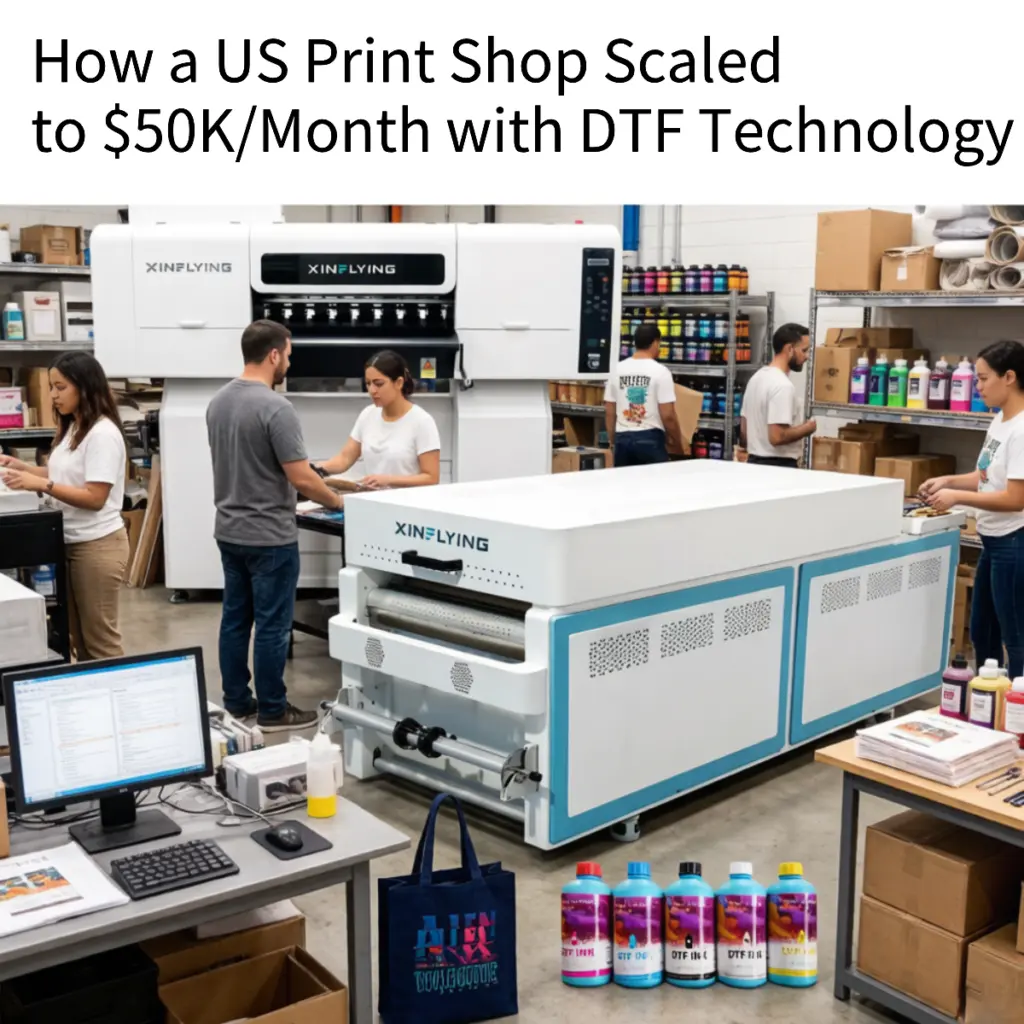
From a one-man operation with a $12K equipment budget to a six-figure monthly revenue business — the real story of how Pencetakan terus ke Filem changed everything for Marcus Rivera and PrintCraft Studio.
$50K: Monthly Revenue (Peak)
11×: Revenue Growth in 14 Months
68%: Gross Margin on DTF Jobs
In January 2022, Marcus Rivera was running a small screen printing operation out of a converted garage in Austin, Texas. He had two part-time employees, a modest list of local clients, and a recurring headache: minimum order requirements were driving away exactly the customers he wanted most.
“Every serious screen-print job needs at least 24 pieces to justify the setup cost,” Marcus recalls. “But my best prospects — the ones with real money to spend — wanted 6 shirts for a team event, atau 10 hoodies for a pop-up shop launch. I kept turning away business that should have been easy wins.”
That friction led Marcus to research alternative print technologies. By March 2022, he had purchased his first DTF (Terus-ke-Filem) pencetak. By the end of 2023, PrintCraft Studio was generating over $50,000 in monthly revenue, with DTF accounting for 74% of total output. This is how he got there.
The Problem with “Minimum Order” Business
Screen printing remains one of the most cost-effective methods for large runs — but its economics punish small orders. Setup time, screen preparation, and ink mixing mean a shop needs volume to turn a profit. For Marcus, this created a structural ceiling on growth.
Beyond the minimum order issue, screen printing is labor-intensive and difficult to scale quickly. Hiring skilled press operators takes months. Training adds risk. Equipment downtime during busy seasons can mean missed deadlines and lost clients.
Marcus was also watching the market shift. More of his inquiries were coming from e-commerce sellers, Etsy shop owners, and small brands — buyers who needed on-demand production in small quantities, not bulk runs. The segment was growing fast. He was systematically locked out of it.
“I realized I wasn’t just losing small orders. I was losing the customers who would grow into my biggest accounts — if I could serve them at the start.”— Marcus Rivera, Pengasas, PrintCraft Studio
Why DTF — and Why DTF Xinflying
Marcus evaluated three technologies before committing: percetakan sublimasi, Langsung-ke-kehadaman (DTG), and DTF. Each had a role, but DTF won on the criteria that mattered most to his business model.
Technology Comparison
Why DTF outperformed the alternatives for Marcus
- lwn. Sublimasi:DTF works on 100% cotton and dark fabrics — sublimation requires polyester and light backgrounds, limiting the product range dramatically.
- lwn. DTG:DTF transfers can be pre-printed and stored. No need to print on demand. Lower maintenance cost. Works on any fabric without pre-treatment.
- lwn. Screen print:No screens, no setup cost, no minimum. Full-color prints from a single unit. Ready in minutes, not hours.
- Wash durability:Modern DTF transfers consistently pass 50+ industrial wash cycles — a concern Marcus stress-tested before committing.
After narrowing his choice to DTF, Marcus spent six weeks evaluating suppliers. He chose DTF Linko based on three factors: transparent pricing on consumables, a dedicated technical support line that answered real questions before the sale, and a training program that his team could follow without a specialist on-site.
“A lot of vendors will sell you a machine and disappear,” he says. “What sold me was calling the support line with a technical question about ink viscosity settings and getting a real answer in 15 minit. That told me everything about how they’d treat me after the check cleared.”
The Rollout: Month by Month
Mac 2022 — Month 1
Equipment installed. First live jobs shipped.
Marcus ran the DTF printer alongside existing screen print operations. First week focused on calibration and operator training. By week three, the shop was fulfilling paid DTF orders. Monthly DTF revenue: $4,200.
May–July 2022 — Months 3–5
Product catalog expanded. E-commerce integrations added.
Marcus added gang-sheet printing to maximize film usage and reduce per-unit cost. He integrated Printify and Printful connectors to capture e-commerce drop-ship volume. DTF revenue doubled to $9,800/month by July.
September 2022 — Month 7
Second DTF unit purchased. Dedicated operator hired.
Demand for same-day and next-day turnaround created a capacity bottleneck. Adding a second printer doubled throughput and allowed Marcus to introduce a premium rush-order tier priced at 40% above standard.
S1 2023 — Months 10–12
B2B wholesale channel launched.
Marcus began selling pre-printed DTF transfers wholesale to other local embroidery and print shops that lacked their own DTF equipment. This channel required zero additional labor — just pre-production during off-peak hours.
Mei 2023 — Month 15
$50K monthly revenue milestone hit.
Combined retail DTF, e-commerce fulfillment, and wholesale transfers pushed total monthly revenue past $50,000 for the first time. DTF Linko equipment accounted for 74% of that output.
The Numbers That Actually Matter
Marcus is candid about the financial mechanics of his business. Scaling to $50K/month is a headline — but the numbers that made that headline sustainable are in the margin structure.
68%: Gross margin on DTF retail orders, versus 34% on equivalent screen print jobs
$0.18: Cost per square inch of finished DTF transfer at full production volume
6 min: Average production time per custom gang sheet, versus 45+ min screen setup
3.2×: Revenue per labor hour on DTF vs. screen print, calculated across 12 bulan
“People get fixated on the revenue number,” Marcus says. “But the real win is that I make more money per hour of work. I’m not running harder — I’m running smarter. The machine does the heavy lifting.”
Three Lessons Marcus Would Tell His Past Self
1. Start with gang sheets from day one
Printing individual transfers wastes film and ink. Gang sheets — printing multiple designs on a single sheet — drop material cost by 30–40% almost immediately. Marcus waited two months before implementing this, a mistake he’d fix if starting over.
2. Price for the value, not the material cost
Early on, Marcus priced DTF transfers close to his screen print rates because the output looked similar to customers. That was wrong. DTF’s no-minimum, fast-turnaround, and full-color capabilities command a premium. Clients who needed 6 shirts yesterday will pay 25–35% more than a buyer ordering 100 shirts for delivery in two weeks.
3. The wholesale channel is the hidden gold mine
Selling pre-printed transfers to other shops was an afterthought that became a major revenue line. “There are thousands of embroidery shops, vinyl cutters, and heat press operators who would love to offer DTF but don’t want the capital expense,” Marcus explains. “You become their production partner. It’s a recurring, predictable revenue stream that runs on your excess capacity.”
“The machine pays for itself. What you’re really buying is the ability to say yes to every customer — no minimums, no ‘we can’t do that color’, no ‘come back next week’.”— Marcus Rivera, PrintCraft Studio
What’s Next for PrintCraft Studio
As of mid-2026, Marcus is evaluating Teknologi UV DTF for hard substrate applications — custom phone cases, gelas air, dan produk promosi. “DTF got me to $50K a month on soft goods,” he says. “UV DTF opens the entire hard product market. Same business model, new category.”
He’s also exploring white-label production agreements with larger brands that need overflow capacity during peak season — a deal structure that would convert PrintCraft from a retail print shop into a manufacturing partner for brands generating far more volume than a single shop can produce independently.
What started as a solution to a minimum-order problem has become a platform. The technology changed what was possible. The business model changed what was profitable. And the combination turned a garage operation into a company with ambitions that a screen-print-only shop could never realistically reach.
Ready to Build Your Own DTF Success Story?
Talk to our equipment specialists about the right DTF setup for your shop size, bajet, and target market. No pressure — just honest answers.Get a Free Consultation