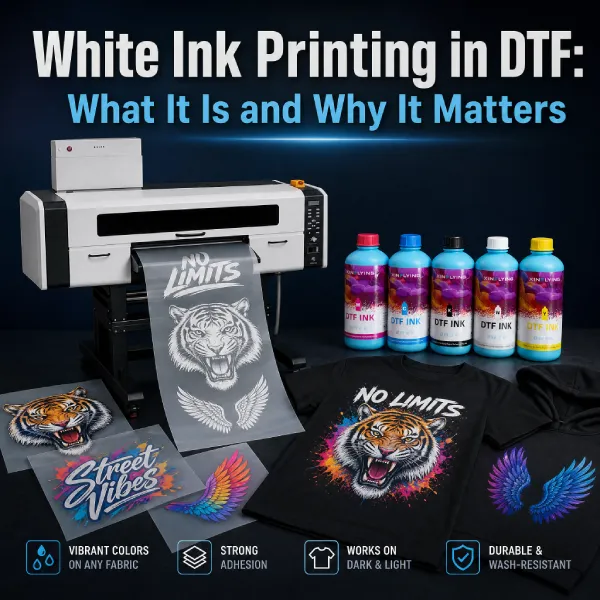
Standard CMYK printing has a blind spot: it can’t produce white. That single limitation is a big part of why DTF (Terus-ke-Filem) percetakan works the way it does — white ink is what lets a DTF transfer print in full color and still show up correctly on a black t-shirt, a navy hoodie, or any fabric that isn’t white.
What Is White Ink Printing?
White ink printing is the use of a dedicated white ink channel — separate from standard CMYK — to print opaque white directly onto a substrate. CMYK inks are transparent by design, which is exactly what lets cyan, magenta, kuning, and black mix together to form other colors. That same transparency means CMYK inks can’t cover a dark or colored surface; the base material always shows through. White ink solves this by being fully opaque, so it can sit underneath or alongside CMYK colors and give designs a solid, visible foundation on virtually any surface.
This wasn’t always possible. For a long time, white simply wasn’t part of the digital printing color spectrum — if you needed white on a dark surface, your only real options were physical methods like screen printing or vinyl. The introduction of dedicated white ink channels in digital printers changed that, opening up dark and colored substrates to the same full-color, photo-quality printing that was previously reserved for white or light-colored materials.
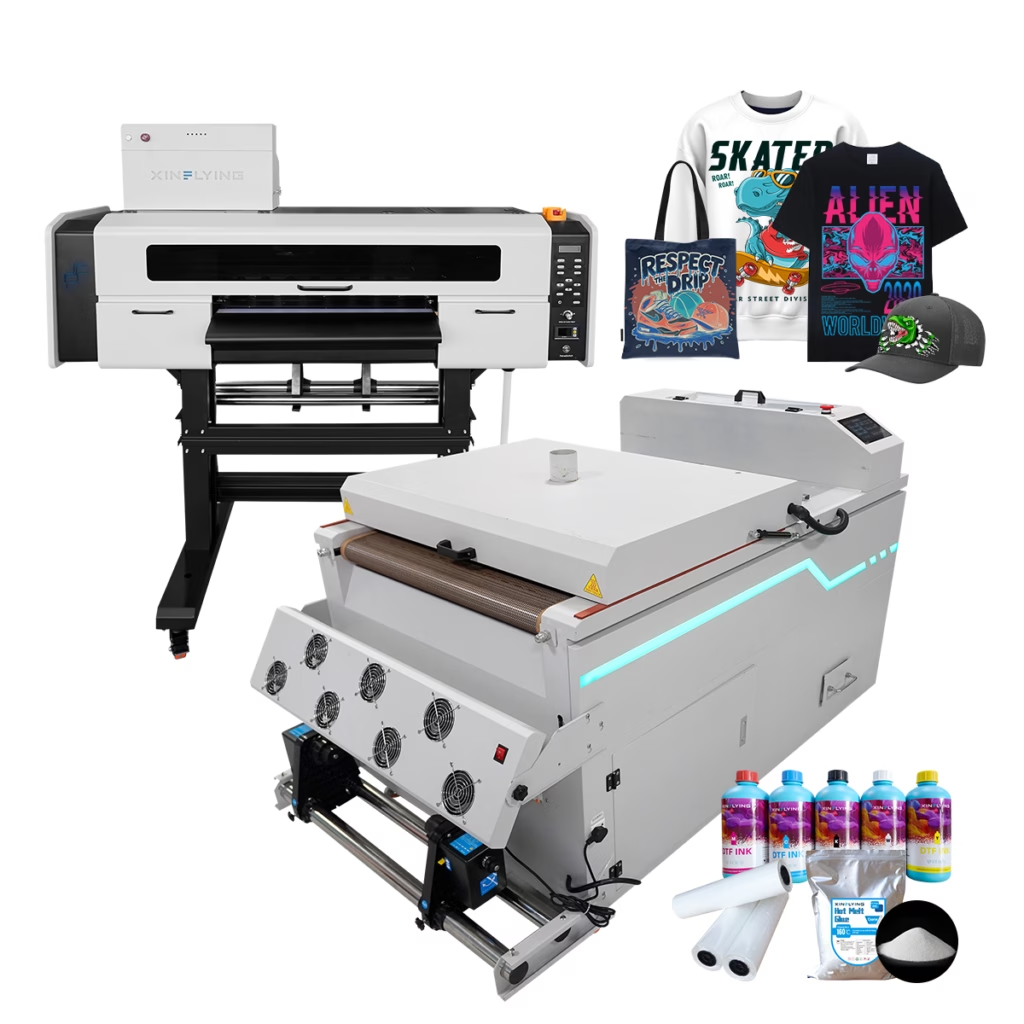
702E+Z650-2 24 "2PCS EPSON I3200-A1 Printheads DTF Printer
The 702E+Z650-2 24″ DTF printer with 2 Kepala cetak Epson i3200-A1 memberikan kelajuan tinggi, cetakan berkualiti tinggi untuk pelbagai bahan. Sesuai untuk pakaian tersuai, tekstil, dan barangan promosi dengan bersemangat, hasil yang tahan lama.
Why White Ink Matters
- It makes printing on dark or colored substrates possible in the first place — without it, colors printed on black fabric, dark film, or tinted acrylic would look faded or simply disappear.
- Used as an underbase beneath CMYK, white ink boosts color vibrancy and accuracy, since the colors printed on top of it aren’t being dulled by the material underneath.
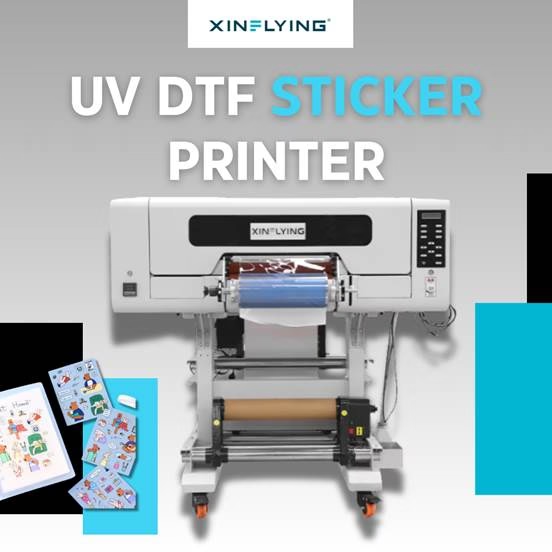
- On clear or transparent materials, a white base layer prevents designs from looking washed out or translucent, which matters for products like window graphics, clear labels, or UV DTF stickers.
- It expands what substrates a shop can realistically take on — dark garments, kraft packaging, colored acrylic, and metallic surfaces all become viable once white ink is part of the workflow.
How White Ink Works in Digital Printing
White ink typically prints as its own pass, either before, after, or between CMYK layers depending on the effect needed. RIP (Pemproses imej raster) software controls exactly where white ink is placed — a design file usually needs a separate white ink layer defined before printing, since the printer won’t automatically know which areas need a white base and which don’t.
- Underbase (most common): white is printed first, and CMYK colors print directly on top, boosting vibrancy on dark or colored materials.
- Spot white: white ink is applied only to specific areas of a design rather than the whole print, often used for text or accents on dark backgrounds.
- Flood white: the entire background is coated in white, typically used when the full design area needs a consistent, opaque base.
- Layered white: multiple passes of white ink build up opacity or even create a raised, textured effect — this technique is behind embossed-look prints and UV DTF 3D effects.
Why White Ink Is Central to DTF Printing
In DTF printing specifically, white ink isn’t an optional add-on — it’s a core part of what makes the process work at all. A DTF transfer is built in layers on film: white ink prints first as the underbase, then CMYK colors print directly on top of it. Without that white layer, the design would print with no opacity and effectively disappear once pressed onto anything other than a white garment.
- White ink is what allows a single DTF printer to handle black, Tentera Laut, dark green, or any other garment color without swapping equipment or processes.
- Because the white underbase is built into the filem itself, DTF transfers stay consistent and opaque even on heavily textured or dark synthetic fabrics that give other methods trouble.
- White ink density in DTF is usually adjustable in the RIP software, letting shops fine-tune opacity versus fabric feel — more white ink means better opacity but a slightly heavier hand-feel on the finished garment.
Note: white ink also exists in other digital printing methods like DTG dan Percetakan UV, where it plays a similar underbase role — but in those contexts it’s typically just referred to as “dakwat putih” rather than “percetakan dakwat putih” as its own category. In DTF, white ink is specifically what makes the transfer method function at all, which is why the two are so closely associated.
Common Challenges with White Ink (and How to Manage Them)
- Settling and clogging: white ink’s titanium dioxide particles settle faster than CMYK pigments, so printers need an active circulation or agitation system, along with regular nozzle checks, to avoid clogs.
- Higher cost per print: white ink is typically more expensive than CMYK and is used in larger volume as a solid underbase, so factor this into pricing for jobs on dark or colored fabric.
- File preparation: designs need a properly defined white ink layer before printing — skipping this step is one of the most common reasons DTF transfers come out looking dull or missing their underbase entirely.
- Consistency over time: white ink systems that sit idle for extended periods need to be re-agitated before use, since separation can happen even in printers with circulation systems if they’re powered off for days.
White Ink Printing vs. Other Ways to Print on Dark Fabric
White ink isn’t the only way to get a design onto dark or colored fabric, but it’s usually the most efficient one once you understand the alternatives and their tradeoffs.
- Vinyl cutting (HTV): works well for simple shapes and text, but struggles with photo-quality detail, kecerunan, or complex multi-color designs — each color typically means a separate layer to cut and weed.
- Screen printing with a white base: can achieve a similar underbase effect, but requires a dedicated screen and setup for the white layer alone, which adds cost and time that DTF’s digital white ink avoids for small or one-off runs.
- Pencetakan sublimasi: doesn’t use white ink at all and depends on the base fabric already being light-colored, since sublimation dye has no opacity of its own — this is why sublimation is limited to white or very light polyester.
- DTF with white ink: prints the underbase and color layers in the same digital pass, with no per-design setup cost and no fabric color restriction, which is why it’s become the default choice for shops handling varied, small-batch, or full-color apparel work.
Real-World Applications of White Ink in DTF
Because white ink is what makes a DTF transfer opaque and vibrant, it’s the deciding factor in what kinds of garments and orders a DTF shop can take on:
- Dark and colored apparel: hitam, Tentera Laut, heather grey, and other non-white t-shirts, hoodie, and hats — the single biggest reason white ink matters in DTF.
- Mixed fabric orders: since DTF transfers carry their own white underbase on the film, the same printer setup handles cotton, poliester, and blends without changing process.
- Full-color and photo-quality designs: gradients and detailed artwork stay accurate on dark fabric because the white underbase supports the CMYK layer evenly across the whole design.
- Gang sheets with mixed garment colors: a single gang sheet can include designs destined for both light and dark garments, since each design’s white ink layer is handled individually in the file.
What to Look for in a DTF Printer’s White Ink System
Not all white ink systems are built the same, and the difference matters once a printer is in daily use rather than sitting in a showroom. A few things are worth checking before choosing a DTF printer:
- Active circulation or agitation: look for a system that keeps white ink moving even when the printer is idle, rather than relying entirely on manual shaking before each session.
- Dedicated capping station: printheads that park in a sealed capping station when not printing stay primed longer and clog less often between jobs.
- White ink density control in the RIP software: the ability to adjust how much white ink is laid down (rather than a single fixed setting) gives more control over opacity, kos, and fabric hand-feel.
- Nozzle check accessibility: a printer that makes it quick and easy to run a nozzle check test encourages the habit of checking daily, which catches white ink clogs early before they show up in a full print run.
- Ink cost and consumption rate per print: white ink is used in higher volume than any single CMYK color as a solid underbase, so its price per liter has an outsized effect on your overall cost per DTF transfer.
Soalan yang sering ditanya
CMYK (cyan, magenta, kuning, hitam) inks are transparent, which is what allows them to layer and mix into other colors. White is opaque by nature, so it can’t be created by mixing transparent inks — a printer needs a dedicated white ink channel and formulation to produce it at all.
Not automatically — white ink capability depends on the specific printer model having a dedicated white ink channel, circulation system, and compatible RIP software. When shopping for a DTF printer, confirm white ink is included rather than assuming it comes standard on every model.
White ink is formulated with titanium dioxide particles, which are heavier and denser than standard color pigments. These particles settle out of suspension faster than CMYK ink, which is why white ink channels need active circulation or regular agitation to prevent clogging.
ya. Beyond serving as a base layer under CMYK colors, white ink can be used to create spot-white designs, layered textures, subtle watermark-style effects through opacity variation, and raised or embossed looks when combined with multiple passes or varnish.
White ink typically costs more than CMYK ink and is used in higher volume as a solid underbase layer, so it does add some per-print cost. Most businesses find this justified by the expanded range of substrates and improved print quality it enables, especially for dark or colored materials.
Because white ink settles faster, printers with white ink typically need daily agitation or circulation, along with more frequent nozzle checks, to keep the ink flowing evenly and prevent print quality issues like faint or streaky underbase coverage.
If most of your orders are already on white or very light materials, white ink is less critical day-to-day, but having it available still expands what orders you can accept — turning away dark-garment requests is a missed opportunity that a white-ink-capable printer avoids.
White ink itself is a flat, opaque white rather than metallic, but it’s often used as a base coat underneath specialty finishes like metallic or pearlescent overlays, since those finishes need a solid, neutral base to render accurately.
Related Resources
• Apakah Percetakan DTF? The Full Process Explained Step by Step
• A1, Pencetak DTF A2 dan A3, Yang mana untuk dipilih?
External reference — Benefits of Printing with White Ink (Mimaki USA)