The less expensive roll of DTF film is often the one that survives more wash cycles. That inversion surprises buyers who assume hot peel film, with its faster workflow and slightly higher price, must also be the more durable choice. In the hot peel vs cold peel decision, speed and wash fastness pull in opposite directions.
Both films print the same way. The difference lives in the release coating and in what happens in the seconds after you open the press. Here is the full picture before the detail:
| Wymiar | Folia na gorąco | Folia na zimno |
|---|---|---|
| Release timing | Seconds after opening the press | After full cooling to room temperature |
| Typical press window | 140–150 °C | 150–160 °C per film spec |
| Production rhythm | Naciskać, obierać, load the next garment | Naciskać, queue for cooling, then peel |
| Trwałość prania | Dobry | Generally higher |
| Fabric coverage | Broad | Broadest, including heat-sensitive materials |
| Relative cost | Slightly higher | Generally lower |
| Coating stability | Process-sensitive, demands tight QC | More stable across batches |
| Best fit | Speed-driven runs | Durability-driven orders |
One more framing before the detail: peel type decides the workflow around the press, not the print quality coming off the printer.
The same artwork, atrament, and powder produce near-identical images on both films at the moment of pressing. Where they separate is everything after — how fast the next garment loads, how many wash cycles the print survives, and which fabrics the release coating tolerates.
If you only remember one line from this comparison: buy the peel type your order book promises, press to the film’s spec sheet, and never let inventory decide.
What Hot Peel and Cold Peel Mean
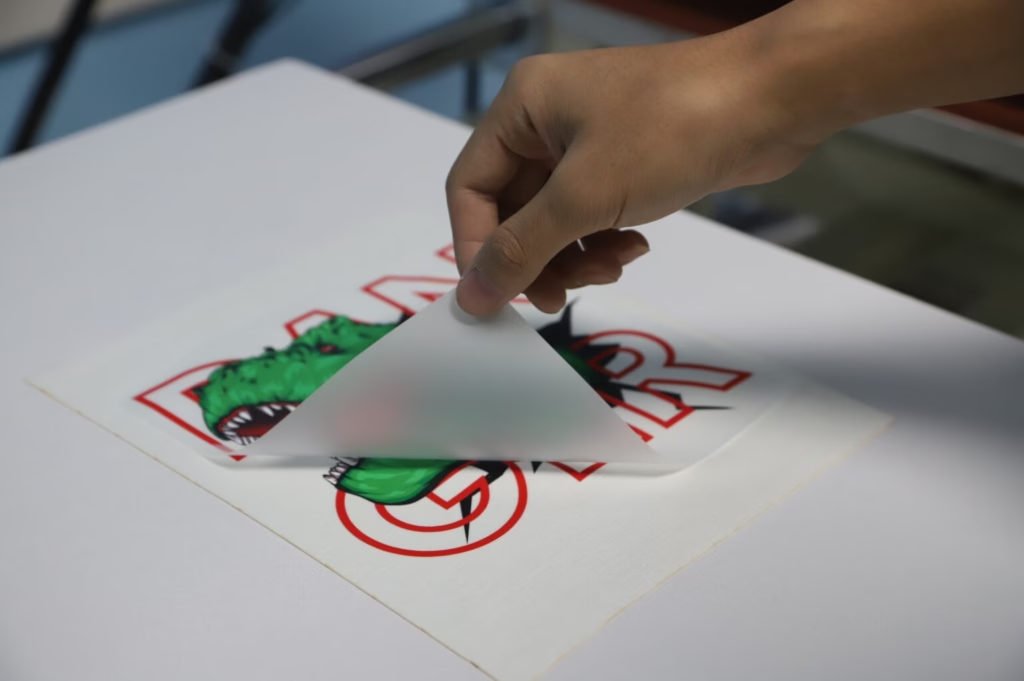
Peel timing is a film property, not an operator preference. Hot peel film is engineered to release while the transfer is still warm, you open the press and pull the film in one smooth, continuous motion within seconds. Cold peel film must cool to room temperature first; peeling it warm tears the ink layer off along with the film and leaves a partial print behind.
The failure mode is adhesive splitting at the wrong interface. Peeled too early, part of the ink and adhesive layer stays bonded to the film instead of the fabric, and the missing areas cannot be recovered by re-pressing. Left too long on hot peel film, the cooled coating grips harder and the pull turns jagged. Cooling time is not fixed either. Heavy ink coverage and thick garments hold heat longer, so a hoodie needs more patience than a single jersey tee before a cold peel.
Between the two sits a third label that keeps growing: instant peel. Marketed names vary by supplier, but the mechanics are the same family as hot peel — a release coating tuned to let go almost immediately, sometimes even sooner than traditional hot peel formulations. Treat instant peel as a faster cousin of hot peel, not a separate technology.
Get the timing wrong in either direction and the failure is immediate and visible. That is why film type belongs on the press card next to temperature and dwell, and why shops that run both films label their rolls the day they arrive. The full printing workflow around the press is covered in the DTF printing process guide.
Buying film for a production line? XINLOTANIE manufactures both hot peel and cold peel PET film in the same factory that builds the printers, atramenty, and powders they run with. Browse the DTF film category and request samples matched to your fabrics.
The Coating Difference Behind Timing
The timing rule comes from the release layer, the coating between the PET base and the printed ink. Industry formulations split along one line: hot peel release layers are predominantly wax-based, while cold peel layers are predominantly silicone-based. That single chemistry choice drives most of the differences in the table above.
Silicone melts and distributes more predictably during coating, which is why cold peel film tends to be the more stable product across batches and suppliers. Wax is harder to lay down evenly and pushes the coating process tighter — when a hot peel roll underperforms, uneven release coating is the usual suspect. The practical consequence shows up in fine detail: hot peel film historically absorbs ink slightly less aggressively, so very small lettering and thin strokes carry a bit more lift risk.
None of this makes either film “better.” A DTF PET film is a layered product — base, release, adhesive, druk, protective, and antistatic layers — and suppliers tune each stack for its intended peel behavior. What it does mean is that batch consistency matters more on the hot peel side, which is an argument for buying both types from a film maker with in-house coating QC rather than whichever roll carries the lowest sticker price that week.
Two adjacent specs confuse buyers more than they should. Single-sided and double-sided film describes which faces accept ink, not how the film peels, both constructions come in hot and cold peel versions. Grubość, commonly 75 μm on quality rolls, affects feeding flatness and curl more than release behavior. Match those specs to your printer first, then choose peel type on the order book, and the purchasing decision stays clean.
Press Settings for Each Film Type

Film type shifts the press recipe in two of three variables. Hot peel coatings release at a lower temperature window, while cold peel films generally want the standard range and simply add a cooling step. Start from these bands, then defer to your film supplier’s spec sheet:
| Film Type | Temperatura | Dwell | Peel Action |
|---|---|---|---|
| Hot peel | 140–150 °C (284–302 °F) | 10–15 s | Peel warm, one continuous motion |
| Cold peel | 150–160 °C (300–320 °F) | 10–15 s | Wait until fully cool, then peel |
| Instant peel | Per supplier spec | Per supplier spec | Release within seconds of opening |
Whatever the film, the three-variable logic — temperature, dwell, pressure — does not change. The complete fabric-by-fabric starting points, pressure calibration, and the second press are laid out in the DTF transfer temperature and time guide, and they apply to both films on any press you run, from a compact shop machine to an A2 dual-head DTF printer feeding a production queue.
Two habits keep either film performing to spec. Store rolls sealed and flat — PET film absorbs ambient humidity, and a damp edge misfeeds or streaks on the first prints of the day. And keep the second press in the routine for both film types: flattening the adhesive after peeling lifts wash results regardless of release chemistry. A rolled edge stored upright for weeks also develops a curl that no press setting fixes.
The Throughput and Wash Fastness Trade

Run the arithmetic of a cooling wait. A cold peel garment needs minutes at room temperature before anyone touches the film. Count it through on one station: a 12-second press plus 60–90 seconds of cooling means each piece occupies the machine or the rack for well over a minute; hot peel returns the station to loading in seconds. Multiply that across a 300-piece team order and the cooling queue becomes furniture.
For event work, same-day fulfillment, and large-format jobs where the film itself cools slowly, the gap compounds into hours of shop time. It is the difference between quoting two days and quoting one.
Cold peel buys durability with those same minutes. The slower release gives the adhesive layer a fuller set, which is a large part of why cold peel prints generally lead on wash fastness and hold their edge quality through more cycles — the property that matters when a retail brand customer evaluates your work after twenty washes.
Cold peel also extends to the widest fabric range, including materials that dislike aggressive heat, and it usually costs less per roll.
Verify durability claims instead of collecting them. A film supplier worth ordering from can show wash test data — cycles run, water temperature, detergent, and drying method — for the exact film you are buying, not a best-case sister product.
If the answer to a request for the wash test report is a marketing chart, that silence is a purchasing signal in itself, and worth repeating at every batch change.
So pick by order book, not by roll price. When the promise is “ready tomorrow,” hot peel wins the day. When the promise is “this print outlasts the shirt,” cold peel does. For wash-failure causes that trace back further than film choice, the DTF washing instructions guide maps each symptom to its origin.
How to Tell Which Film You Have

Rolls lose their labels, suppliers merge SKUs, and inventory corners hide mystery film. Before you risk a production run on a guess, three checks settle it:
- Read the spec sheet. Every named film — xTool, Ninja Transfers, Jiffy, or any factory brand — publishes its peel type. If your supplier cannot answer in one email, that silence is your answer about the supplier.
- Run a two-timing test. Press two identical small logos on scrap garments. Peel one warm and one after full cooling. The warm pull that comes clean identifies hot peel film; a torn or partial warm pull identifies cold peel.
- Feel the release side. Cold peel coatings tend to feel slightly slicker to the touch. This is a weak signal on its own — use it only to decide which film to test first, never as the final word.
Run the test on the actual garment fabric, not on a scrap tee of unknown origin — fabric finish changes release behavior enough to flip a verdict. A clean warm pull with sharp edges confirms hot peel film. A warm pull that takes ink with it, leaves adhesive spots on the film, or delivers a partial image confirms cold peel and tells you the batch needs the cooling rack. Ten minutes of testing protects a 200-piece order from a single wrong assumption.
Which Film Fits Which Production Line

Most shops should not run both films at once — mixed inventory is how the wrong film ends up on the wrong press at 4 p.m. Standardize on one, keep the other as a deliberate exception:
| Shop Profile | Standardize On | Why It Wins |
|---|---|---|
| Event and same-day fulfillment | Hot peel | No cooling queue; one-operator continuous pressing |
| Brand and retail contract work | Cold peel | Higher wash fastness holds through customer laundering |
| Heat-sensitive and technical fabrics | Cold peel | Lower-temperature release and broadest fabric coverage |
| Cost-driven high volume | Cold peel | Generally lower roll cost at equal print quality |
| Mixed order book | Cold peel default | Durability failures cost more than slower cycle times |
The one verdict that holds across every profile: never let film type be an accident of what was in stock. Film choice is a purchasing decision with production consequences, and it deserves the same scrutiny as the printer it feeds — revisited whenever the order mix shifts. For a deeper comparison of specific film products, the best DTF film roundup looks at what separates premium rolls from commodity ones.
Switching a line from one film to the other is a re-validation exercise, not a swap. Update the press card, re-run the two-timing test on current inventory, run a ten-piece validation batch at full production settings, and check the results after a wash cycle before the new film goes live on customer work. Shops that skip the validation batch are the ones who discover a peel-timing mismatch on the order that mattered.
Wniosek
Hot peel and cold peel films differ in release coating, not in print quality. Wax-based hot peel coatings release warm for maximum throughput; silicone-based cold peel coatings release cool for maximum wash fastness, wider fabric coverage, and lower roll cost.
- Speed-critical runs: gorąca skórka, peeled in one continuous motion seconds after the press opens.
- Durability-critical orders: cold peel, fully cooled before peeling, generally the wash-fastness leader.
- Instant peel is a faster cousin of hot peel, not a third technology.
- Identify mystery film with a spec sheet check and a two-timing test — never a guess.
- Ask any film supplier for batch-level wash test data before committing a production line.
XINLOTANIE manufactures both film types alongside its DTF printers, atramenty, and powders, so the release coating, adhesive, and consumable chain are tuned as one system. Request film samples matched to your fabric list and order mix before you standardize your line.
Hot Peel vs Cold Peel FAQ
Check the supplier’s spec sheet first. If the label is gone, press two identical test logos and peel one warm and one fully cooled — the clean warm pull identifies hot peel film, while a torn warm pull identifies cold peel.
xTool publishes peel type per product in its spec sheets, and formulations change between batches. Confirm against the current product documentation or ask their support directly before running production.
Ninja Transfers specifies peel behavior in its application instructions for each transfer product. Follow the sheet that ships with your order — application timing differs between their product lines.
Cold peel film generally delivers higher wash fastness, because the full cooling period lets the adhesive set completely. Hot peel prints still wash well, but cold peel leads when durability is the deciding requirement.
Instant peel is a hot peel variant with a release coating tuned to let go almost immediately after pressing. Mechanically it belongs to the hot peel family, not a separate film technology.