
In today’s fast-growing customization and digital printing market, efficiency and print versatility have become critical for business production environments. As a global digital printing supplier, Xinflying provides advanced solutions across DTF, УФ ДТФ, ДТГ, and sublimation technologies to meet evolving industrial demands. Among these innovations, в УФ-DTF-принтер has become one of the most practical tools for producing high-adhesion, high-detail decals and labels on a wide range of surfaces.
Однако, achieving stable output and scalable production requires more than just equipment. Proper workflow design, material selection, and machine configuration are essential to fully unlock the potential of UV DTF printers. В этой статье, we share how businesses can effectively use and implement UV DTF technology for consistent, high-quality production results.
Understanding UV DTF Printer Technology in Modern Production
A UV DTF printer works by printing UV-cured ink onto a transfer film, which is then laminated and applied to various substrates without the need for direct surface printing. This method expands application possibilities beyond flat materials, making it ideal for glass, металл, пластик, и поверхности с покрытием.
For business manufacturers, this technology significantly reduces production limitations while increasing customization flexibility. Compared with traditional labeling or screen printing methods, UV DTF solutions offer faster setup, lower labor dependency, and improved design precision.
When implementing UV DTF printers, companies must prioritize stability in ink curing, film adhesion, and environmental control to ensure consistent output quality.
Key Workflow Optimization for UV DTF Printers
Efficient production with УФ DTF принтеры depends heavily on a streamlined workflow. The standard process includes printing, lamination, film transfer, and final application. Each stage must be optimized to prevent quality loss and production delays.
Первый, print accuracy must be ensured through proper calibration of printheads and color profiles. Second, lamination pressure and roller temperature must remain consistent to avoid bubbles or uneven adhesion. Окончательно, the transfer process requires stable handling conditions to maintain graphic integrity.
For industrial users, workflow automation can significantly reduce manual intervention, improving both productivity and output consistency in large-scale operations.
XF-420S Integrated Solution for UV DTF Printer Applications
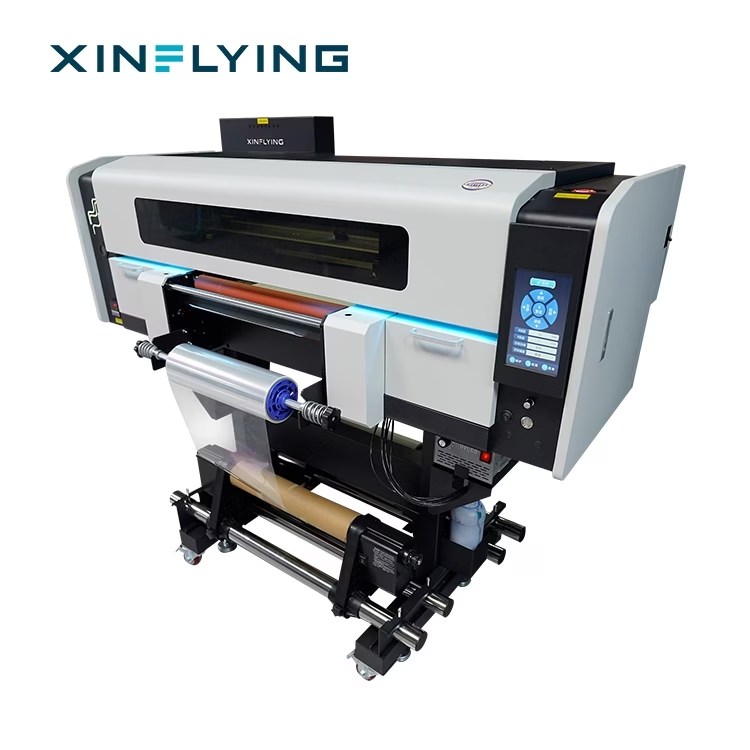
To support multi-functional production needs, we developed the XF-420S i1600-U1 integrated printer system. This model combines 3D embroidery capabilities with UV DTF printing functions, offering a flexible solution for textile and customized product manufacturers.
The XF-420S is equipped with 4 Печатающие головки Epson i1600-U1, delivering high-resolution and vibrant output. It supports a compact 420mm printing width, making it suitable for labels, наклейки, and precision custom designs.
Its integrated lamination system uses a high-adhesion rubber roller to ensure strong bonding and a glossy finish. Combined with Hoson control board stability, the system ensures long-term operational reliability for continuous production environments.
Кроме того, the XF-420S includes a 7-inch touchscreen, автоматическая система снятия пленки, вакуумная всасывающая платформа, защита печатающей головки от столкновений, УФ-лампы для отверждения с воздушным охлаждением, and intelligent base plate heating. These features improve automation while reducing operator workload.
Material Selection and Maintenance for UV DTF Printers
Material quality plays a decisive role in the final output of UV DTF printers. High-quality PET films, UV inks, and adhesives ensure better color reproduction, долговечность, and adhesion performance.
Businesses should prioritize compatible consumables recommended by equipment manufacturers to avoid issues such as ink bleeding or weak transfer adhesion. Regular inspection of film tension, ink flow systems, and curing lamps also helps maintain consistent production quality.
From a maintenance perspective, printhead cleaning schedules and UV lamp performance checks should be integrated into daily operational procedures. This reduces downtime and extends machine lifespan in high-volume production environments.
Scaling Production with UV DTF Printing Technology
As demand for customized products continues to rise, scalability becomes a key consideration for manufacturers using UV DTF printers. Efficient scaling requires not only multiple machines but also standardized workflows and trained operators.
Centralized production control systems can help synchronize multiple UV DTF units, ensuring consistent output quality across batches. This is especially important for businesses serving promotional product industries, packaging customization, and branded merchandise markets.
By adopting integrated systems like XF-420S, companies can reduce process fragmentation and improve production efficiency while maintaining high design accuracy.
Implementation Strategy for бизнес Manufacturers
For business enterprises, implementing UV DTF printers should begin with application assessment. Businesses must identify target products, surface materials, and production volume requirements before selecting equipment configurations.
Следующий, operator training is essential to ensure proper handling of lamination systems, UV curing units, and file preparation workflows. A structured onboarding process helps reduce operational errors and material waste.
Окончательно, businesses should establish quality control checkpoints at each production stage to ensure consistency and meet customer expectations in large-scale delivery scenarios.
Заключение: Building Competitive Advantage with UV DTF Printing
The adoption of UV DTF printer technology offers manufacturers a powerful opportunity to expand customization capabilities and improve production efficiency. When properly implemented, UV DTF printers enable businesses to achieve high-quality output across diverse materials while maintaining cost efficiency and operational stability.
В Синьфлайинге, we continue to develop advanced printing solutions like the XF-420S to support global manufacturers in scaling their customization capabilities. By combining integrated hardware systems, intelligent automation, and reliable consumables, businesses can build a more competitive and sustainable production model in the evolving digital printing industry.