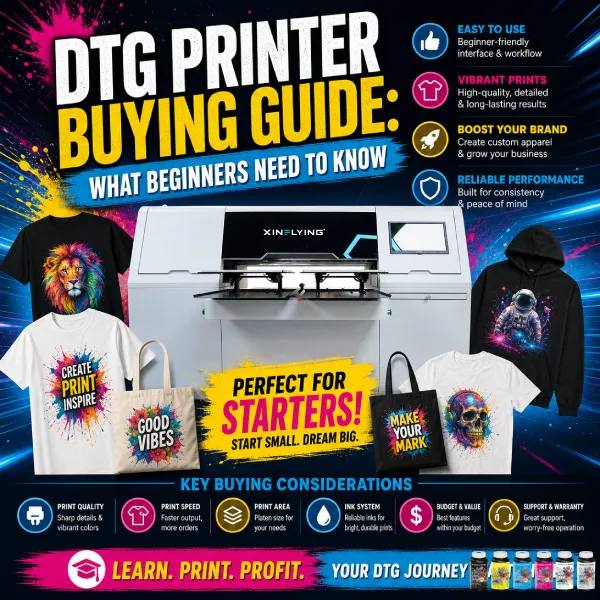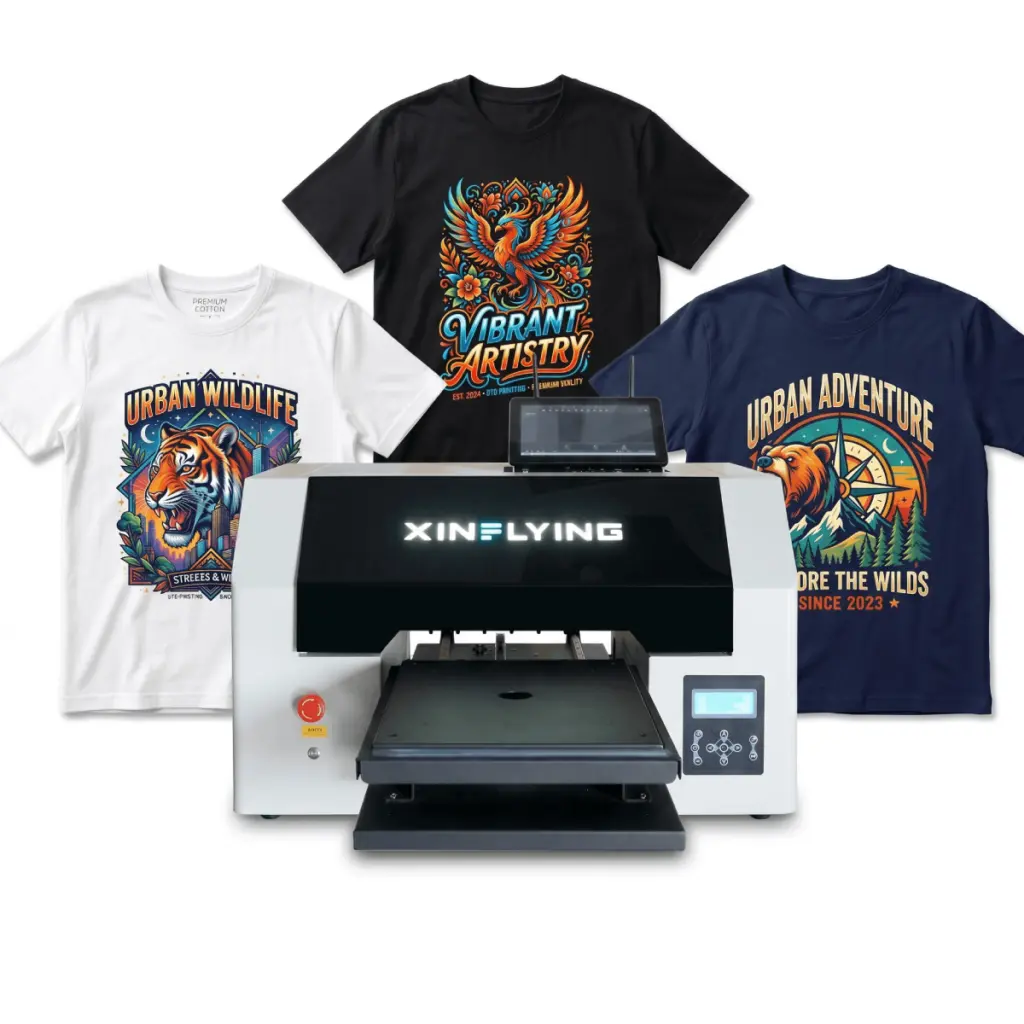
UN Appareil DTG (abréviation de Direct-to-Garment) est une imprimante spécialisée qui applique des motifs en couleur directement sur le tissu, utilisant le même principe de base qu'une imprimante à jet d'encre, sauf à la place du papier, la "page" est un t-shirt, sweatshirt à capuche, ou sac fourre-tout chargé sur un plateau plat appelé plateau.
Si vous vous êtes déjà demandé comment les boutiques de t-shirts personnalisés produisent des singles, des conceptions uniques avec des détails de qualité photo et sans minimum de commande, une machine DTG est presque toujours la réponse. Ce guide explique comment fonctionne réellement la machine, ce que ça coûte, et comment cela se compare aux autres méthodes d'impression courantes.
Comment fonctionne une machine DTG
Une machine DTG suit trois étapes principales à chaque fois qu'elle imprime un vêtement:
1. Prétraitement
Avant l'impression, le vêtement - particulièrement sombre ou 100% tissu en coton — est enduit d'une solution de prétraitement. Cette étape est essentielle lors de l'utilisation de l'encre blanche, car il maintient l'encre au-dessus des fibres au lieu de pénétrer et de disparaître. Le prétraitement peut être appliqué avec un pulvérisateur portatif ou une machine de prétraitement automatisée pour les ateliers à volume plus élevé.. Les t-shirts blancs qui ne nécessitent pas d’encre blanche peuvent souvent ignorer complètement cette étape.

2. Impression
Le vêtement est chargé à plat sur le plateau, et la conception - préparée dans RIP (Traitement des images raster) logiciel — est envoyé à l’imprimante. La machine dépose d'abord une couche d'encre blanche comme base (si nécessaire), imprime ensuite le motif en couleur directement sur le dessus à l'aide d'encres textiles spécialisées à base d'eau. Le temps d'impression est généralement compris entre 2 et 5 minutes par vêtement, en fonction de la complexité et de la taille de la conception.
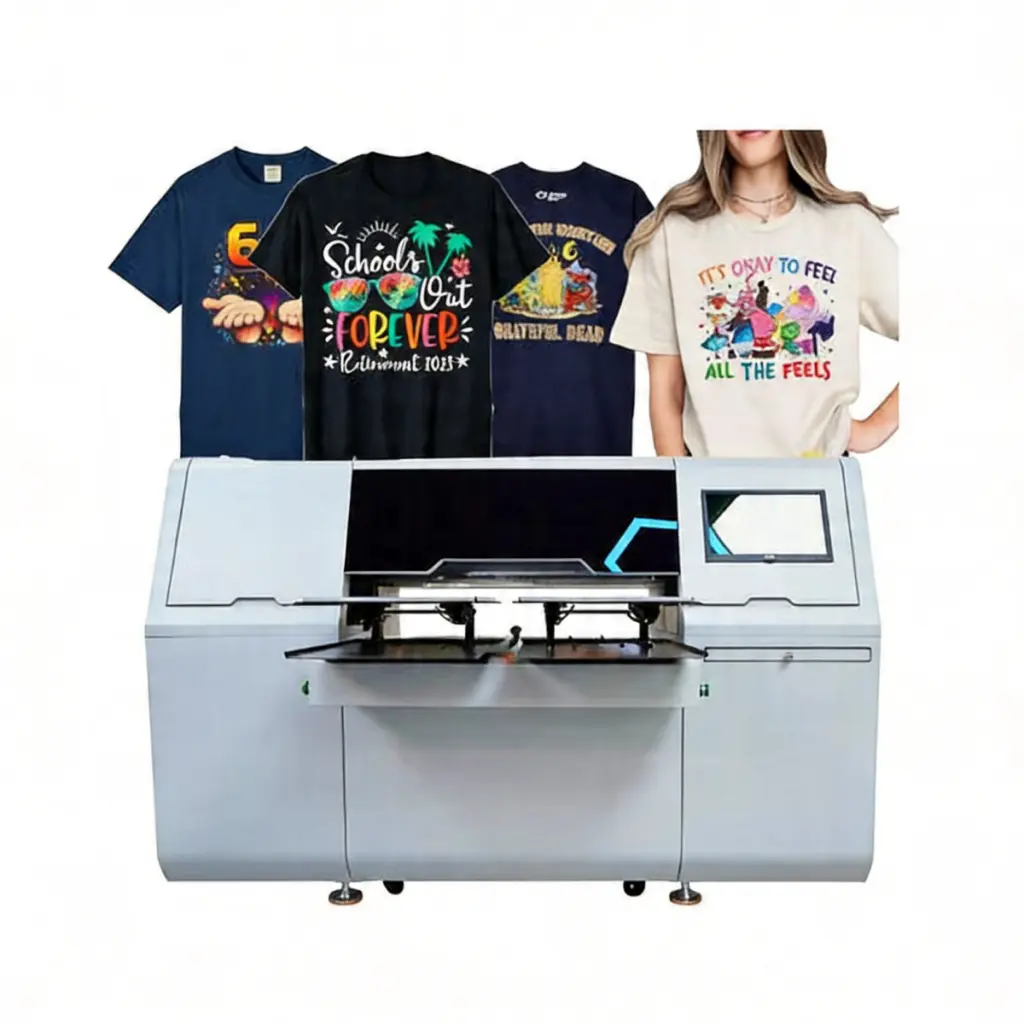
3. Guérison
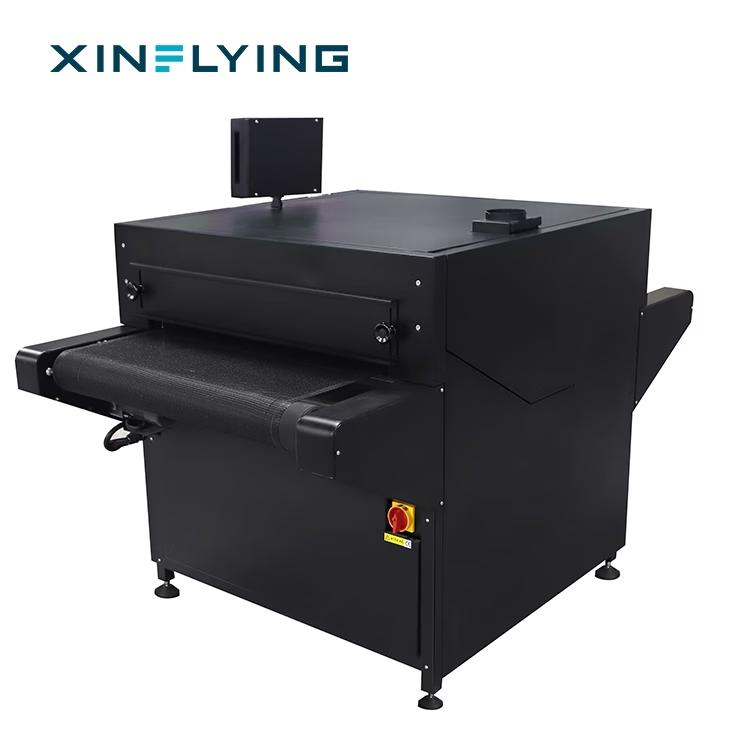
Une fois imprimé, l'encre doit être durcie à la chaleur - généralement à l'aide d'une presse à chaud ou d'un séchoir à convoyeur - pour la lier de manière permanente aux fibres du tissu. Cette étape prend généralement environ 60 secondes et c'est ce qui donne aux impressions DTG leur durabilité, empêchant le design de se fissurer ou de se laver.
Quels matériaux fonctionnent avec une machine DTG?
Les machines DTG fonctionnent mieux sur les fibres naturelles, le coton étant la référence. La compatibilité générale se décompose comme suit:
- 100% coton – substrat idéal, produit les impressions les plus douces et les plus durables
- Mélanges coton-polyester — généralement compatibles, bien qu'une teneur très élevée en polyester puisse affecter l'absorption de l'encre
- 100% polyester — possible avec des encres spécialisées, mais les résultats sont moins cohérents que sur le coton
- Vêtements sombres et clairs – les deux fonctionnent, mais les vêtements sombres nécessitent un prétraitement et une couche de base à l'encre blanche
DTG contre. Autres méthodes d'impression
Le DTG est l'une des nombreuses façons d'apposer un motif sur un vêtement.. Voici comment cela se compare aux autres méthodes principales:
| Méthode | Idéal pour | Coût d'installation | Compatibilité des tissus | Durabilité |
| DTG | Petits lots, dessins en couleur/photo | Aucun coût d'installation par conception | Coton (meilleur), mélanges | Élevé – sensation de douceur au toucher, pas de fissure |
| Impression d'écran | Grands lots, 1–4 modèles de couleurs | Élevé – nouvel écran par couleur | Coton, mélanges, polyester | Élevé : norme industrielle en matière de durabilité |
| Sublimation | Produits en polyester, tasses, panneaux | Faible coût par conception | Polyester / revêtement polymère uniquement | Très élevé : le colorant fait partie de la fibre |
| DTF (Direct-to-Film) | Types de tissus mixtes, lots petits à moyens | Faible coût par conception | Coton, polyester, mélanges, nylon | Haut - 40+ cycles de lavage typiques |
| Vinyle de transfert de chaleur | Conceptions simples, noms/numéros | Faible – coupe-vinyle uniquement | Coton, mélanges | Moyen – peut se fissurer avec le temps |
La version courte: choisissez DTG lorsque vous avez besoin de détails en couleur sur de petites commandes de vêtements en coton. Choisissez la sérigraphie pour les grosses commandes groupées de designs simples. Choisissez la sublimation ou le DTF lorsqu'il s'agit de polyester ou de tissus mixtes.
Combien coûte une machine DTG?
Le prix des machines DTG varie considérablement en fonction de l’échelle de production:
- Niveau d'entrée / imprimantes DTG de bureau: environ 3 000 à 8 000 dollars – adapté aux petites entreprises et aux startups testant des modèles d'impression à la demande
- Imprimantes DTG commerciales de milieu de gamme: environ 10 000 $ à 25 000 $ – des vitesses d'impression plus rapides, assiettes plus grandes, options à double plateau pour une production continue
- Systèmes DTG industriels: $30,000+ — souvent associé à un prétraitement automatisé et à un durcissement sur convoyeur pour les opérations à volume élevé
Au-delà de la machine elle-même, les coûts permanents incluent l'encre, solution de prétraitement, plateaux pour différentes tailles de vêtements, et entretien de routine tel que le nettoyage des têtes d'impression.
Une machine DTG est-elle difficile à utiliser?
Utiliser une machine DTG est relativement simple une fois que vous comprenez le flux de travail de base, mais en obtenant une cohérence, les résultats professionnels demandent de la pratique. Les défis courants pour les débutants incluent:
- Un prétraitement approprié du tissu : trop ou pas assez d'encre blanche affecte la qualité de sa tenue sur le tissu.
- Calibrage des paramètres d'impression : différents tissus et motifs nécessitent différents paramètres de densité d'encre et de résolution.
- Entretien des têtes d'impression — Les encres DTG peuvent obstruer les buses si la machine n'est pas utilisée ou nettoyée régulièrement
- Correspondance des couleurs : pour que les couleurs à l'écran correspondent au résultat final imprimé, il faut calibrer le profil de couleur.
La plupart des opérateurs se familiarisent avec les bases dès les premières douzaines d'impressions., bien que l'affinage du contrôle qualité soit un processus continu.
Qui utilise les machines DTG?
La technologie DTG est utilisée dans un large éventail de types d'entreprises:
- Entreprises d'impression à la demande – réalisant des tâches uniques, commandes personnalisées au fur et à mesure de leur arrivée sans détenir de stock
- Ateliers de sérigraphie – acceptant des petits travaux ou des travaux urgents qui ne seraient pas rentables avec les sérigraphies traditionnelles
- Entreprises de produits promotionnels – produisant des produits de marque en petites quantités variables
- Détaillants et marchés en ligne : les grandes plates-formes utilisent des flottes d'imprimantes DTG pour traiter les commandes personnalisées à grande échelle
Questions fréquemment posées
Une machine DTG peut-elle imprimer sur du polyester?
Oui, mais avec des réserves. Les encres DTG standard sont optimisées pour le coton, et les résultats sur 100% le polyester peut être moins éclatant ou sujet à la migration des colorants (où les colorants polyester s'infiltrent dans l'impression au fil du temps, surtout sous la chaleur). Certaines formulations d'encre spécialisées résolvent ce problème, mais le coton et les mélanges de coton restent le substrat le plus fiable.
Combien de temps durent les impressions DTG?
Avec un durcissement approprié, Les impressions DTG résistent généralement 50+ cycles de lavage sans fissures significatives, peeling, ou décoloration, à condition que le vêtement soit lavé à l’envers à l’eau froide et ne soit pas exposé à un séchage à haute température.
Le DTG est-il moins cher que la sérigraphie?
Cela dépend de la taille de la commande. DTG n'a aucun coût d'installation par conception, ce qui le rend moins cher pour les petites commandes (1–20 pièces). La sérigraphie devient plus rentable à mesure que le volume des commandes augmente, puisque le coût initial de l'écran est réparti sur plusieurs unités.
Ai-je besoin d'un logiciel spécial pour une machine DTG?
Oui. Les machines DTG nécessitent RIP (Traitement des images raster) un logiciel pour convertir vos illustrations dans un format que l'imprimante peut lire, contrôler la densité de l'encre, et gérer la séparation des couleurs pour les couches de base d'encre blanche. La plupart des fabricants de DTG incluent le logiciel RIP avec la machine.
Choisir la bonne machine DTG
Si vous évaluez des machines DTG pour votre entreprise, le bon choix dépend du volume de commande attendu, types de vêtements, et budget. La gamme d'imprimantes DTG de Xinflying couvre les options allant des modèles de bureau d'entrée de gamme aux systèmes commerciaux à volume plus élevé. Vous pouvez comparer les modèles et spécifications actuels sur notre page d'imprimante DTG..