
ที่ซินฟลายอิ้ง, we have spent years at the forefront of the digital printing industry, supplying printing machines and consumables to businesses across the globe. Recently, we have noticed a growing number of customers asking about multi-color หมึกยูวี management specifically for 3D printing scenarios. Unlike traditional flatbed or roll-to-roll printing, 3D applications introduce unique challenges: variable layer heights, curved surfaces, and the need for instantaneous curing between thin deposits. Through extensive testing with our UV curing ink formulations, we have developed practical strategies for maintaining color accuracy, adhesion, and throughput. Let us share what we have learned.
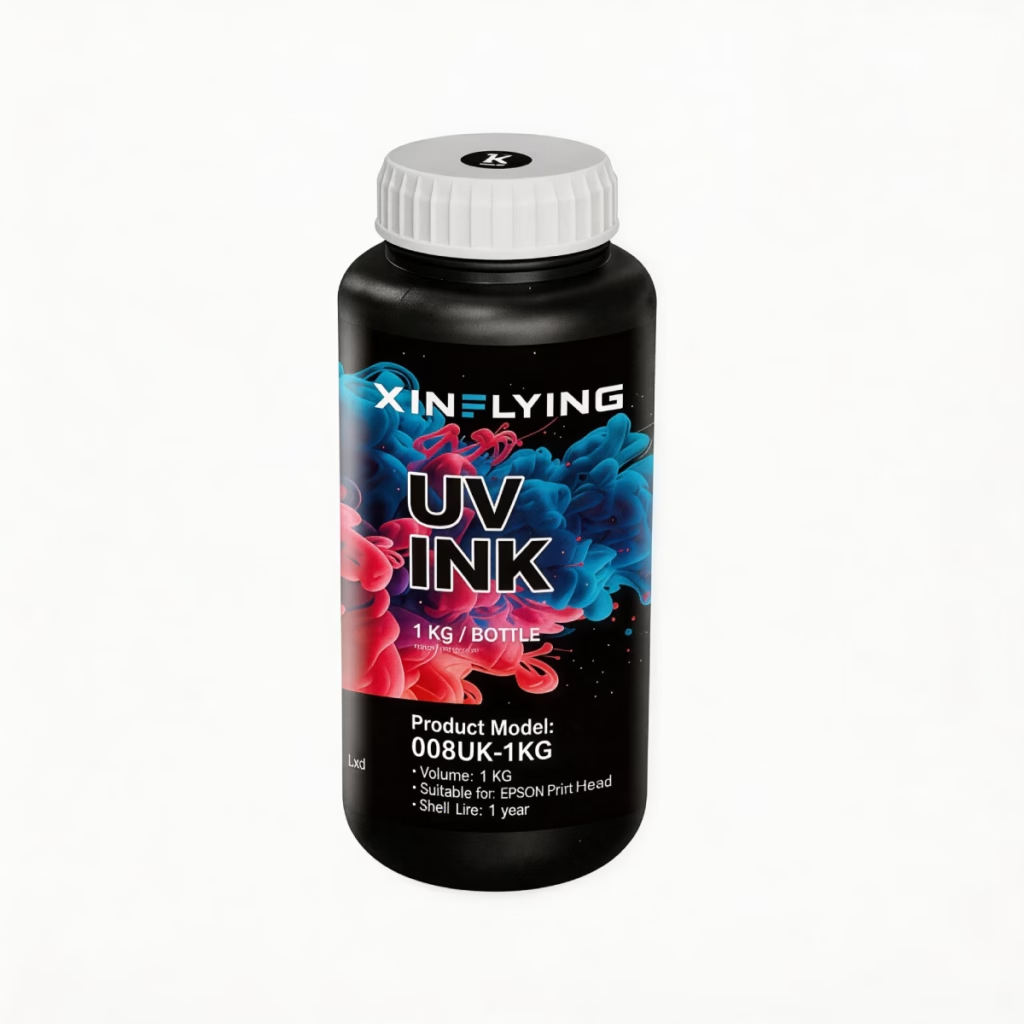
Understanding How UV Ink Behaves on 3D-Printed Surfaces
To produce high-value 3D tactile effects, industrial print shops utilize sequential white-ink layers to build physical thickness before applying the colored CMYK and varnish layers. In these heavy-deposit multi-color scenarios, the UV ink chemistry must allow precise interlayer cross-linking. If the curing speed or lamp intensity is miscalibrated, the dense white ink foundation will remain soft underneath, causing the top color layer to wrinkle, bleed, or lose its pristine alignment. Xinflying’s CMYK and high-density whiteUV curing ink sets are engineered to balance this thorough curing depth with precise color reproduction, preventing interlayer bleeding even during maximum-thickness 3D embossed production.
Matching Ink Chemistry to Your Print Head and Workflow
Not all UV ink flows the same way through industrial print heads. We have formulated our professional UV printer ink specifically for stable performance with industrial heads, ensuring smooth ink flow, การยึดเกาะที่แข็งแกร่ง, และคุณภาพการพิมพ์ที่สม่ำเสมอสำหรับเครื่องพิมพ์ UV Flatbed และระบบการพิมพ์ UV DTF. When adapting to 3D printing scenarios, we advise customers to pay close attention to ink viscosity at the operating temperature. Multi-color jobs require frequent head cleaning cycles if the UV curing ink sits idle between color passes. Our solution: integrate automated head wiping and capping routines into your 3D printing workflow. นอกจากนี้, store UV ink cartridges away from direct sunlight and shake them gently before installation to maintain pigment suspension.
Color Management Across Curved and Irregular Geometries
When replicating complex multi-color patterns onto irregular or highly curved items (such as custom tumblers or helmets), directly printing with a flatbed carriage risks scattering due to excessive nozzle-to-substrate distance. To solve this limitation, we recommend utilizing the UV DTF (ตรงสู่ภาพยนตร์) transfer workflow. By printing the multi-layer, high-definition graphics onto a specialized carrier film first, studios can seamlessly wrap and transfer the complete multi-color design onto complex geometries. For operators executing direct micro-curved printing, reducing print speed by 15 ถึง 20 percent and optimizing the curing lamp distance ensures the ink wets out properly without dripping or pooling on vertical faces, keeping registration immaculate.
Mastering Multi-Color UV for 3D Success
Managing multi-color UV ink in 3D printing scenarios requires attention to surface preparation, print head compatibility, and motion control. ที่ซินฟลายอิ้ง, our UV curing ink formulations are engineered for fast curing, การยึดเกาะที่แข็งแกร่ง, and vibrant CMYK results across challenging substrates. Whether you are printing decorative textures onto 3D-printed prototypes or adding full-color graphics to finished parts, the right UV ink management strategy makes the difference between a reject and a masterpiece. Let us help you dial in your process for reliable, repeatable multi-color results.