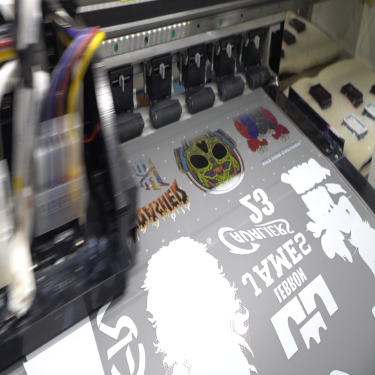
DTF (Directo a la película) impresión has become one of the fastest-growing technologies in custom apparel production. No se requiere pretratamiento de la tela, compatible with virtually any material, minimum order of just one piece — this guide walks you through everything you need to know, from the science behind DTF to how it fits your business model.
40+:Standard wash cycles without fading (premium inks)
1 pc:Minimum order — zero inventory pressure
90%:Of fabric types can be printed on
01. ¿Qué es la impresión DTF??
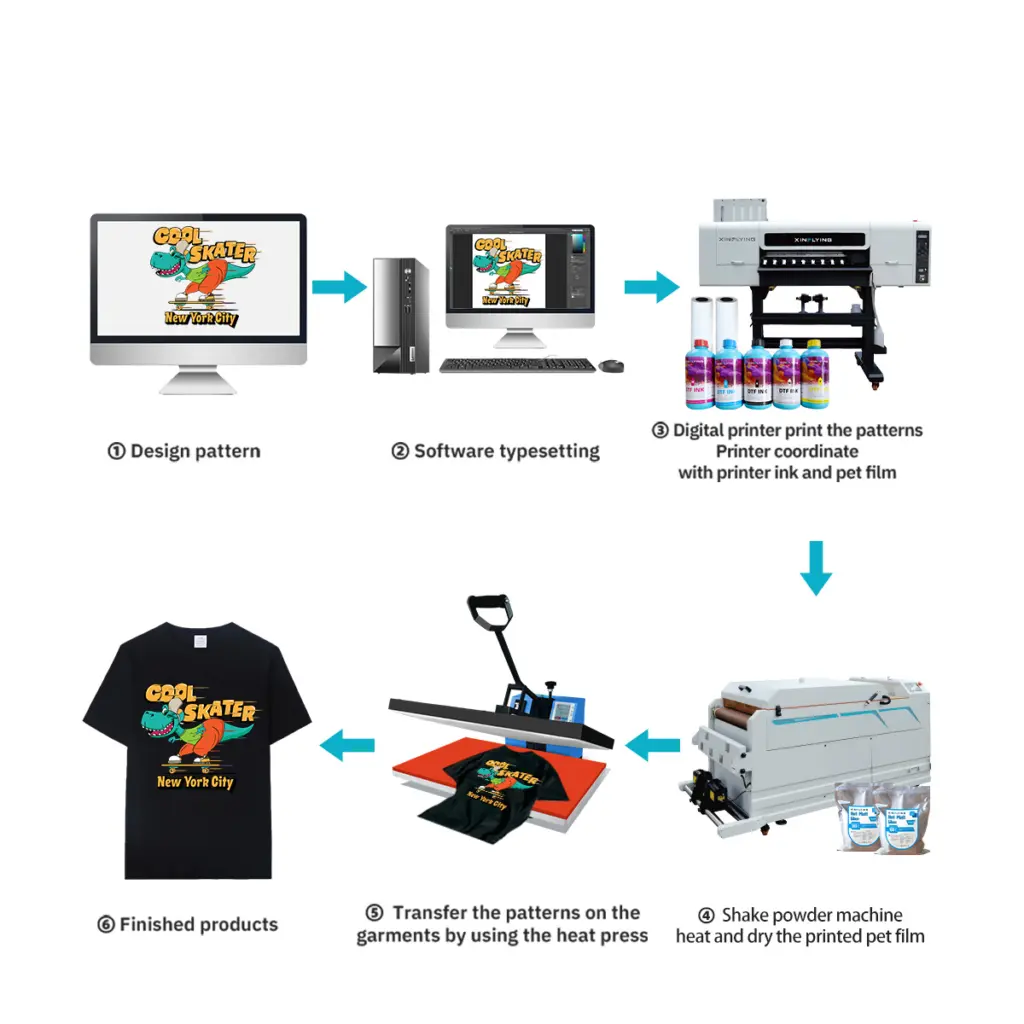
DTF stands forDirecto a la película. The technology works by printing a full-color design (including a white ink base layer) onto a special PET (poliéster) película, coating it with hot-melt adhesive powder, curing the powder in an oven, and then heat-pressing the entire transfer onto the final garment or substrate.
Unlike traditional heat transfer vinyl (TVH), DTF produces a soft, flexible ink layer with no hard edges or plastic feel. Unlike DTG (Directo a la prenda), it doesn’t require pre-treatment solution on dark fabrics — because the white ink on the film acts as the coverage base before the design even touches the garment.
💡 Market Context
DTF went mainstream between 2019 y 2021 and has since expanded rapidly across Asia, Europa, and the Americas. The Brazil market has seen especially strong growth since 2022, driven by demand for small-batch personalization in fashion, ropa de deporte, y productos promocionales.
02. Cómo funciona la impresión DTF
Three core materials work together to make DTF possible: tintas DTF, Película de PET, ypolvo adhesivo termofusible. Understanding each one helps you make better decisions when sourcing consumables.
Tintas DTF (CMYK + Blanco)
DTF uses two types of ink printed in a specific sequence:
- CMYK color inks — reproduce the full-color design with high fidelity; formulated specifically for adhesion to PET film rather than direct fabric absorption
- tinta blanca — printed as a flood layer over the color image (from the film’s perspective) to act as a brightness base; ensures vivid colors on dark or colored fabrics once transferred
Película de PET
The film is a temporary carrier — a coated polyester sheet that holds the ink just long enough for the powder to bond and the heat press to do its job. Once transferred, the film is peeled away and discarded, leaving only the ink layer behind on the fabric.
Hot-Melt Adhesive Powder (Polvo DTF)
Often called DTF powder or hot-melt powder, this is the adhesive medium between the ink and the fabric. When heated in a curing oven, the powder melts and fuses with the ink layer, creating a flexible bond layer that grips fabric fibers while maintaining softness and stretch.
✅ Key Insight
The white ink layer is what makes DTF work on dark garments without pre-treatment. DTG printing requires spraying a pre-treatment solution (PTM) on dark fabrics before printing; DTF skips that entirely — the white base is already part of the transfer.
03. The Full DTF Production Process — Step by Step
1. Preparación del diseño & RIP Processing
Prepare your artwork in design software (Photoshop, ilustrador, CorelDRAW). Then import it into RIP software (Palo mayor, Foto impresa, Wasatch, etc.), which converts the image into printer-readable data and controls white ink coverage zones, color curves, and print order.
2. Print onto PET Film
Load the PET film into the printer and begin printing. Most DTF printers print color layers first, then flood the white ink layer on top. Some machines reverse this order — always follow your manufacturer’s RIP profile. Después de imprimir, the ink needs to be slightly wet (not fully dried) before the next step.
3. Apply Hot-Melt Powder
While the ink is still tacky (within ~30 seconds of printing), evenly coat the printed area with DTF adhesive powder. This can be done manually by shaking powder over the film, or automatically with a powder shaker machine. Excess powder is tapped off and collected for reuse.
4. Cure in the Oven
Pass the powdered film through a curing oven or use a standalone DTF oven at approximately 160–170°C for 60–90 seconds. This melts the powder and fuses it into the ink layer. Una vez curado, the transfer film can be used immediately or stacked and stored at room temperature for months.
5. Transferencia de prensa de calor
Position the film ink-side down on the garment. Apply heat at approximately 160°C for 15–20 seconds at medium-high pressure using a heat press. Wait a few seconds for slight cooling, then peel the film — the design is now bonded to the fabric.
6. (Opcional) Second Press
For improved wash durability, place a silicone sheet over the design and apply a second press for 5–10 seconds. Este “seal press” step is especially recommended for workwear, ropa de deporte, or any garments that will be laundered frequently.
⚠️ Common Beginner Mistakes
Applying powder too late (after ink has dried) or using incorrect heat press temperature and pressure are the most frequent issues in DTF. Always calibrate your heat press with an infrared thermometer, and complete the powdering step within 2–3 minutes of printing.
04. Consumibles: Choosing the Right Inks, Película & Polvo
What to Look for in DTF Inks
- Printer compatibility — always use inks recommended or certified by your machine manufacturer; mixing incompatible inks risks clogging the print head
- White ink stability — white ink pigment settles quickly; look for fine-particle formulations with slow settling rates that reduce maintenance time
- Color gamut — high-quality DTF inks should cover at least 95% of the sRGB color space
- Wash fastness — request ISO 105 wash fastness test results; Grade 4–5 is the industry standard for acceptable durability
PET Film Specifications
- Cold peel vs. cáscara caliente — cold peel film requires the transfer to cool before removing and produces sharper detail on fine designs; hot peel film can be removed immediately after pressing, improving throughput
- Coating type — the film’s coating determines ink adhesion speed and transfer quality; always test new film with your existing inks before buying in bulk
- Ancho — match the film roll width to your printer’s print width (30 cm, 60 cm, o 120 cm)
Hot-Melt Powder
- Particle size — 80–120 mesh (fine powder) produces a thinner, softer feel ideal for detailed designs; 60 mesh (coarse) offers stronger adhesion for workwear
- Color — white powder for light fabrics; black powder for dark fabrics (prevents white specks showing through); clear powder for specialty applications
05. DTF vs DTG vs Screen Printing: Full Comparison
| Comparison Factor | DTF | DTG | Impresión de pantalla |
|---|---|---|---|
| Minimum order qty | 1 pedazo | 1 pedazo | Típicamente 50+ |
| Compatibilidad de telas | Almost any fabric | Cotton-heavy, weak on poly | Flat fabrics mainly |
| Dark fabric pre-treatment | Not required | Required (PTM solution) | Requires white underbase |
| Full-color gradients | Sí, unlimited colors | Sí, unlimited colors | Limited by color count |
| Durabilidad del lavado | 40+ cycles (premium) | 50+ cycles | 60+ cycles |
| Unit cost at 50 pcs | Low–Medium | Medium–High | Medio (incl. setup amortization) |
| Unit cost at 500 pcs | Medio | Alto | Bajo |
| Equipment startup cost | $3K–$25K | $15K–$30K+ | Bajo (manual) to Medium |
| Design changeover | Instant, no setup | Instant, no setup | New screen per color |
| Operator skill required | Low–Medium | Medium–High | Medio (experience needed) |
| Feel on garment | Slight tactile layer | Suave, fabric-like | Slight raise on thick inks |
06. Business Applications: Who’s Making Money with DTF?
Print-on-Demand (VAINA) E-Commerce
DTF is tailor-made for Shopify, Etsy, and marketplace sellers running personalization stores. Produce only when an order comes in, carry no inventory, and maintain profit margins of 40–70% per item. The 1-piece minimum is the key enabler.
Regalos Corporativos & Promotional Merchandise
Anniversary gifts, employee uniforms, event merchandise — orders in the 50–300 unit range are DTF’s sweet spot. Full-color logo reproduction at small quantities with fast turnaround is where DTF consistently outperforms alternatives.
Sports Teams & Uniformes
Player numbers, nombres, and club logos require individual customization that screen printing can’t deliver cost-effectively at small runs. DTF handles this naturally, and the Brazil market — with its deeply embedded football culture — creates enormous demand for personalized team kits.
Ropa de trabajo & Staff Uniforms
Restaurantes, logistics companies, retail chains ordering 20–200 uniform pieces with a complex logo. DTF’s full-color accuracy outperforms embroidery on detailed designs and beats screen printing on small quantities.
Independent Streetwear & Designer Brands
DTF allows independent designers to test market appetite with 10 units before committing to 500. The ability to iterate quickly and affordably is a business model game-changer for small brands.
07. DTF Advantages & Real Limitations
What DTF Does Well
- No fabric pre-treatment — saves time, chemicals, and labor
- 1-piece minimum order — perfect for on-demand production models
- Broad fabric compatibility: algodón, poliéster, nylon, mezclas, cuero, y más
- Full-color, photorealistic design reproduction with smooth gradients
- Pre-printed transfer films can be batch-produced and stored, decoupling printing from pressing
- Lower mechanical complexity than DTG — fewer moving parts, lower maintenance cost
- Standardized process — easier to train operators compared to DTG calibration
Honest Limitations to Understand
- sensación de la mano — there is always a slight tactile layer over the printed area; premium inks and powder minimize this, but it’s inherent to the process
- Breathability — printed areas have slightly reduced airflow vs. blank fabric; less of an issue with thin powder formulations
- Large full-coverage prints — for massive all-over prints at 500+ unidades, screen printing is more cost-efficient; DTF shines at small-to-medium runs
- White ink maintenance — white ink requires regular agitation (manual or automated); machines idle for 24+ hours need white ink channel flushing to prevent clogging
- Powder dust — the powder application step requires good ventilation; operators should wear basic dust masks in enclosed workspaces
08. Preguntas frecuentes
papel de transferencia de calor?
Standard heat transfer paper uses a wax or resin coating that produces a stiff, plastic-feeling result that tends to crack after repeated washing (typically 10–15 washes). DTF uses a PET film with specialized ink and hot-melt powder, creating a flexible, stretchy transfer layer that maintains quality for 40+ washes with premium materials.
Sí, with some adjustments. Genuine leather is heat-sensitive, so lower your press temperature to 140–150°C and increase time to 25–30 seconds. Always test on a sample piece first. Faux leather (PU) is generally more forgiving and works well at standard DTF settings.
With quality inks, correctly cured powder, and proper heat press parameters, DTF prints routinely pass 40+ ISO standard wash cycles with no significant fading or cracking. Washing inside-out in cold water without bleach extends longevity further.