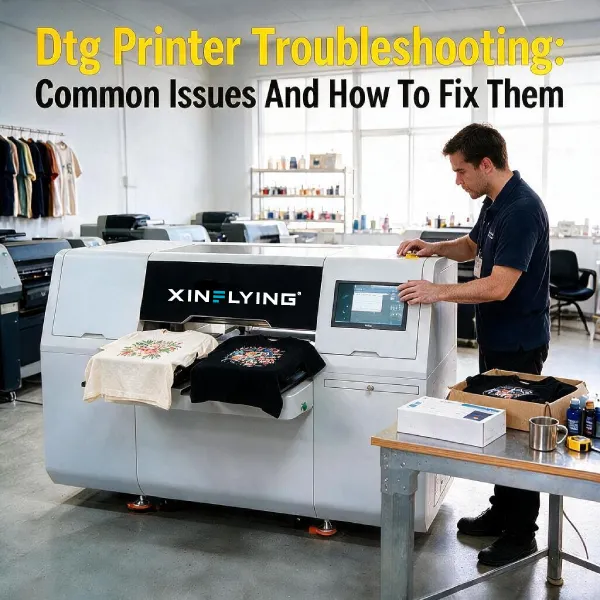
La plupart des problèmes d'impression DTG concernent une poignée de récidivistes: colmatage de l'encre blanche, prétraitement inégal, baguage, and prints that crack after the first wash. None of these mean your printer is broken — they’re almost always workflow issues with a straightforward fix. Here’s how to diagnose and solve the most common ones.
Issue 1: White Ink Clogging or Settling
Encre blanche contains heavier titanium dioxide particles that settle out of suspension much faster than standard CMYK inks. If it sits idle — overnight, over a weekend, or even for a few hours without circulation — it can separate and clog the printhead nozzles, showing up as faint, streaky, or missing white underbase on your prints.
- Run a printhead cleaning and nozzle check before your first print job of the day, even if the printer sat idle overnight.
- If your printer has a white ink circulation or agitation system, make sure it’s actually running — these systems only work if they’re powered on and functioning correctly.
- For printers left idle for extended periods (a week or more), manually shake or agitate the white ink cartridges before resuming production.
- Keep a maintenance log of nozzle checks so recurring clogs in the same printhead are caught early instead of treated as one-off issues.

Issue 2: Uneven or Incorrect Pretreatment
Pretreatment problems are one of the most common causes of DTG print issues that get mistaken for printer malfunctions. Too little pretreatment causes dull colors and poor ink absorption; too much causes stiff prints, ink pooling, and scorching during curing.
- Apply pretreatment in a thin, even coat — the garment should look evenly damp, not soaked or dripping.
- Let pretreatment dry fully before printing; printing on a still-wet garment causes ink to bleed and colors to look muddy.
- Dark garments generally need a heavier white ink underbase, but that’s a printer software setting, not a reason to add more pretreatment liquid.
- Test new fabric types or blends on a scrap piece first, since pretreatment behaves differently on cotton blends versus 100% coton.
Issue 3: Banding or Streaking in Prints
Banding shows up as thin horizontal lines or inconsistent color density across a print, and it’s usually a mechanical or maintenance issue rather than a design file problem.
- Run a nozzle check pattern first — missing or weak nozzles are the most common cause of banding and are fixed with a standard cleaning cycle.
- Check print head height above the platen; a head set too high or too low from the garment surface can cause inconsistent ink deposition.
- Inspect the carriage belt for wear or looseness, since a slipping belt causes the printhead to misalign slightly on each pass.
- If banding appears only in one color, the issue is likely isolated to that specific printhead channel rather than the whole machine.
Issue 4: Prints Crack or Peel After Washing
A print that looks perfect fresh off the printer but cracks, fades, or peels after the first wash almost always points to a curing problem, not a printing problem.
- Verify actual curing temperature with an external thermometer or heat-sensitive strip — display readings on heat presses and conveyor dryers can drift over time.
- Make sure the ink reaches full cure time at the correct temperature; rushing the curing step is one of the most common causes of wash failure.
- Avoid over-applying pretreatment, since excess liquid can prevent the ink from properly bonding to the fibers during curing.
- Follow the ink manufacturer’s specific cure temperature and dwell time recommendations rather than a generic setting, since requirements vary between ink brands.
Issue 5: Dull or Inaccurate Colors
If prints consistently look washed out or don’t match what’s on screen, the cause is usually upstream of the printer itself.
- Check that the correct ICC color profile is loaded in your RIP software for the specific ink and garment combination you’re using.
- Confirm ink levels — a nearly empty cartridge can cause gradual color shifts before it triggers a low-ink warning.
- Make sure the white underbase is applying correctly, since a weak or uneven white layer directly affects how vibrant the CMYK colors appear on top.
- Recalibrate your monitor periodically, since screen color and printed color can drift apart even when the printer itself is working correctly.
Issue 6: Garment Shifting or Misaligned Prints
If designs are printing slightly off-position or garments move mid-print, the issue is typically in how the garment is loaded rather than the printer’s mechanics.
- Make sure the platen adhesive (tacky pad) is clean and still holding — a worn-out adhesive layer is a common, easy-to-miss cause of shifting.
- Smooth out wrinkles and load the garment evenly on the platen before locking it in for the print job.
- Double-check platen height settings match the garment’s thickness, especially when switching between t-shirts and thicker items like hoodies.
Preventive Maintenance Checklist
- Tous les jours: nozzle check and cleaning cycle before the first print job.
- Tous les jours: confirm white ink circulation/agitation system is running.
- Hebdomadaire: wipe down printheads and capping station per manufacturer guidelines.
- Hebdomadaire: inspect platen adhesive and replace if worn.
- Mensuel: check belt tension and carriage alignment.
- Mensuel: verify curing temperature accuracy with an external thermometer.
Questions fréquemment posées
Most DTG printers with a white ink circulation system still benefit from a daily agitation or print head cleaning cycle before the first job of the day, since white ink settles faster than CMYK inks even with circulation running.
Cracking after wash is almost always a curing problem rather than a printing problem — it means the ink didn’t reach full cure temperature for long enough, so double-check your heat press or conveyor dryer’s actual temperature with a separate thermometer rather than trusting the display alone.
Oui, in most cases. Start with a nozzle check and cleaning cycle, then check head height and belt tension before assuming the printhead itself is damaged — worn belts and misaligned print heights cause far more banding than actual printhead failure.
As a general rule, the garment should look evenly damp, not soaked — visible puddling, dripping, or a stiff, crusty feel after drying are signs of over-application, which leads to stiff prints, poor ink absorption, and scorching risk during curing.
Oui. 100% cotton is the most forgiving fabric for DTG, while blends, dark synthetics, and treated fabrics are more prone to pretreatment and adhesion issues, so it’s worth testing a new fabric type on a scrap piece before running a full order.
If you’ve checked pretreatment consistency, run nozzle checks and cleaning cycles, verified curing temperature, and the problem persists across multiple garments and designs, it’s worth contacting technical support — that pattern usually points to a hardware issue rather than a workflow mistake.
Related Resources
• Qu'est-ce qu'une machine DTG? Comment fonctionnent les imprimantes directes sur vêtements