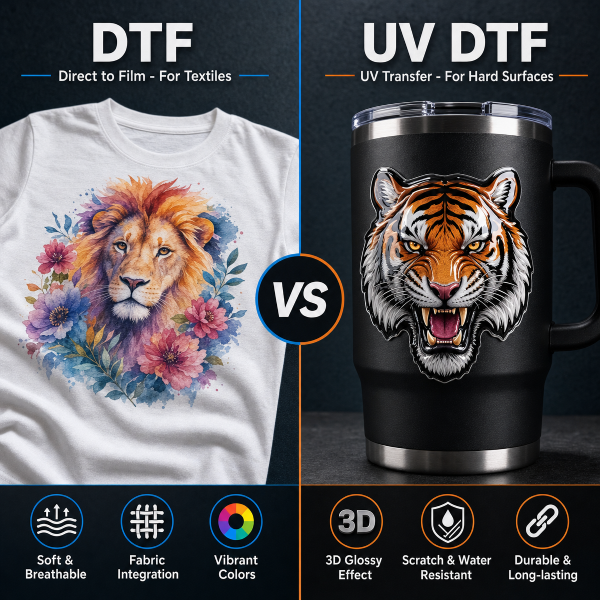
Si ha estado buscando una solución de impresión, Es casi seguro que te has topado con ambos. DTF y ULTRAVIOLETA DTF - y si suenan igual con un nombre ligeramente diferente, no estas solo. Comparten algo de ADN., pero en la práctica están diseñados para aplicaciones completamente diferentes.
Elegir el incorrecto no sólo afecta la calidad de impresión. Afecta a toda su línea de productos, su inversión en equipos, y los mercados a los que puede servir de manera realista. Esta comparación desglosa todo lo que necesita saber para tomar la decisión correcta..
La respuesta corta
- DTF (Directo a la película) = diseñado para telas y prendas
- ULTRAVIOLETA DTF (Ultravioleta directo a la película) = diseñado para superficies duras y productos rígidos
Si tu negocio se centra en las camisetas, sudaderas con capucha, y textiles — DTF es tu herramienta. Si estás decorando fundas de teléfonos, vasos, acrílico, o productos duros: UV DTF es la mejor opción. Muchas tiendas establecidas operan ambos.
Cómo funciona cada tecnología
Impresión DTF estándar
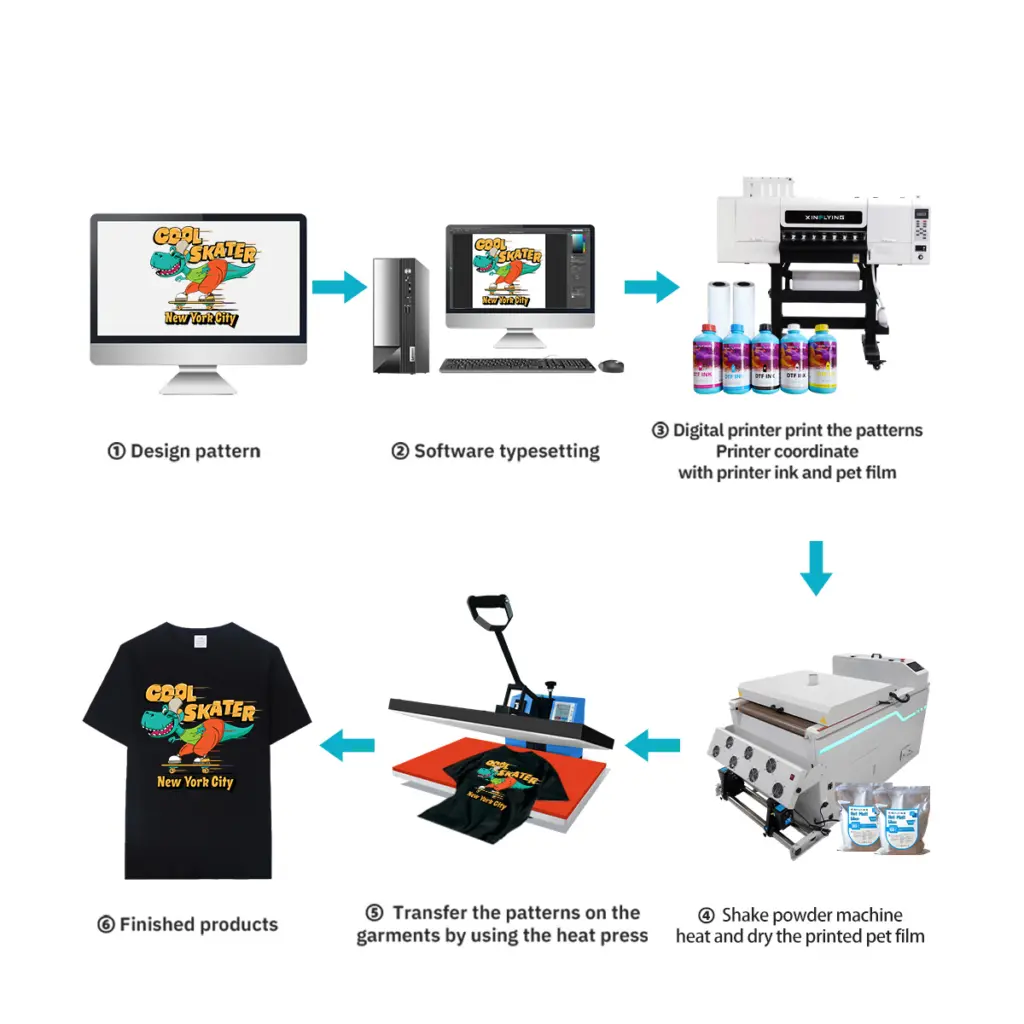
El DTF estándar imprime un diseño en un MASCOTA (poliéster) película de pelado en caliente usando tintas pigmentadas a base de agua. una capa de polvo adhesivo termofusible Se aplica mientras la tinta aún está húmeda., luego la película se cura en un horno para unir el polvo a la tinta.. La transferencia terminada se aplica a la tela usando un prensa de calor a temperatura y presión controladas.
La prensa térmica activa el polvo adhesivo., unir el diseño permanentemente a las fibras de la tela. Una vez enfriado, la película se despega, dejando un suave, impresión flexible.
Impresión UVDTF
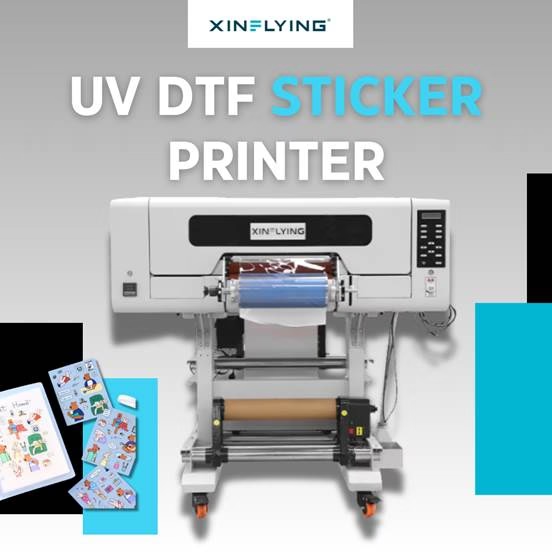
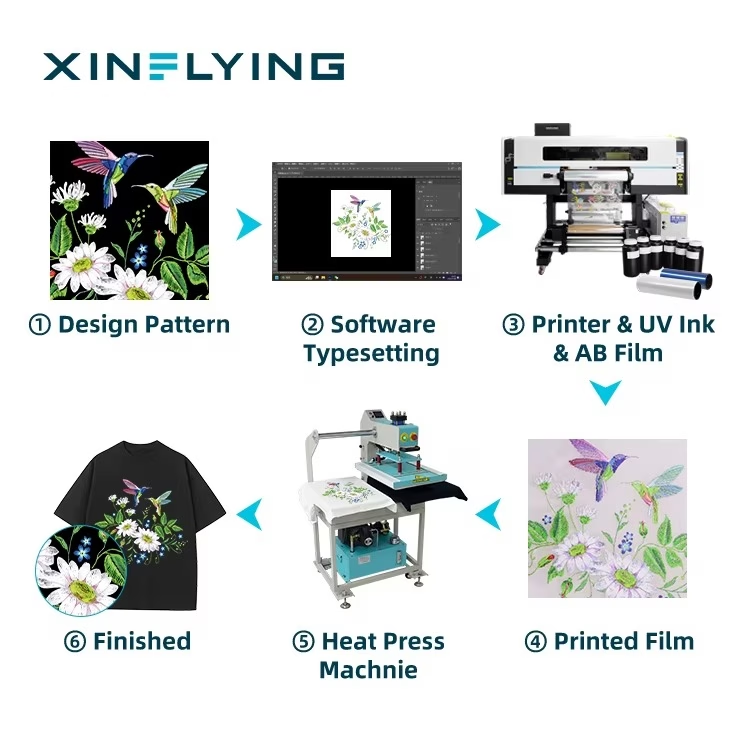
Impresiones UV DTF en un Película A reactiva a los rayos UV utilizando tintas curables por UV: CMYK, blanco, y barniz. En lugar de polvo adhesivo, Lámparas LED UV integradas en la impresora cura la tinta instantáneamente a medida que se deposita. La película A curada se lamina a una película B transparente usando un laminador en frío., creando una transferencia lista para aplicar.
La solicitud solo requiere presión de la mano — sin prensa de calor, sin polvo, sin curado en horno. La transferencia se adhiere a superficies duras lisas mediante una combinación de adhesión curada con UV y contacto superficial..
Comparación lado a lado
| Característica | DTF estándar | ULTRAVIOLETA DTF |
|---|---|---|
| Mejor superficie | Telas & textiles | Bienes duros & superficies rígidas |
| Tipo de tinta | pigmento a base de agua | curable por UV (CMYK + Blanco + Barniz) |
| Método de curado | Horno + polvo adhesivo | Lámparas LED ultravioleta (integrado en la impresora) |
| Se requiere prensa de calor | ✅ Sí | ❌No |
| Polvo adhesivo | ✅ Sí | ❌No |
| tinta blanca | ✅ Sí | ✅ Sí |
| 3Efecto de textura D | ❌No | ✅ Sí (con capa de barniz) |
| Funciona en superficies curvas | Limitado | ✅ Sí |
| Durabilidad del lavado (tela) | Excelente | No aplicable |
| Durabilidad al rayado (bienes duros) | No aplicable | Excelente |
| mín.. Cantidad de pedido | 1 pedazo | 1 pedazo |
| Velocidad de producción | Moderado | Moderado |
| Costo inicial | Más bajo | Moderado-alto |
Calidad de impresión comparada
Vibrancia del color
Ambos métodos producen a todo color, impresiones de calidad fotográfica. En sus respectivos materiales de destino., ambos funcionan excepcionalmente bien. Las impresiones UV DTF tienden a tener un color ligeramente mayor en superficies duras debido a la base de tinta blanca y al acabado brillante curado por UV.. Las impresiones DTF sobre tela tienen un tacto más suave que se integra naturalmente con el tejido..
Rendimiento de la tinta blanca
La tinta blanca es fundamental en ambos métodos: proporciona la capa base opaca que hace que los colores sean visibles en superficies oscuras o no blancas.. UV DTF generalmente tiene una ventaja aquí: La tinta blanca curada con UV se fija con mayor dureza y uniformidad que el blanco adhesivo en polvo en DTF, reducir el riesgo de manchas semitransparentes en áreas blancas de alta cobertura.
Detalle fino
Ambas tecnologías manejan bien las líneas finas y el texto pequeño.. UV DTF tiene una ligera ventaja para trabajos de detalle muy fino en productos duros debido a la rigidez, naturaleza no absorbente de la película de transferencia. El DTF sobre tela está sujeto a una dispersión menor cuando la tinta entra en contacto con las fibras textiles., aunque esto rara vez es visible a simple vista en la mayoría de los diseños..
Compatibilidad de materiales
El DTF estándar funciona mejor en:
- 100% mezclas de algodón y algodón
- Tejidos de poliéster y de alto rendimiento.
- Mezclilla
- Bolsas y totes de lona
- Nylon (con limitaciones)
UV DTF funciona mejor en:
- Fundas de teléfono (todo tipo de plástico y silicona)
- Vasos y vasos de acero inoxidable y metal.
- Tazas y azulejos de cerámica.
- Acrílico y plexiglás
- Superficies de vidrio
- Artículos de piel y piel sintética.
- Letreros y placas de madera.
- Metal pintado y aluminio revestido
Importante: UV DTF no funciona bien en telas. La capa rígida de tinta curada con UV se agrieta y se pela bajo la flexión y el lavado repetidos que experimentan las prendas.. Si intentas usar UV DTF en una camiseta, la transferencia fallará rápidamente.
Equipo y configuración
Configuración DTF estándar
| Equipo | Objetivo |
|---|---|
| Impresora DTF | Imprime el diseño en una película de PET. |
| Coctelera en polvo | Distribuye uniformemente el polvo adhesivo termofusible |
| Horno de curado | Une el polvo a la tinta |
| Prensa de calor | Transfiere el diseño a la tela. |
| Software RIP | Gestiona perfiles de impresión |
Configuración UVDTF
| Equipo | Objetivo |
|---|---|
| Impresora UV DTF | Imprime y cura con UV el diseño en una película A. |
| Laminador en frío | Une una película A y una película B juntas |
| Software RIP | Gestiona los canales de tinta UV y la capa blanca. |
UV DTF tiene un costo inicial más alto pero un flujo de trabajo más simple — menos máquinas, sin lío de polvo, sin gestión de prensa de calor.
Complejidad del flujo de trabajo
Flujo de trabajo DTF (5 pasos)
- Preparar el diseño en el software RIP.
- Imprimir en película PET
- Aplicar polvo adhesivo (agitador manual o automático)
- Curar el polvo en el horno. (160–170°C, 2–3 minutos)
- Presione con calor sobre la prenda. (160ºC, 6–10 segundos)
Puntos de dolor: Consistencia de la aplicación del polvo, gestión de la temperatura del horno, Los ajustes de la prensa de calor varían según el tipo de tela..
Flujo de trabajo UVDTF (4 pasos)
- Preparar el diseño en el software RIP.
- Imprimir en una película (El curado UV ocurre automáticamente en la máquina)
- Laminado en frío película A con película B
- Transferir con presión manual sobre el producto y pelar
Puntos de dolor: Preparación de la superficie (debe estar limpio y liso), Alineación de película B en laminadora..
UV DTF gana en simplicidad de flujo de trabajo, especialmente para operadores que desean una limpieza, Proceso de producción rápido sin controlar las temperaturas del horno ni la aplicación de polvo..
¿Cuál es más rentable??
Ambos métodos son rentables: la respuesta depende de su mercado objetivo..
Márgenes DTF son fuertes para los decoradores de prendas, especialmente tiendas de camisetas personalizadas. El bajo costo de entrada significa un retorno de la inversión más rápido, y la demanda de ropa personalizada es enorme.
Márgenes UV DTF tienden a ser más altos por artículo porque los productos duros como vasos personalizados y fundas para teléfonos tienen precios minoristas superiores ($20–$50+), mientras que el costo por impresión es sólo ligeramente superior al de DTF. Una tienda UV DTF que se centra en bebidas premium o productos de regalo puede lograr márgenes brutos del 60 % al 80 % en artículos individuales..
¿Puedes ejecutar ambos en la misma tienda??
Sí, y muchas imprentas en crecimiento hacen exactamente esto.
Una configuración común:
- impresora DTF para pedidos de prendas (camisetas, sudaderas con capucha, bolsas de mano)
- Impresora UVDTF (como el XF-600S) para productos duros (vasos, cajas del teléfono, productos acrílicos)
Esta combinación le permite atender casi cualquier solicitud de impresión personalizada sin rechazar pedidos.. Los dos flujos de trabajo son lo suficientemente independientes como para no interferir entre sí., y la inversión en equipo se realiza por etapas: puede comenzar con uno y agregar el otro a medida que crece su base de clientes..
Resumen: ¿Cuál deberías elegir??
| Tu situación | Elección recomendada |
|---|---|
| Principalmente decoración de prendas y telas. | DTF estándar |
| Principalmente decoración de productos duros y rígidos. | ULTRAVIOLETA DTF |
| Quiere ofrecer efectos de bordado/relieve 3D | ULTRAVIOLETA DTF |
| Costo inicial más bajo posible | DTF estándar |
| Más limpio, flujo de trabajo de producción más simple | ULTRAVIOLETA DTF |
| Sirviendo a los mercados de telas y bienes duraderos | Ambos |
No existe universalmente “mejor” opción: solo la mejor opción por lo que estás imprimiendo. Si todavía no estás seguro, Comience por mapear los pedidos de sus clientes actuales o de destino.: ¿Qué están comprando realmente?? Deje que esa respuesta guíe la decisión sobre el equipo..
Preguntas frecuentes
q: ¿Puedo usar una impresora UV DTF para imprimir en camisetas??
A: No recomendado. La tinta curada con UV es rígida y se agrietará y pelará en la tela con el uso y lavado normales.. Para la impresión de tela, DTF estándar es el método correcto.
q: ¿Es UV DTF más caro que DTF??
A: Las impresoras UV DTF generalmente cuestan más por adelantado, y los costos por impresión son ligeramente más altos. Sin embargo, los productos en los que se utiliza (vasos, cajas del teléfono) exigir precios minoristas más altos, por lo que los márgenes de beneficio siguen siendo fuertes.
q: ¿Ambos métodos requieren software RIP??
A: Sí. Tanto DTF como UV DTF requieren software RIP para gestionar los canales de tinta., perfiles de color, y configuración de capa blanca. Las opciones comunes incluyen Maintop y Photoprint..
q: ¿Qué método tiene mejor durabilidad al lavado??
A: Para aplicaciones textiles, El DTF estándar tiene una excelente durabilidad al lavado. (clasificado para más de 40 a 50 lavados en condiciones normales). UV DTF no está diseñado para el lavado de telas y no debe compararse en esta métrica; está diseñado para la durabilidad de productos duros., donde se desempeña muy bien.
q: ¿Se pueden almacenar las transferencias UV DTF antes de su uso??
A: Sí. Las transferencias DTF UV impresas y laminadas se pueden almacenar planas, lejos del calor y la luz directa, durante varias semanas a meses antes de la aplicación sin degradación significativa.