Si vous avez exploré les options d'impression personnalisées pour les vêtements, tasses, ou des produits promotionnels, vous avez probablement rencontré impression par sublimation. Mais qu'est-ce que c'est exactement, comment ça marche, et est-ce le bon choix pour votre entreprise?
Ce guide couvre tout ce que vous devez savoir — de la science derrière le processus à une comparaison pratique avec l'impression DTG et DTF — afin que vous puissiez prendre une décision éclairée..
Qu'est-ce que l'impression par sublimation?
Impression par sublimation est un procédé d'impression numérique qui utilise la chaleur pour transférer le colorant directement dans les fibres d'un matériau, plutôt que de rester sur la surface comme l'encre traditionnelle. Le résultat est un imprimé qui devient partie intégrante du tissu lui-même – vibrant, doux au toucher, et très résistant.
Le mot “sublimation” fait référence au processus scientifique par lequel une substance passe directement de l'état solide à l'état gazeux., sauter complètement la phase liquide. En impression par sublimation, les particules de colorant solide sont chauffées à environ 220°C, se transformant en gaz et se liant de manière permanente aux fibres polymères du matériau.
Parce que le colorant se lie au niveau moléculaire, les impressions par sublimation ne se fissureront pas, peler, ou s'estompent comme le peuvent les impressions sérigraphiées ou par transfert thermique au fil du temps.
Comment fonctionne l'impression par sublimation?
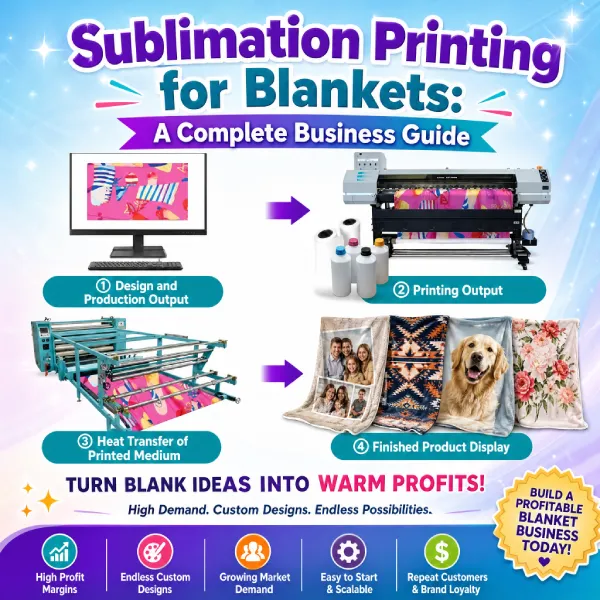
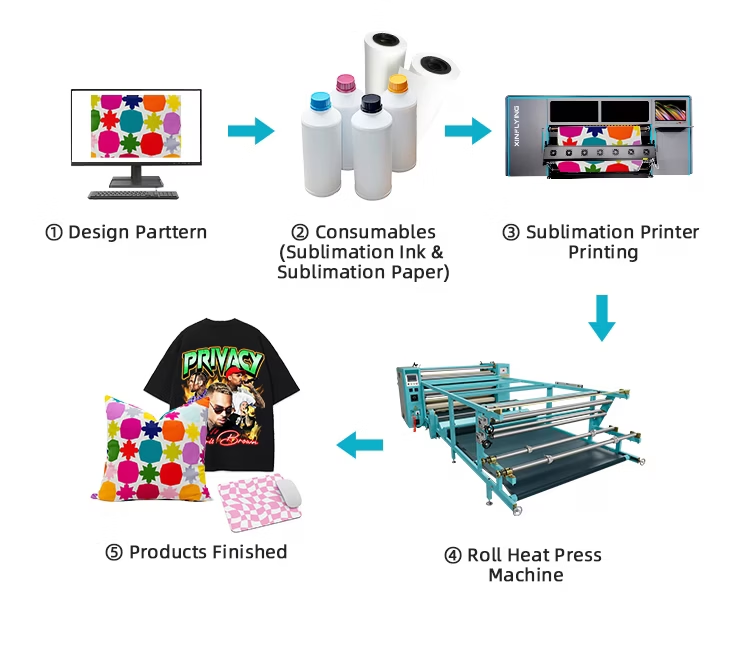
Le processus d'impression par sublimation comprend quatre étapes:
Étape 1: Création de conception Créez votre œuvre numériquement à l'aide d'un logiciel tel qu'Adobe Illustrator, CorelDRAW, ou tout programme de conception qui exporte des fichiers haute résolution. Le design est ensuite reflété (retourné horizontalement) avant l'impression, puisqu'il sera transféré face vers le bas sur le substrat.
Étape 2: Imprimer sur du papier de transfert par sublimation Le motif miroir est imprimé sur un papier de transfert par sublimation spécial à l'aide d'une imprimante à sublimation chargée d'encre de sublimation.. A ce stade, l'encre semble terne et atténuée - elle ne devient vibrante qu'une fois la chaleur appliquée.
Étape 3: Transfert de chaleur Le papier transfert imprimé est placé face vers le bas sur le substrat (tissu, tasse, cas de téléphone, etc.) et pressé à l'aide d'une presse à chaud à la bonne température et pression. La chaleur provoque la sublimation des particules d’encre solide en gaz, qui pénètre la surface du matériau.
Étape 4: Refroidissement et finition Une fois le cycle de presse à chaud terminé (typiquement 20 secondes), le papier transfert est décollé. Au fur et à mesure que le substrat refroidit, le gaz revient à l'état solide - désormais intégré de manière permanente dans le matériau. Le résultat est un vif, impression en couleur sans bords surélevés ni texture.
Quels matériaux peuvent être imprimés par sublimation?
C'est l'une des choses les plus importantes à comprendre sur l'impression par sublimation.: il ne fonctionne que sur des matériaux à base de polyester ou à revêtement polymère.
Parce que le colorant se lie aux molécules de polymère pendant la phase gazeuse, il ne peut pas pénétrer les fibres naturelles comme 100% coton. Plus la teneur en polyester du tissu est élevée, plus l'impression par sublimation sera vibrante et durable.
Les matériaux compatibles incluent:
- Tissu polyester (100% ou mélange élevé) - vêtements de sport, vêtements de sport, maillots
- Produits durs à revêtement polymère – tasses, Coque de téléphone, porte-clés, gobelets
- Panneaux métalliques recouverts de polyester — récompenses, plaques, signalisation
- Céramique avec revêtement polymère — plaques, carrelage, ornements
- Nylon et autres tissus synthétiques
Non compatible:
- 100% coton
- Fibres naturelles (lin, soie, laine)
- Tissus de couleur foncée (l'encre de sublimation est transparente; il ne peut pas couvrir les couleurs de base sombres)
- Métal non revêtu, verre, ou du bois
Quels produits sont les meilleurs pour l'impression par sublimation?
L'impression par sublimation est utilisée dans un large éventail d'industries et de catégories de produits:
Vêtements
- Maillots de sport et uniformes d'équipe
- Vêtements de sport et vêtements de sport
- Maillots de bain et shorts de bain
- Sweats à capuche et fermetures éclair personnalisés (mélange de polyester)
- T-shirts entièrement imprimés
Produits promotionnels et corporatifs
- Mugs et tasses à café personnalisés
- Bouteilles d'eau et gobelets
- Tapis de souris
- Longes et porte-cartes d'identité
- Sacs fourre-tout de marque (polyester)
Home Décor
- Coussins et taies d'oreiller
- Couvertures et tapisseries
- Panneaux photo et décoration murale
- Sous-verres et sets de table
Récompenses et signalisation
- Plaques et trophées métalliques
- Prix acryliques
- Panneaux composites en aluminium
Impression par sublimation vs Impression DTG: Quelle est la différence?
Sublimation et DTG (Directement sur le vêtement) l'impression est une méthode d'impression numérique, mais ils fonctionnent très différemment et conviennent à différents cas d'utilisation.
| Fonctionnalité | Impression par sublimation | Impression DTG |
|---|---|---|
| Comment l'encre est appliquée | L'encre devient gazeuse et se lie aux fibres polymères | L'encre est pulvérisée directement sur la surface du tissu |
| Tissus compatibles | Matériaux enduits de polyester et de polymère uniquement | Mélanges de coton et à haute teneur en coton |
| Couleur sur tissus foncés | Ne convient pas : l'encre est transparente | Fonctionne sur les tissus foncés avec une sous-couche d'encre blanche |
| Sensation d'impression | Complètement doux – pas de texture | Légère texture de la couche d'encre |
| Durabilité | Extrêmement durable, ne se fissurera pas et ne pèlera pas | Très durable avec un durcissement approprié |
| Coût d'installation | Modéré | Modéré à élevé |
| Prétraitement requis | Non | Oui, pour les vêtements sombres |
| Idéal pour | Vêtements en polyester, tenue de sport, marchandises | T-shirts en coton, impression à la demande |
La réponse courte: Si vous imprimez sur du polyester, tenue de sport, ou des biens durables, l'impression par sublimation est le meilleur choix. Si vous imprimez sur des T-shirts en coton en petits lots, Le DTG est plus adapté.
Impression par sublimation vs Impression DTF: Lequel devriez-vous choisir?
DTF (Direct-to-Film) l'impression s'est développée rapidement comme alternative à la sublimation et au DTG. Voici comment les deux se comparent:
| Fonctionnalité | Impression par sublimation | Impression DTF |
|---|---|---|
| Compatibilité des tissus | Polyester uniquement | Fonctionne sur pratiquement tous les tissus |
| Impression de biens durables | Oui (avec revêtement polymère) | Non |
| Couleur sur tissus foncés | Ne convient pas | Oui – excellent éclat sur les tissus foncés |
| Texture d'impression | Aucun — entièrement intégré | Légère sensation de relief |
| Durabilité | Excellent | Excellent |
| Prétraitement | Non requis | Non requis |
| Flexibilité de production | Moins flexible | Très flexible |
| Idéal pour | Vêtements en polyester, tenue de sport, biens durables de marque | Divers types de tissus, vêtements sombres, commandes mixtes |
La réponse courte: L'impression par sublimation excelle sur le polyester et les biens durables. L'impression DTF offre plus de polyvalence entre les types et les couleurs de tissus, en particulier pour les entreprises qui gèrent des commandes mixtes ou impriment fréquemment sur des vêtements sombres..
De nombreuses entreprises d'impression utilisent à la fois la sublimation et le DTF pour couvrir l'ensemble des besoins des clients..
Avantages de l'impression par sublimation
1. Qualité d'impression exceptionnelle La sublimation produit des impressions photoréalistes avec des dégradés fluides, détail net, et des couleurs vives, en particulier sur du polyester blanc ou clair. La qualité d'impression est difficile à égaler avec d'autres méthodes au même prix.
2. Extrêmement durable Parce que le colorant est intégré dans le matériau plutôt que de rester dessus, les impressions par sublimation ne se fissurent pas, peler, disparaître, ou laver. Les produits correctement sublimés conservent leur apparence même après des centaines de cycles de lavage.
3. Aucune texture ni sensation au toucher Contrairement à la sérigraphie, DTG, ou vinyle de transfert thermique, les impressions par sublimation sont complètement invisibles au toucher. Le tissu conserve sa douceur d'origine, ce qui est particulièrement important pour les vêtements de sport et de performance.
4. Aucun prétraitement requis Contrairement à l'impression DTG, la sublimation ne nécessite aucun prétraitement du vêtement avant impression. Cela simplifie le flux de travail et réduit les coûts unitaires.
5. Impression en couleur sans limite de couleurs La sublimation prend en charge un nombre illimité de couleurs, dégradés photographiques, et des illustrations complexes sans aucun coût supplémentaire par couleur – contrairement à la sérigraphie, où chaque couleur supplémentaire augmente le coût.
6. Capacité d'impression intégrale La sublimation est idéale pour les motifs imprimés sur toute la surface qui couvrent tout le vêtement d'une couture à l'autre., y compris les manchons et les panneaux - quelque chose de difficile ou coûteux à réaliser avec d'autres méthodes.
Limites de l'impression par sublimation
1. Exigence en polyester La sublimation ne fonctionne efficacement que sur le polyester (ou recouvert de polymère) matériaux. Pour les gammes de produits à forte teneur en coton, L'impression DTG ou DTF est une meilleure solution.
2. Tissus de couleur claire uniquement Parce que l'encre de sublimation est transparente, il ne peut pas produire des couleurs vives sur des tissus foncés ou noirs. La teinture se mélange à la couleur de base du matériau : imprimer du jaune sur un vêtement bleu marine ne produira pas un jaune propre..
3. L'encre blanche n'est pas possible L'impression par sublimation ne peut pas produire du blanc - le “blanc” dans un dessin, c'est simplement la zone non imprimée du substrat. C'est pourquoi des supports en polyester blanc ou de couleur claire sont nécessaires.
4. La précision des couleurs dépend du substrat Le même motif peut paraître légèrement différent lorsqu'il est imprimé sur différents mélanges de polyester ou substrats.. Un profilage des couleurs et des tests de substrat cohérents sont importants pour maintenir la qualité dans toutes les gammes de produits..
De quel équipement avez-vous besoin pour l'impression par sublimation?
Démarrer une opération d’impression par sublimation nécessite quatre équipements de base:
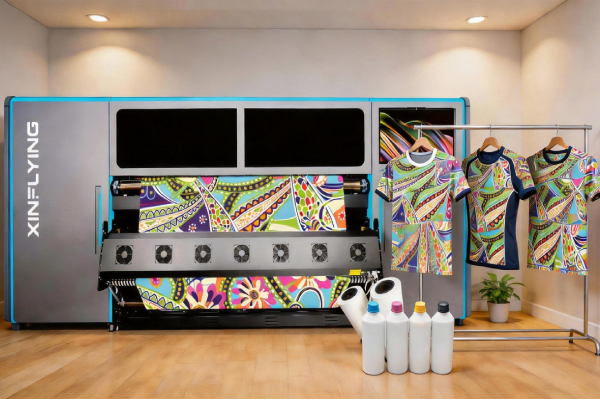
1. Imprimante à sublimation Une imprimante grand format ou de bureau convertie ou conçue pour l'encre de sublimation. Les largeurs d'impression courantes vont du A3 (11.7″) pour travaux petit format jusqu'au 64″ (162cm) pour la production grand format. Recherchez des modèles équipés de têtes d'impression Epson i3200 ou DX5 pour une sortie fiable.
2. Encre de sublimation Des encres de sublimation spécialisées sont nécessaires : les encres à jet d'encre standard ne se sublimeront pas. La qualité de l'encre affecte directement l'éclat et la gamme des couleurs. L'encre de sublimation de haute qualité produit plus riche, des couleurs plus précises et des résultats plus durables.
3. Papier de transfert par sublimation Le papier de sublimation spécialement conçu est enduit pour retenir l'encre jusqu'à ce que le transfert soit terminé.. Il est important d'utiliser le papier adapté à votre marque d'encre et à votre imprimante pour éviter les bavures et garantir une diffusion nette des couleurs..
4. Presse chauffée Une presse à chaud plate est utilisée pour le tissu et les articles durs plats. Pour les articles cylindriques (tasses, bouteilles), une presse à mug est nécessaire. Pour les casquettes, un accessoire de presse à capuchon est nécessaire. La précision de la température et la pression uniforme du plateau sont essentielles pour des résultats cohérents.
L'impression par sublimation est-elle adaptée à votre entreprise ??
L'impression par sublimation est un excellent choix si:
- Vos principaux produits sont des vêtements en polyester, tenue de sport, ou vêtements de sport
- Vous produisez des biens durables personnalisés tels que des mugs, gobelets, ou des coques de téléphone
- Vous avez besoin d'une capacité d'impression intégrale pour des conceptions de vêtements à couverture complète
- Vous voulez du dynamisme, impressions durables sans texture ni sensation au toucher
- Vous imprimez sur des supports blancs ou de couleur claire
Envisagez plutôt l'impression DTF ou DTG si:
- Vos clients commandent principalement des T-shirts ou des sweats à capuche en coton
- Vous imprimez fréquemment sur des vêtements foncés ou noirs
- Vous avez besoin d'une flexibilité de substrat maximale sur des types de tissus mixtes
Foire aux questions sur l'impression par sublimation
Q: A quoi sert l'impression par sublimation?
UN: L'impression par sublimation est utilisée pour produire des vêtements personnalisés (maillots, vêtements de sport, t-shirts imprimés), biens matériels promotionnels (tasses, Coque de téléphone, gobelets), home décor (oreillers, couvertures, art mural), et récompenses ou signalisation sur des substrats recouverts de polymère.
Q: L'impression par sublimation fonctionne-t-elle sur le coton?
UN: Non. L'encre de sublimation se lie aux molécules de polymère et ne peut pas pénétrer les fibres naturelles comme le coton. Pour l'impression sur coton, L'impression DTG ou DTF est la technologie appropriée. Un minimum de 65% la teneur en polyester est recommandée pour des résultats de sublimation acceptables; 100% le polyester produit le résultat le plus dynamique.
Q: Combien de temps durent les impressions par sublimation?
UN: Lorsqu'il est produit correctement sur des matériaux compatibles, les impressions par sublimation sont extrêmement durables. Ils ne craquent pas, peler, ou s'estomper considérablement même après des centaines de cycles de lavage. L'impression est incrustée dans la fibre, je ne suis pas assis dessus, ce qui lui confère une résistance au lavage supérieure à la plupart des autres méthodes d'impression.
Q: L'impression par sublimation est-elle la même chose que l'impression par transfert thermique?
UN: Non, bien que les deux utilisent une presse à chaud. En impression par transfert thermique, un motif imprimé sur du papier transfert est pressé sur la surface du matériau et reste dessus comme une couche. En impression par sublimation, l'encre se transforme en gaz et se lie de manière permanente au matériau - il n'y a ni couche de surface ni texture.
Q: L'impression par sublimation peut-elle être réalisée à la maison?
UN: Oui. Configurations de sublimation d'entrée de gamme utilisant une imprimante de bureau A3, presse à chaud de base, et du papier de sublimation sont disponibles pour moins de $1,000 et sont couramment utilisés par les petites entreprises et les amateurs.
Q: Quelle est la différence entre l'impression par sublimation et la sérigraphie?
UN: La sérigraphie applique de l'encre sur le tissu à travers un écran à mailles, chaque couleur nécessitant un écran séparé. Il est rentable pour les grands lots de conceptions simples. L'impression par sublimation est un processus entièrement numérique sans écran ni frais d'installation, prend en charge des couleurs illimitées, et produit des impressions intégrées dans le tissu plutôt que posées sur la surface.
Prêt à commencer l'impression par sublimation?
Que vous lanciez une entreprise de vêtements personnalisés ou que vous développiez une activité d'impression existante, Xinflying propose une gamme complète de imprimantes à sublimation conçu pour la production d'entrée de gamme et industrielle.
Vous ne savez pas quelle imprimante à sublimation correspond à vos besoins? Contactez notre équipe et nous vous aiderons à trouver la solution adaptée à votre volume de production et à votre gamme de produits.