If you’ve been exploring custom printing options for apparel, kubki, lub produkty promocyjne, you’ve likely come across druk sublimacyjny. But what exactly is it, how does it work, and is it the right choice for your business?
This guide covers everything you need to know — from the science behind the process to a practical comparison with DTG and DTF printing — so you can make an informed decision.
Co to jest drukowanie sublimacji?
Drukowanie sublimacji is a digital printing process that uses heat to transfer dye directly into the fibers of a material, rather than sitting on top of the surface like traditional ink. The result is a print that becomes part of the fabric itself — vibrant, soft to the touch, i bardzo trwałe.
The word “sublimacja” refers to the scientific process where a substance transitions directly from a solid state to a gas, skipping the liquid phase entirely. In sublimation printing, solid dye particles are heated to around 220°C, turning into gas and bonding permanently with the polymer fibers of the material.
Because the dye bonds at a molecular level, sublimation prints will not crack, obierać, or fade the way screen-printed or heat transfer prints can over time.
Jak działa druk sublimacyjny?
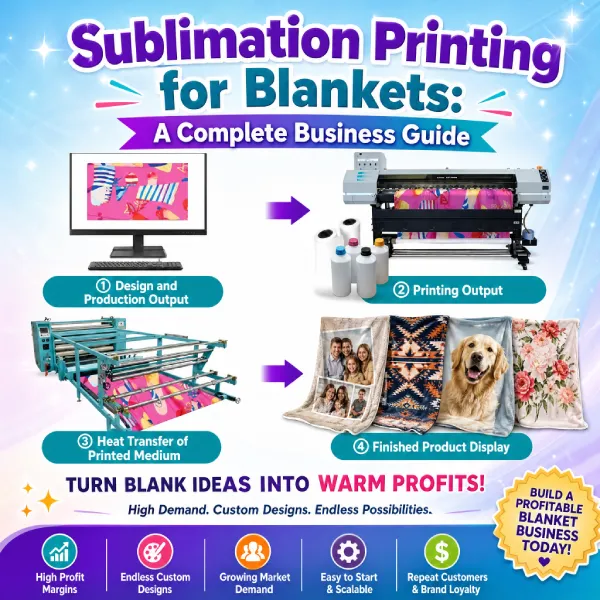
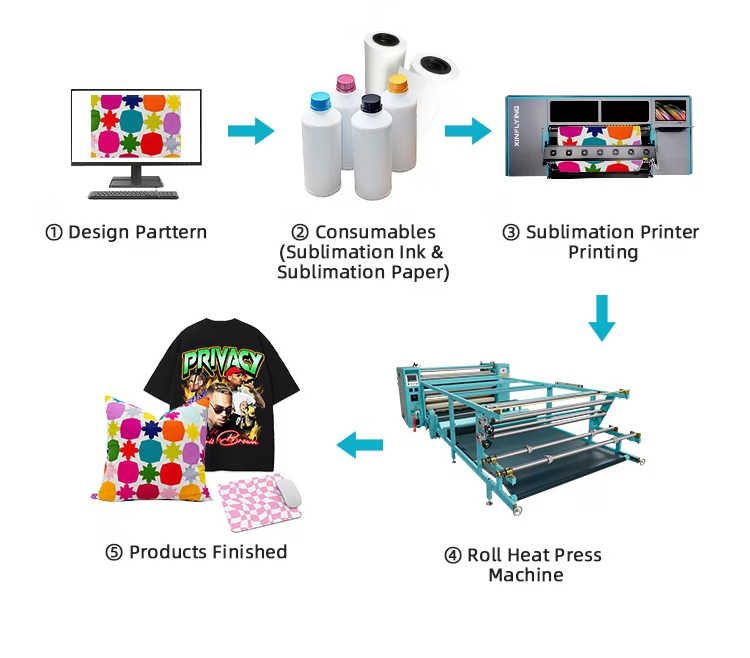
The sublimation printing process involves four steps:
Krok 1: Tworzenie projektu Create your artwork digitally using software such as Adobe Illustrator, CorelDRAW, or any design program that exports high-resolution files. The design is then mirrored (flipped horizontally) before printing, since it will be transferred face-down onto the substrate.
Krok 2: Print onto Sublimation Transfer Paper The mirrored design is printed onto a special sublimation transfer paper using a sublimation printer loaded with sublimation ink. At this stage, the ink appears dull and muted — it only becomes vibrant once heat is applied.
Krok 3: Przenikanie ciepła The printed transfer paper is placed face-down onto the substrate (tkanina, kubek, phone case, itp.) and pressed using a heat press at the correct temperature and pressure. The heat causes the solid ink particles to sublimate into gas, which penetrates the surface of the material.
Krok 4: Chłodzenie i wykończenie Once the heat press cycle is complete (typically 20 sekundy), the transfer paper is peeled away. As the substrate cools, the gas reverts to a solid state — now permanently embedded within the material. The result is a vivid, full-color print with no raised edges or texture.
What Materials Can Be Sublimation Printed?
This is one of the most important things to understand about sublimation printing: it only works on polyester-based or polymer-coated materials.
Because the dye bonds with polymer molecules during the gas phase, it cannot penetrate natural fibers like 100% bawełna. The higher the polyester content of the fabric, the more vibrant and durable the sublimation print will be.
Compatible materials include:
- Polyester fabric (100% or high-blend) — sportswear, odzież aktywna, koszulki
- Polymer-coated hard goods — mugs, etui na telefony, breloki, kubki
- Polyester-coated metal panels — awards, Płytki, oznakowanie
- Ceramic with polymer coating — plates, płytki, ozdoby
- Nylon and other synthetic fabrics
Not compatible:
- 100% bawełna
- Natural fibers (linen, jedwab, wool)
- Dark-colored fabrics (sublimation ink is transparent; it cannot cover dark base colors)
- Uncoated metal, szkło, or wood
What Products Are Best for Sublimation Printing?
Sublimation printing is used across a wide range of industries and product categories:
Strój
- Sports jerseys and team uniforms
- Activewear and gym clothing
- Swimwear and board shorts
- Custom hoodies and zip-ups (polyester blend)
- All-over-print T-shirts
Promotional and Corporate Products
- Custom mugs and coffee cups
- Water bottles and tumblers
- Mouse pads
- Lanyards and ID holders
- Branded tote bags (poliester)
Home Décor
- Throw pillows and pillowcases
- Blankets and tapestries
- Photo panels and wall art
- Coasters and placemats
Awards and Signage
- Metal plaques and trophies
- Acrylic awards
- Aluminum composite panels
Druk sublimacyjny vs Druk DTG: Co za różnica?
Both sublimation and DTG (Bezpośrednio do odzieży) printing are digital printing methods, but they work very differently and suit different use cases.
| Funkcja | Druk sublimacyjny | Druk DTG |
|---|---|---|
| How ink is applied | Ink becomes gas and bonds with polymer fibers | Ink is sprayed directly onto the fabric surface |
| Kompatybilne tkaniny | Polyester and polymer-coated materials only | Cotton and high-cotton blends |
| Color on dark fabrics | Not suitable — ink is transparent | Works on dark fabrics with white ink underbase |
| Wyczucie druku | Completely soft — no texture | Slight texture from ink layer |
| Trwałość | Niezwykle trwały, won’t crack or peel | Very durable with proper curing |
| Setup cost | Umiarkowany | Umiarkowane do wysokiego |
| Pre-treatment required | NIE | Tak, for dark garments |
| Najlepsze dla | Odzież poliestrowa, odzież sportowa, towary twarde | Bawełniane T-shirty, Drukowanie na żądanie |
The short answer: If you’re printing on polyester, odzież sportowa, or hard goods, sublimation printing is the better choice. If you’re printing on cotton T-shirts in small batches, DTG is more suitable.
Druk sublimacyjny vs Druk DTF: Which Should You Choose?
DTF (Bezpośrednio do filmu) printing has grown rapidly as an alternative to both sublimation and DTG. Here’s how the two compare:
| Funkcja | Druk sublimacyjny | Druk DTF |
|---|---|---|
| Kompatybilność tkanin | Polyester only | Works on virtually any fabric |
| Hard goods printing | Tak (with polymer coating) | NIE |
| Color on dark fabrics | Not suitable | Yes — excellent vibrancy on dark fabrics |
| Print texture | None — fully embedded | Slight raised feel |
| Trwałość | Doskonały | Doskonały |
| Pre-treatment | Nie jest wymagane | Nie jest wymagane |
| Production flexibility | Less flexible | Very flexible |
| Najlepsze dla | Odzież poliestrowa, odzież sportowa, branded hard goods | Diverse fabric types, ciemne ubrania, mixed orders |
The short answer: Sublimation printing excels on polyester and hard goods. DTF printing offers more versatility across fabric types and colors — especially for businesses that handle mixed orders or frequently print on dark garments.
Many print businesses run both sublimation and DTF to cover the full range of customer needs.
Zalety druku sublimacyjnego
1. Exceptional print quality Sublimation produces photo-realistic prints with smooth gradients, sharp detail, and vibrant color — especially on white or light polyester. The print quality is difficult to match with other methods at the same price point.
2. Niezwykle trwały Because the dye is embedded within the material rather than sitting on top of it, sublimation prints do not crack, obierać, fade, or wash out. Properly sublimated products maintain their appearance even after hundreds of wash cycles.
3. No texture or hand feel W przeciwieństwie do sitodruku, DTG, or heat transfer vinyl, sublimation prints are completely invisible to the touch. The fabric retains its original softness, which is particularly important for activewear and performance garments.
4. No pre-treatment required Unlike DTG printing, sublimation does not require any pre-treatment of the garment before printing. This simplifies the workflow and reduces per-unit costs.
5. Full-color printing with no color limits Sublimation supports unlimited colors, photographic gradients, and complex artwork without any additional cost per color — unlike screen printing, where each additional color increases cost.
6. All-over printing capability Sublimation is ideal for all-over print designs that cover the entire garment from seam to seam, including sleeves and panels — something difficult or expensive to achieve with other methods.
Ograniczenia druku sublimacyjnego
1. Polyester requirement Sublimation only works effectively on polyester (or polymer-coated) przybory. For cotton-heavy product lines, DTG or DTF printing is a better fit.
2. Light-colored fabrics only Because sublimation ink is transparent, it cannot produce vibrant colors on dark or black fabrics. The dye blends with the base color of the material — printing yellow on a navy blue garment will not produce a clean yellow.
3. White ink is not possible Sublimation printing cannot produce white — the “biały” in a design is simply the unprinted area of the substrate. This is why white or light-colored polyester substrates are required.
4. Color accuracy depends on substrate The same design can look slightly different when printed on different polyester blends or substrates. Consistent color profiling and substrate testing are important for maintaining quality across product lines.
What Equipment Do You Need for Sublimation Printing?
Starting a sublimation printing operation requires four core pieces of equipment:
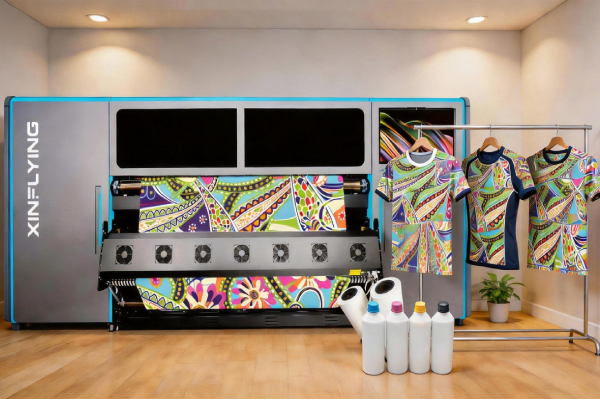
1. Drukarka sublimacyjna A wide-format or desktop printer converted or designed for sublimation ink. Common print widths range from A3 (11.7″) for small-format work to 64″ (162cm) for wide-format production. Look for models with Epson i3200 or DX5 print heads for reliable output.
2. Atrament sublimacyjny Specialized sublimation inks are required — standard inkjet inks will not sublimate. Ink quality directly affects color vibrancy and gamut. High-quality sublimation ink produces richer, more accurate colors and longer-lasting results.
3. Papier transferowy sublimacyjny Purpose-made sublimation paper is coated to hold ink until the transfer is complete. Using the right paper for your ink brand and printer is important for preventing bleeding and ensuring clean color release.
4. Prasa ciepła A flat heat press is used for fabric and flat hard goods. For cylindrical items (kubki, butelki), a mug press is required. For caps, a cap press attachment is needed. Temperature accuracy and even platen pressure are critical for consistent results.
Is Sublimation Printing Right for Your Business?
Sublimation printing is an excellent choice if:
- Your primary products are polyester apparel, odzież sportowa, or activewear
- You produce customized hard goods such as mugs, kubki, lub etui na telefon
- You need all-over print capability for full-coverage garment designs
- You want vibrant, durable prints with no texture or hand feel
- You are printing on white or light-colored substrates
Consider DTF or DTG printing instead if:
- Your customers primarily order cotton T-shirts or hoodies
- You frequently print on dark or black garments
- You need maximum substrate flexibility across mixed fabric types
Frequently Asked Questions About Sublimation Printing
Q: What is sublimation printing used for?
A: Sublimation printing is used to produce custom apparel (koszulki, odzież aktywna, all-over print T-shirts), promotional hard goods (kubki, etui na telefony, kubki), wystrój domu (poduszki, koce, sztuka ścienna), and awards or signage on polymer-coated substrates.
Q: Does sublimation printing work on cotton?
A: NIE. Sublimation ink bonds with polymer molecules and cannot penetrate natural fibers like cotton. For cotton printing, DTG or DTF printing is the appropriate technology. A minimum of 65% polyester content is recommended for acceptable sublimation results; 100% polyester produces the most vibrant output.
Q: How long do sublimation prints last?
A: When produced correctly on compatible materials, sublimation prints are extremely durable. They do not crack, obierać, or significantly fade even after hundreds of wash cycles. The print is embedded within the fiber, not sitting on top of it, which gives it superior wash-fastness compared to most other printing methods.
Q: Is sublimation printing the same as heat transfer printing?
A: NIE, although both use a heat press. In heat transfer printing, a design printed on transfer paper is pressed onto the surface of the material and remains on top as a layer. In sublimation printing, the ink converts to gas and bonds permanently within the material — there is no surface layer and no texture.
Q: Can sublimation printing be done at home?
A: Tak. Entry-level sublimation setups using a desktop A3 printer, basic heat press, and sublimation paper are available for under $1,000 and are commonly used by small businesses and hobbyists.
Q: What’s the difference between sublimation printing and screen printing?
A: Screen printing applies ink on top of the fabric through a mesh screen, with each color requiring a separate screen. It is cost-effective for large batches of simple designs. Sublimation printing is a fully digital process with no screens or setup fees, supports unlimited colors, and produces prints that are embedded within the fabric rather than sitting on the surface.
Ready to Start Sublimation Printing?
Whether you’re launching a custom apparel business or expanding an existing print operation, Xinflying offers a complete range of drukarki sublimacyjne designed for both entry-level and industrial production.
Not sure which sublimation printer fits your needs? Contact our team and we’ll help you find the right solution for your production volume and product range.