
In the modern manufacturing landscape, the transition from analog to digital has redefined efficiency and creative freedom. At the center of this revolution is the digital textile printer, a sophisticated piece of industrial equipment designed to apply high-resolution designs directly onto fabrics or transfer media using inkjet technology. Unlike traditional screen printing, which requires costly setup times and physical stencils, digital solutions allow for instantaneous production and unlimited color complexity.
As a professional DTF printer manufacturer, Xinflying has been at the forefront of this shift, developing machinery that caters to the rigorous demands of B2B production environments. But to truly understand the value of this technology, one must look closer at the engineering and the specific applications that make these machines indispensable.
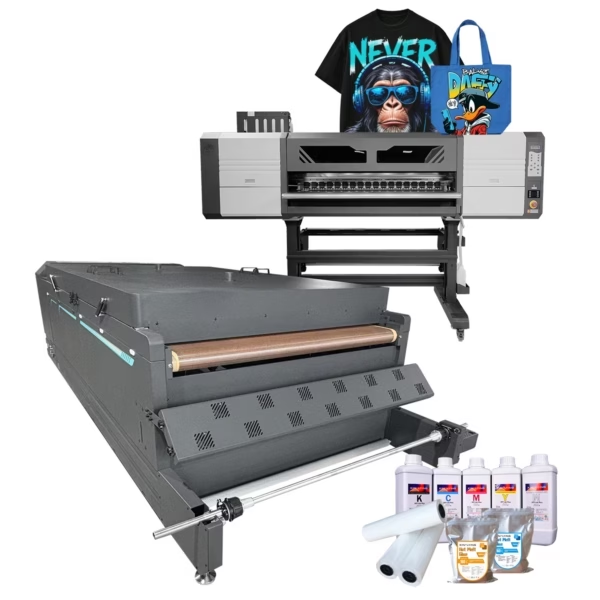
The Core Technology of a Digital Textile Printer
At its most basic level, a digital textile printer operates similarly to a high-end office inkjet printer but on a much larger, industrial scale with specialized inks. These machines use precision printheads—such as the Epson i3200-A1 utilized in Xinflying’s C604+H6501 and L1208+D1208 series—to fire millions of microscopic droplets of pigment or dye per second.
The primary distinction in today’s market is between Direct-to-Garment (DTG), Sublimation, and the increasingly dominant Direct-to-Film (DTF) technology. Xinflying specializes in DTF solutions, where the printer applies ink to a PET film rather than the fabric itself. This film is then coated with adhesive and heat-pressed onto the textile. This “indirect” digital approach has become the industry standard for those requiring maximum fabric versatility and durability.
Why Partner with a Leading DTF Printer Manufacturer
For businesses looking to invest in textile technology, selecting the right DTF printer manufacturer is just as important as the machine’s specifications. A manufacturer like Xinflying provides the engineering backbone necessary for 24/7 industrial operations.
When you source from an established manufacturer, you aren’t just buying a printer; you are acquiring a synchronized system. For example, Xinflying’s industrial-grade printers are paired with:
Advanced Printhead Maintenance: Integrated white ink circulation and stirring systems that prevent the sedimentation of titanium dioxide (white pigment), a common cause of downtime in lesser machines.
Industrial Rails: Imported mute linear guides that ensure the carriage moves with sub-millimeter precision, which is essential for the 600npi resolution required in high-end apparel.
Key Performance Metrics for Industrial Printers
When evaluating a digital textile printer, professional buyers focus on three key metrics: resolution, speed, and stability. Xinflying’s product line is engineered to excel in all three categories.
1. High-Resolution Output
The Xinflying C604 24-inch model is a prime example of high-precision engineering. By utilizing the Epson i3200-A1 printhead, the machine achieves a nozzle resolution of 3,200 nozzles per head. This allows for the reproduction of complex gradients, fine lines, and photographic imagery that traditional screen printing simply cannot replicate.
2. Scalable Production Speeds
For large-scale garment factories, throughput is the ultimate metric for ROI. The Xinflying L1208 series, equipped with up to 8 printheads, can reach production speeds of 60m²/h. This allows manufacturers to fulfill bulk orders for custom jerseys, uniforms, or fashion collections in a fraction of the time required by analog methods.
3. Material Versatility
The hallmark of a high-quality digital textile printer is its ability to handle various substrates. Because the DTF process doesn’t require the fabric to be absorbent, Xinflying machines can print on 100% cotton, high-elasticity polyester, nylon, canvas, and even leather. This versatility allows businesses to expand their product offerings without purchasing multiple types of machinery.
The Economic Impact of Digital Printing for B2B Clients
Switching to a digital workflow significantly reduces the “Total Cost of Ownership” for textile businesses. Traditional methods require significant labor for screen preparation and cleaning. In contrast, a DTF printer manufacturer like Xinflying offers machines that require minimal manual intervention.
The “All-in-One” systems provided by Xinflying include automated powder shaking and curing units. This means a single operator can manage multiple machines, significantly lowering labor costs. Furthermore, the ability to print “on-demand” eliminates the need for large inventories of pre-printed stock, allowing businesses to pivot quickly to market trends.
Technical Specifications: The Xinflying Advantage
To ensure precise results, Xinflying integrates top-tier components into every digital textile printer. The use of industrial-grade vacuum suction platforms ensures the PET film remains perfectly flat during the printing process, preventing “head strikes” and ensuring consistent ink placement. Coupled with high-accuracy feeding systems, the printers can maintain long-run stability for rolls of film up to 100 meters in length.
Conclusion
A digital textile printer is no longer just an alternative to traditional printing; it is the engine of the modern apparel industry. By offering superior resolution, unmatched fabric versatility, and industrial-level durability, these machines allow businesses to scale efficiently while maintaining the highest quality standards.
As a dedicated DTF printer manufacturer, Xinflying continues to push the boundaries of what is possible in textile decoration. By combining the precision of Epson printhead technology with robust industrial frames and intelligent ink management systems, we provide our B2B partners with the tools they need to lead in a competitive global market. Whether you are looking for a compact 24-inch solution or a 48-inch industrial powerhouse, Xinflying has the digital solution to power your growth.
