
Production bottlenecks, inconsistent transfer quality, and labor inefficiencies remain common challenges in garment customization businesses. As Xinflying, a global digital printing supplier specializing in heat transfer systems, DTG printers, UV DTF printers, sublimation printers, and related consumables, we continuously focus on solving real operational problems faced by apparel manufacturers.
In many production environments, the performance of a heat press machine directly determines output stability and product quality. A T shirt heat press machine is not only a finishing tool but also a core production asset that affects workflow efficiency, labor cost, and product consistency. In this article, we explore how modern heat press technology helps solve key production issues in garment printing businesses.
Addressing Inconsistent Transfer Quality in Heat Press Machine Operations
One of the most common issues in garment printing is inconsistent transfer quality. A heat press machine must maintain stable temperature, pressure, and timing to ensure that designs fully bond with fabric surfaces.
When these parameters fluctuate, businesses often face problems such as partial transfers, fading edges, or peeling after washing. These issues not only increase waste but also damage customer trust.
In high-volume production environments, manual pressing systems often struggle to maintain uniform results across batches. A T shirt heat press machine with automated control systems helps stabilize these variables and ensures repeatable output quality across large orders.
Improving Production Efficiency with Dual-Station T Shirt Heat Press Machine Systems
Production speed is another major challenge in garment manufacturing. Traditional single-station systems create idle time during loading and unloading processes, reducing overall efficiency.
A modern T shirt heat press machine with a dual-station design allows operators to prepare one garment while another is being pressed. This parallel workflow significantly reduces downtime and increases daily output capacity.
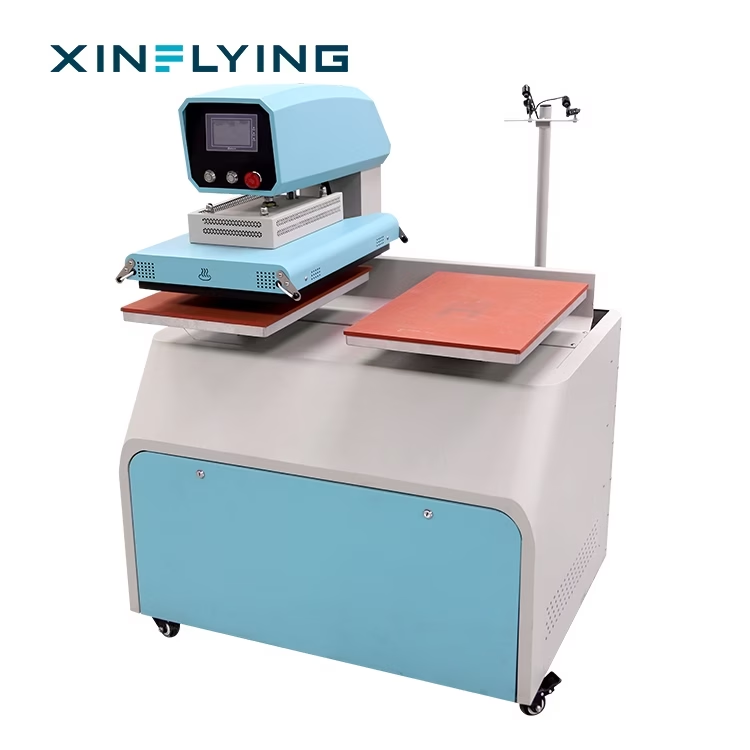
At Xinflying, we design production-oriented systems such as the XF-7CC automatic double station hydraulic heat transfer machine to address this exact issue. Its dual-station structure is optimized for continuous operation, making it suitable for workshops that require stable and high-volume production.
Solving Pressure Instability with Hydraulic Heat Press Machine Technology
Uneven pressure distribution is a critical factor that affects transfer quality. Inconsistent pressure can lead to incomplete ink bonding, especially on thicker garments or textured fabrics.
A hydraulic heat press machine solves this problem by delivering stable and uniform pressure across the entire pressing surface. Unlike manual or spring-based systems, hydraulic mechanisms maintain consistent force throughout the pressing cycle.
The XF-7CC heat press machine uses a stable hydraulic pressure system to ensure consistent heat transfer results. This improves reliability in textile applications where precision and repeatability are essential for maintaining brand quality standards.
Reducing Labor Dependency in T Shirt Heat Press Machine Workflows
Labor efficiency is a major concern in scalable garment production. Manual heat press machine operation requires continuous operator attention, which increases fatigue and reduces productivity over long shifts.
Automated systems help reduce this dependency by streamlining loading, pressing, and unloading processes. A T shirt heat press machine with automatic controls minimizes manual intervention while maintaining consistent operating parameters.
The XF-7CC system is designed with a fully automatic dual-station workflow that reduces operator workload and improves production consistency. This allows businesses to allocate labor more efficiently across other stages of production, such as design preparation and quality control.
Enhancing Production Stability in Continuous Operation Environments
In continuous production environments, equipment stability becomes a critical factor. Frequent temperature fluctuations or mechanical inconsistencies in a heat press machine can disrupt production schedules and lead to material waste.
Stable thermal control ensures that each pressing cycle delivers identical results, regardless of production duration. This is especially important for businesses handling bulk orders or time-sensitive deliveries.
A well-engineered T shirt heat press machine must maintain consistent performance even under long operational cycles. The XF-7CC model is designed for production-oriented environments, ensuring stable output quality during continuous use.
Expanding Application Flexibility with Modern Heat Press Machine Systems
Modern garment businesses require flexibility to handle different materials, fabric thicknesses, and transfer techniques. A heat press machine must adapt to diverse production needs without compromising quality.
From cotton T-shirts to blended textiles, a reliable system ensures consistent transfer results across multiple applications. This flexibility allows businesses to expand their product offerings and serve a wider customer base.
At Xinflying, we focus on developing heat transfer solutions that support both versatility and stability. Our systems are designed to help manufacturers handle varying production requirements without frequent equipment adjustments or downtime.
Building Reliable Production Systems with T Shirt Heat Press Machine Technology
A T shirt heat press machine is more than a standalone device—it is a critical part of a complete garment production workflow. Its performance directly influences product quality, production speed, and operational cost.
By integrating stable pressure systems, automated workflows, and durable structural design, modern heat press machines solve many of the traditional challenges in garment customization businesses.
The XF-7CC automatic double station hydraulic heat transfer machine represents this approach by combining efficiency, stability, and ease of operation into a single system. It helps businesses move toward more scalable and predictable production models.
Production Optimization Through Smarter Heat Transfer Solutions
Long-term success in garment printing depends on consistent output, efficient workflows, and reduced operational errors. A well-designed heat press machine contributes directly to these goals by ensuring stable transfer quality and improving production efficiency.
As Xinflying, we continue to develop advanced heat transfer solutions that support industrial-scale garment production. Through systems like the XF-7CC T shirt heat press machine, we aim to help businesses reduce operational challenges and build more efficient, reliable, and scalable production environments.