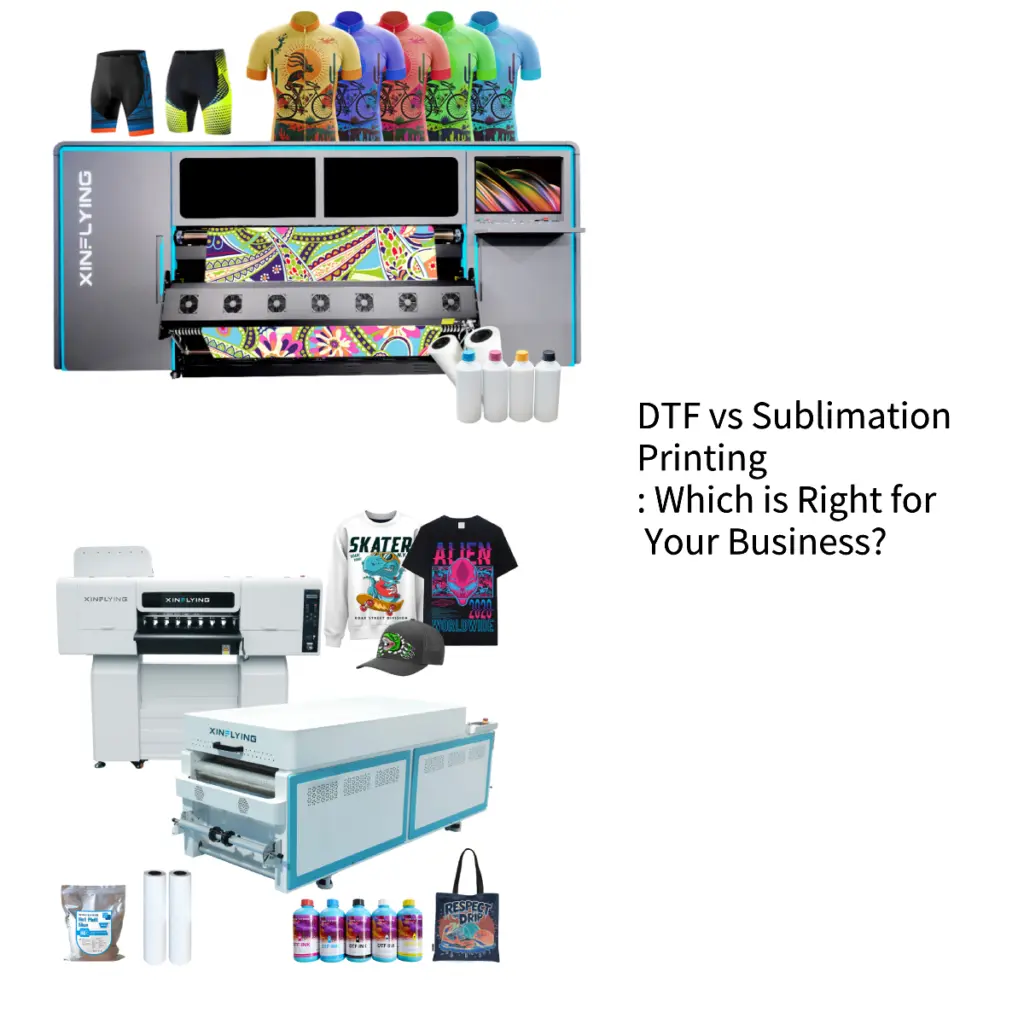
Two of the fastest-growing technologies in the custom printing industry are Direct to Film (ดีทีเอฟ) and dye sublimation printing. Both can produce vibrant, การออกแบบสีเต็มรูปแบบ. Both are far more flexible than traditional screen printing. And both are accessible enough for small shops and large production facilities alike.
But they are not interchangeable — and choosing the wrong one for your business can mean investing in equipment that doesn’t fit your orders, your customers, or your margins.
This guide breaks down DTF and sublimation printing across every dimension that matters for a business decision: substrates, คุณภาพการพิมพ์, setup, ค่าใช้จ่าย, ความทนทาน, and ideal use cases. By the end, you’ll know exactly which technology — or combination of both — belongs in your shop.
What Is การพิมพ์ DTF?
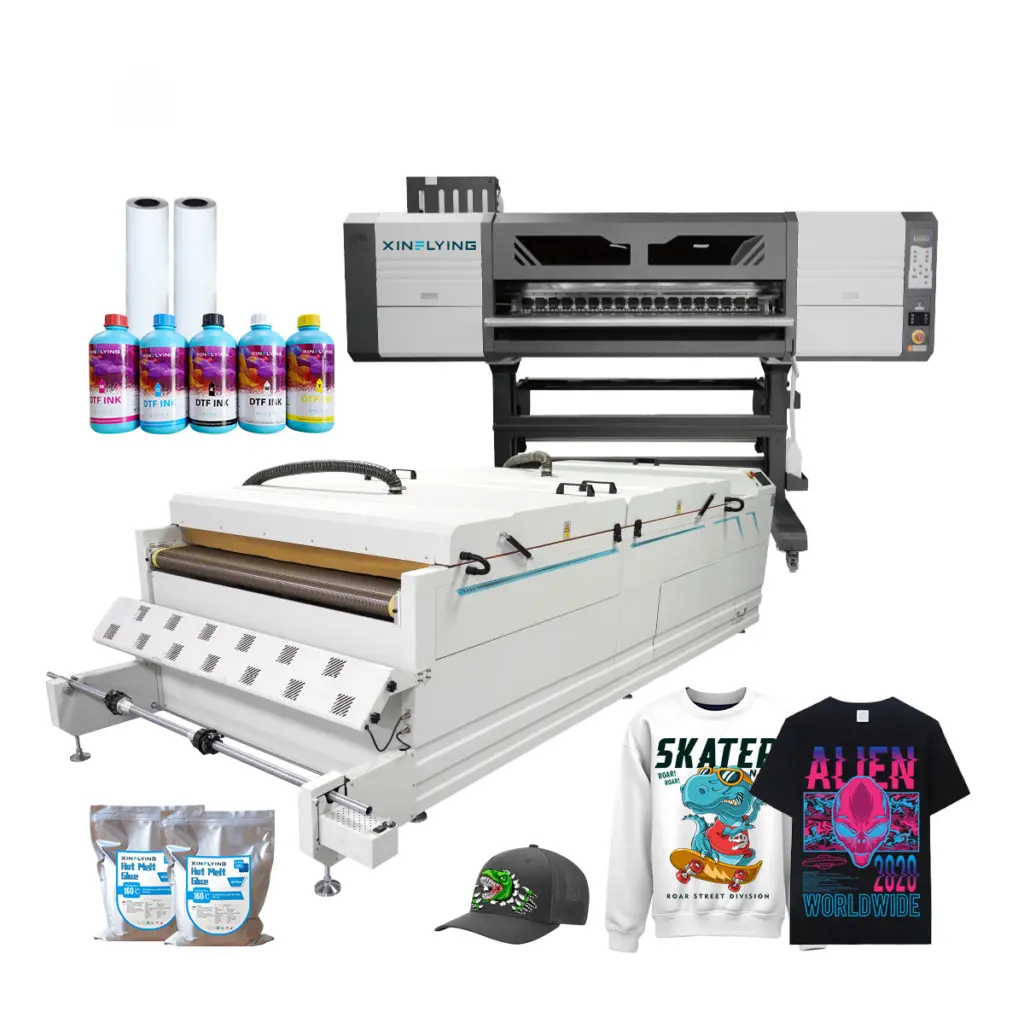
ตรงไปที่ภาพยนตร์ (ดีทีเอฟ) printing is a process where a design is printed onto a special PET film using pigment ink (สีซีเอ็มวายเค + สีขาว), coated with hot melt adhesive powder, หายขาด, and then transferred to fabric using a heat press.
The key characteristic of DTF is that the design is created on the film first, then applied to the garment — which means it can adhere to almost any fabric type regardless of fiber content or color.
How the process works:
- Design is printed onto DTF PET film (color layers first, then white ink underneath)
- Hot melt adhesive powder is applied while ink is still wet
- Film is cured in an oven or heat press to melt the powder
- Transfer is pressed onto the garment at 160°C for 6–10 seconds
- Film is peeled (hot or cold depending on film type)
What Is การพิมพ์ระเหิด?
Dye sublimation printing works on an entirely different chemical principle. Sublimation ink is printed onto special transfer paper, then pressed onto the substrate at high heat (220องศาเซลเซียส). At that temperature, the ink converts from solid to gas and permanently bonds with the polymer fibers of the material.
Because the ink becomes part of the fabric rather than sitting on top of it, sublimation produces a uniquely soft, breathable feel with no texture on the surface.
How the process works:
- Design is printed onto sublimation transfer paper
- Paper is placed face-down on the substrate
- Heat press applies 220°C for 20 ไม่กี่วินาที
- Paper is peeled to reveal the finished transfer
Head-to-Head Comparison
1. ผ้า & Substrate Compatibility
This is the single biggest differentiator between the two technologies.
ดีทีเอฟ:
- ทำงานบนผ้าฝ้าย, โพลีเอสเตอร์, ไนลอน, เดนิม, หนัง, ผ้าใบ, fleece, และผสมผสาน
- Works on both light AND dark fabrics (white ink layer provides opacity)
- Works on stretchy and elastic materials
- ไม่จำเป็นต้องมีการเตรียมผ้าล่วงหน้า
- Also works on non-fabric items like bags, รองเท้า, and patches
การระเหิด:
- Works best on polyester (95%+ polyester content for best results)
- Works on polyester-coated hard substrates: แก้ว, เคสโทรศัพท์, แผงโลหะ, กระเบื้องเซรามิก
- Does NOT work on cotton (ink has nothing to bond with)
- Does NOT work on dark fabrics (sublimation ink is transparent — colors wash out on dark backgrounds)
- No white ink is used; the fabric itself must be white or very light
Verdict: DTF wins on fabric versatility. Sublimation wins on hard substrates.
2. คุณภาพการพิมพ์ & เอาต์พุตสี
ดีทีเอฟ:
- Produces rich, vibrant colors with excellent detail
- White ink creates a solid base that makes colors pop on dark garments
- Slight texture/hand feel on the print surface
- Fine details and gradients reproduce well at 600–1200 dpi
การระเหิด:
- Produces exceptional, photographic-quality output on white polyester
- Colors are part of the fabric — completely smooth, no surface texture
- อ่อนนุ่ม, breathable feel — you cannot feel the design at all
- Gradients and photographic images look stunning
- Colors appear slightly muted on non-white backgrounds
Verdict: Sublimation edges out DTF on pure print quality for white polyester. DTF is the only option for dark garments and cotton.
3. ความทนทาน & Wash Fastness
ดีทีเอฟ:
- Well-executed DTF transfers withstand 40–50+ wash cycles
- Proper curing and pressing parameters are essential for durability
- Can crack or peel over time if adhesive powder or pressing is suboptimal
- Slight fading possible after many washes, especially with low-quality ink
การระเหิด:
- Since the ink is embedded in the fiber, it is essentially permanent
- Will not crack, ปอก, or fade with normal washing
- Colors may shift slightly if washed at very high temperatures
- Long-term durability exceeds DTF in most conditions
Verdict: Sublimation is more durable, especially for sportswear and items that see frequent washing.
4. ติดตั้ง & Equipment
DTF Setup:
- เครื่องพิมพ์ดีทีเอฟ (A3 desktop or commercial roll-feed)
- ซอฟต์แวร์ RIP (เมนท็อป, โฟโต้พริ้นท์, or similar)
- ผงกาวร้อนละลาย
- ฟิล์ม PET DTF
- Powder shaker and curing oven (integrated in commercial models)
- กดความร้อน
Sublimation Setup:
- เครื่องพิมพ์ระเหิด (converted Epson or purpose-built wide-format)
- หมึกระเหิด
- Sublimation transfer paper
- กดความร้อน (flat press for garments, mug press for cups, ฯลฯ)
- White polyester blanks (sublimation requires specific substrates)
เส้นโค้งการเรียนรู้: Both technologies require a period of calibration and learning. DTF has a steeper early curve due to white ink maintenance and powder application. Sublimation is more forgiving day-to-day but requires strict fabric and substrate sourcing.
Verdict: Sublimation has a simpler daily workflow. DTF requires more active maintenance.
5. Minimum Order & Flexibility
ดีทีเอฟ:
- Profitable from 1 ชิ้นส่วน
- No minimum order requirements
- Each design can be different at no extra cost
- Ideal for on-demand and small-batch orders
การระเหิด:
- Also profitable from 1 ชิ้นส่วน
- Each design can be different
- Fabric printing often done in full rolls (all-over print), which works better at higher quantities
- No minimums for cut-piece garments or hard substrates
Verdict: Tie — both technologies support single-piece and no-minimum production.
6. การพิมพ์แบบทั่วถึง
This is a category where sublimation clearly leads.
การระเหิด is the go-to technology for full all-over print garments — athletic jerseys, เลกกิ้ง, custom swimwear, and fashion pieces where the design extends to the seams. Wide-format sublimation printers can print fabric rolls up to 64 กว้างนิ้ว, which are then cut and sewn into finished garments.
ดีทีเอฟ is used for placement prints — designs applied to a specific area of an existing garment (chest, sleeve, back). All-over DTF printing is technically possible but rare, as it requires very large transfers and high adhesive costs.
Verdict: Sublimation is the clear winner for all-over printing. DTF is for placement printing on finished garments.
Side-by-Side Summary
| คุณสมบัติ | ดีทีเอฟ | การระเหิด |
|---|---|---|
| Cotton compatibility | ✅ Yes | ❌ No |
| Dark fabric printing | ✅ Yes | ❌ No |
| Polyester printing | ✅ Yes | ✅ Yes (best results) |
| Hard substrate printing | ⚠️ Limited | ✅ Yes |
| All-over printing | ❌ Not practical | ✅ Yes |
| Print durability | ✅ Good (40–50 washes) | ✅ Excellent (ถาวร) |
| Surface feel | เนื้อสัมผัสเล็กน้อย | Completely smooth |
| ต้นทุนสิ้นเปลือง | ปานกลาง | ต่ำ |
| Equipment investment | Medium-High | Low-Medium |
| Daily maintenance | สูงกว่า | ต่ำกว่า |
| Min. ขนาดการสั่งซื้อ | 1 ชิ้นส่วน | 1 ชิ้นส่วน |
Which Technology Is Right for Your Business?
Choose DTF if you:
- Run a general custom apparel shop serving a wide range of garment types, สี, และผ้า
- Get regular orders for dark-colored garments — black and navy T-shirts are among the most requested, and sublimation simply can’t handle them
- Want to offer no-minimum, การพิมพ์ตามความต้องการ without needing customers to buy specific blank types
- Print on athletic wear, กระเป๋า, หมวก, or accessories made from mixed fabrics
- Are switching from screen printing and want to retain your existing customer base with a more flexible technology
Choose Sublimation if you:
- Specialize in white polyester sportswear — team jerseys, cycling kits, yoga wear, ชุดว่ายน้ำ
- Sell hard substrate products — custom mugs, เคสโทรศัพท์, metal prints, กระเบื้องเซรามิก, or photo panels
- Focus on all-over print fashion where the design covers the entire garment
- Prioritize print durability above all else — sublimation prints are essentially permanent
- Want the lowest possible consumable cost at scale
Run both if you:
Many successful print businesses operate both technologies side by side. DTF handles the dark-fabric, ฝ้าย, and mixed-fiber orders. Sublimation handles the polyester all-over print and hard substrate orders. Together, they cover nearly every custom printing use case with no overlap and minimal waste.
What About ดีทีจี?
ตรงสู่การ์เม้นท์ (ดีทีจี) printing is a third technology that often comes up in this comparison. Briefly:
- DTG prints directly onto cotton garments with excellent softness and breathability
- It requires fabric pre-treatment and works best on high-cotton-content materials
- Ink cost per print is higher than both DTF and sublimation
- Ideal for short-run, high-quality cotton prints where feel matters as much as color
DTG occupies a niche between DTF and sublimation for premium cotton applications. For most shops starting out, DTF offers better flexibility at lower cost.
คำถามที่พบบ่อย
ถาม: Can DTF transfers be applied to sublimation blanks? ก: ใช่, DTF transfers can be applied to polyester-coated hard substrates, but with mixed results. Sublimation is still the preferred method for hard substrates designed for sublimation coating.
ถาม: Is sublimation ink washable? ก: Yes — because sublimation ink bonds chemically with the polyester fiber, it will not wash out under normal conditions. It is significantly more wash-resistant than DTF.
ถาม: Do I need a special printer for sublimation? ก: ใช่. Sublimation requires either a purpose-built sublimation printer or an Epson inkjet printer converted with sublimation ink. Standard pigment or dye ink printers cannot be used.
ถาม: Can I convert my DTF printer to do sublimation? ก: เลขที่. DTF and sublimation use fundamentally different ink chemistries and require different hardware. They are not interchangeable.
ถาม: Which technology has a higher profit margin per print? ก: It depends on your pricing model. Sublimation has lower consumable costs, which improves margins at scale. DTF allows premium pricing on small orders and dark garments where there is no alternative technology, which can produce strong margins even with higher consumable costs.
บทสรุป
DTF and sublimation printing are complementary technologies, not competitors. The right choice depends almost entirely on what your customers are ordering.
If you’re serving a broad custom apparel market — cotton tees, เสื้อผ้าสีเข้ม, mixed fabrics, small batch orders — DTF is your foundation. If you’re targeting sportswear, all-over print fashion, or hard substrates — sublimation is the better tool.
For shops that want to serve the widest possible range of customers without compromise, running both technologies is a well-proven strategy that eliminates the need to turn away any order.
Related articles: